Introduction
B2B data enrichment has become an important part of modern B2B lead generation sales and marketing strategies. Businesses collect information from websites, CRM systems, forms, campaigns, customer interactions, and other sources. The problem is that this information is often incomplete, outdated, or spread across different systems.
A prospect record may contain a name, email address, and company, but it may not include a current job title, company size, technology stack, business priorities, or relevant buying signals. Over time, even previously accurate information can become outdated.
This creates a common problem for revenue teams: more data does not necessarily mean better data.
B2B data enrichment helps solve this problem by adding relevant company and contact information to existing records. AI can take the process further by identifying missing information, analyzing multiple data points, detecting potential inconsistencies, and helping teams turn raw records into actionable prospect intelligence.
In this guide, we’ll explore seven ways AI can improve B2B data enrichment, why data quality and freshness matter, and how businesses can build a practical enrichment strategy.
Table of Contents
What Is B2B Data Enrichment?
B2B data enrichment is the process of adding relevant information to existing business and prospect records.
For example, a basic CRM record might contain:
- Contact name
- Email address
- Company name
- Job title
Enrichment can add information such as:
- Industry
- Company size
- Revenue range
- Location
- Department
- Seniority
- Technology used
- Business category
- Company growth information
- Relevant engagement signals
- Buying or intent signals
The purpose isn’t simply to collect more information.
The real goal of B2B data enrichment is to create a more complete, accurate, and actionable view of a prospect or account.
For sales teams, this can provide more context before outreach.
For marketing teams, enriched data can improve segmentation and personalization.
For revenue teams, it can support better lead scoring, account prioritization, and demand generation.
Why B2B Data Enrichment Matters for Sales, Marketing, and Data Quality
B2B data changes constantly.
People change jobs. Companies grow. Departments change. Technology stacks evolve. Businesses enter new markets. Contact information becomes outdated.
As a result, even a well-maintained CRM can gradually become less reliable.
An outdated job title, duplicate company record, incorrect contact detail, or incomplete account profile can affect:
- Lead qualification
- Lead scoring
- Account segmentation
- Sales prospecting
- Marketing personalization
- Campaign targeting
- Reporting
- Revenue forecasting
This is why B2B data enrichment and B2B data quality should work together.
Enrichment adds useful information, while data-quality processes help ensure that the information is accurate, complete, consistent, relevant, and current.
B2B data freshness is equally important. A database that was accurate six months ago may contain outdated information today.
7 Ways AI Improves B2B Data Enrichment and Prospect Intelligence
1. AI Helps Build More Complete Prospect Profiles
A basic CRM record rarely tells the complete story about a potential customer.
AI-powered data enrichment can help identify missing information and determine which additional data may be useful for a specific sales or marketing workflow.
An enriched prospect profile may include:
- Job title and seniority
- Industry
- Company size
- Revenue range
- Location
- Department
- Technology environment
- Business activity
- Company characteristics
- Relevant engagement signals
Bringing these data points together gives sales and marketing teams more context before deciding how and when to engage a prospect.
The objective isn’t to create the longest possible prospect record.
The objective is to create a prospect profile that helps your team make better decisions.
2. AI Improves Firmographic Targeting
Not every company within an industry is a good fit for your product or service.
AI can help analyze multiple firmographic characteristics together, making it easier to identify accounts that closely match an ideal customer profile.
For example, a B2B company may prioritize accounts based on:
- Industry
- Employee count
- Revenue range
- Geography
- Technology environment
- Business model
- Growth stage
- Department structure
Instead of treating every company as equally valuable, sales and marketing teams can use enriched firmographic information to create more focused segments.
This can help sales representatives spend more time on accounts that are closely aligned with the company’s target market.
3. AI Strengthens Lead Validation and B2B Data Quality
Not every record entering a CRM represents a qualified sales opportunity.
Some records may be:
- Incomplete
- Outdated
- Duplicated
- Incorrectly categorized
- Outside the target market
- Missing important company information
AI-assisted enrichment can help identify potential data-quality issues such as missing fields, duplicate records, inconsistent company information, outdated job titles, and incomplete account profiles.
This makes enrichment useful for more than simply adding new information.
It can also support efforts to improve the reliability of existing prospect data.
Better B2B data quality can contribute to more accurate:
- Segmentation
- Lead scoring
- Campaign targeting
- Sales prioritization
- Reporting
The result is a database that is more useful for both marketing and sales teams.
4. AI Connects Firmographic Data With Intent Signals
Firmographic information tells you what a company looks like.
Intent signals can provide additional context about what that company may currently be researching or interested in.
When these data types are combined, teams can develop a more useful account-level view.
For example, a company may match your ideal customer profile based on:
- Industry
- Company size
- Geography
- Technology stack
If the same account is also showing relevant engagement or research activity, the combined information may help sales teams decide whether the account deserves additional attention.
However, intent should be treated as a signal rather than proof that an account is ready to buy.
The strongest approach is to combine intent with firmographic fit, contact information, engagement, and other relevant business signals.
5. AI Helps Improve B2B Data Quality and Freshness
B2B data doesn’t remain accurate forever.
People change jobs. Companies restructure. Technologies change. Businesses expand into new markets. Contact responsibilities evolve.
This makes B2B data freshness an important part of data enrichment.
AI-assisted processes can help identify records that may contain:
- Missing information
- Inconsistent information
- Duplicate records
- Potentially outdated information
- Incomplete company profiles
For example, a contact may still have an old job title in your CRM even though they have moved into another role.
A company may also have changed its:
- Employee count
- Location
- Technology environment
- Business focus
- Organizational structure
Regular validation and enrichment can help sales and marketing teams maintain more current prospect information.
More data isn’t necessarily better. Better-quality and fresher data is what creates better prospect intelligence.
6. AI Improves Sales Prioritization
Sales teams rarely have enough time to research every potential account in the same level of detail.
Enriched data gives sales representatives additional context when deciding which accounts deserve attention first.
AI can help analyze factors such as:
- ICP fit
- Company size
- Industry
- Contact seniority
- Technology environment
- Engagement
- Business activity
- Relevant intent signals
This can reduce the amount of manual research required before a salesperson decides where to focus.
AI doesn’t have to make the final sales decision.
Instead, it can provide better information so sales professionals can make more informed decisions.
7. Turn Enriched Data Into Actionable Prospect Intelligence
The real value of B2B data enrichment comes when enriched information leads to action.
A useful way to think about the process is:
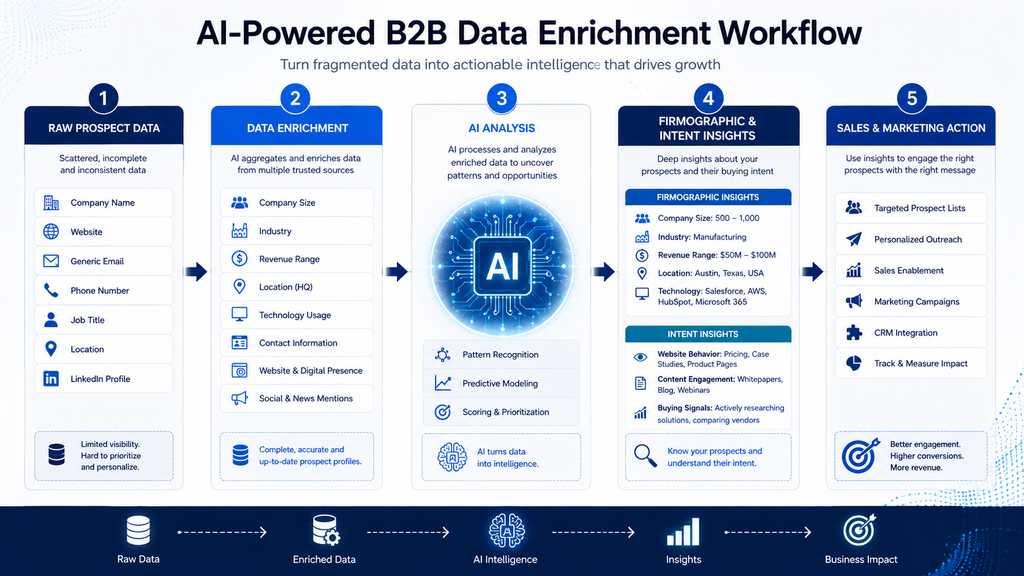
Raw Data → Enriched Data → Data Validation → AI Analysis → Prospect Intelligence → Sales or Marketing Action
A more complete prospect profile can help teams understand:
- Who the relevant decision-makers are
- Whether an account matches the ICP
- What technologies the company uses
- What business changes may be taking place
- Which signals deserve attention
- What information can support personalization
This turns data enrichment from a simple database activity into a broader prospect intelligence strategy.
The objective isn’t to build the biggest database.
B2B Data Quality and Freshness: Why They Matter
B2B data enrichment and data quality are closely connected.
Adding information to a database is useful only when the information is relevant and reliable.
Outdated Contact Information
Contact information can become outdated quickly in B2B markets.
People may:
- Change companies
- Change job titles
- Move between departments
- Take on new responsibilities
- Leave an organization
When CRM records aren’t regularly updated, sales representatives may spend time contacting people who are no longer relevant to the buying process.
Regular enrichment and validation can help businesses identify outdated contact information and maintain more useful prospect records..
Duplicate Records
Duplicate records can fragment account histories and create problems for:
- Reporting
- Segmentation
- Lead scoring
- Sales workflows
- Campaign targeting
A good enrichment process should therefore include duplicate detection and data standardization rather than simply adding more information.oved.
Incomplete Company Information
A prospect record may contain valid contact information but still lack important company-level context.
Useful company information can include:
- Industry
- Employee count
- Revenue range
- Location
- Technology usage
- Business model
- Growth information
This information can help sales and marketing teams determine whether an account fits their ideal customer profile.
Why B2B Data Freshness Matters
B2B information changes continuously.
A company can:
- Expand into a new market
- Change its technology stack
- Increase hiring
- Restructure its organization
- Change business priorities
- Acquire another company
For this reason, B2B data freshness should be treated as an ongoing process rather than a one-time database cleanup.
Regular validation and enrichment help teams maintain a more current view of their target accounts and prospects.
How to Build an AI-Powered B2B Data Enrichment Strategy
A successful enrichment strategy doesn’t begin with technology.
It begins with a clear understanding of what information your revenue teams actually need.
Step 1: Define Your Ideal Customer Profile
Start by identifying the characteristics of your best customers.
Consider:
- Industry
- Company size
- Revenue
- Geography
- Technology
- Business model
- Growth stage
- Relevant departments
Your ICP determines which data points are actually useful.
Step 2: Audit Your Existing Data
Before adding new information, review the quality of your existing database.
Look for:
- Missing fields
- Duplicate records
- Incorrect information
- Outdated job titles
- Invalid contact information
- Inconsistent company names
- Incomplete account profiles
This gives you a clearer understanding of where enrichment can create the most value.
Step 3: Identify the Data You Actually Need
Avoid collecting information simply because it is available.
Ask:
What information helps our sales or marketing team make a better decision?
Depending on your business, that could include:
- Company size
- Industry
- Revenue
- Seniority
- Technology
- Location
- Department
- Engagement
- Intent signals
Prioritize the fields that directly support your revenue workflow.
Step 4: Select Relevant Data Sources
Use reliable sources that are appropriate for the type of information you’re trying to enrich.
Different data sources may provide different types of information, including:
- Company information
- Contact information
- Firmographics
- Technology data
- Engagement data
- Intent signals
The quality of your enrichment depends heavily on the quality and relevance of the underlying data.
Step 5: Use AI Where It Adds Value
AI can be particularly useful when teams need to analyze large volumes of information.
Use AI to help:
- Identify missing information
- Classify accounts
- Detect potential inconsistencies
- Analyze multiple data points
- Prioritize records for review
- Support segmentation
- Identify patterns
AI should complement your data strategy rather than replace data governance.
Step 6: Validate Data Quality and Freshness
Enrichment should not end when new information is added.
Review the data for:
- Accuracy
- Completeness
- Duplicates
- Missing fields
- Outdated information
- Consistency
Establish a process for refreshing important fields so prospect and company information remains useful over time.
Step 7: Connect Enriched Data to Your Revenue Workflow
The final step is turning enriched information into action.
Connect useful data to workflows such as:
- CRM
- Marketing automation
- Lead scoring
- Account-based marketing
- Sales intelligence
- Personalization
- Campaign targeting
- Reporting
This is where B2B data enrichment becomes a revenue-enablement process rather than simply a database activity.
Traditional vs. AI-Powered B2B Data Enrichment
| Area | Traditional Enrichment | AI-Powered Enrichment |
|---|---|---|
| Data collection | Manual or automated | Automated + AI-assisted |
| Missing data | Often identified manually | AI can help identify gaps |
| Data quality | Periodic checks | AI-assisted monitoring |
| Prospect research | Time-consuming | Faster and more scalable |
| Buying signals | Limited analysis | Multiple signals can be analyzed |
| Lead prioritization | Often rule-based | Data + AI-assisted |
| Personalization | More manual | More context-driven |
| Prospect intelligence | Basic | More contextual |
AI doesn’t eliminate the need for human review.
Instead, it can help teams process more information and identify areas that deserve attention.
Common B2B Data Enrichment Mistakes to Avoid
1. Collecting Too Much Data
More fields don’t automatically create better prospect intelligence.
Focus on information that supports actual business decisions.
2. Ignoring Data Freshness
A database can contain thousands of records and still be unreliable if the information isn’t current.
3. Treating Enrichment as a One-Time Project
B2B data changes continuously, so enrichment should become an ongoing process.
4. Ignoring Duplicate Records
Duplicate accounts and contacts can create inaccurate reporting and fragmented customer histories.
5. Focusing Only on Contact Data
Company-level information can be just as important as individual contact information.
6. Using AI Without Data Governance
AI can help analyze and organize information, but businesses still need processes for validation, privacy, accuracy, and data governance.
Best Practices for B2B Data Enrichment
A practical strategy can follow these principles:
Start with business objectives.
Know what decisions the enriched data needs to support.
Prioritize important fields.
Focus on information that directly affects targeting, qualification, personalization, or sales prioritization.
Keep data fresh.
Enrichment should be an ongoing process rather than a one-time database project.
Combine different signals.
Firmographics, prospect data, first-party activity, and intent signals can provide a more complete view of an account.
Monitor data quality.
Create processes for detecting duplicates, missing information, invalid records, and outdated fields.
Measure business outcomes.
Look beyond the number of enriched records. Track whether better data contributes to stronger targeting, better-qualified leads, improved sales productivity, or more relevant campaigns.
The Future of B2B Data Enrichment
B2B data enrichment is moving beyond simply filling missing CRM fields.
As AI becomes more integrated into sales and marketing workflows, enrichment can become part of a broader system for understanding accounts and prospects.
Future enrichment strategies are likely to place greater emphasis on:
- Real-time data updates
- AI-assisted prospect research
- Predictive signals
- Account intelligence
- Automated data validation
- Intent analysis
- Personalization
- Revenue workflow automation
The businesses that benefit most won’t necessarily be the ones with the largest databases.
They will be the ones that can turn accurate, relevant, and current data into useful decisions.
Frequently Asked Questions About B2B Data Enrichment
What Is B2B Data Enrichment?
B2B data enrichment is the process of adding relevant information to existing business and prospect records. This can include company information, contact details, firmographics, technology data, engagement signals, and other information that helps sales and marketing teams better understand prospects.
What Is B2B Data Quality?
B2B data quality refers to how accurate, complete, consistent, relevant, and current business and prospect information is. Good data quality helps sales and marketing teams make more reliable decisions.
What Is B2B Data Freshness?
B2B data freshness refers to how current the information in a business database is. Because contacts, companies, technologies, and business conditions change over time, important prospect and company records need to be reviewed and refreshed regularly.
How Does AI Improve B2B Data Enrichment?
AI can help identify missing information, analyze large volumes of records, detect potential inconsistencies, classify accounts, identify patterns, and support prospect prioritization. This can make enrichment more scalable and useful for sales and marketing teams.
How Do Sales Teams Deal With Outdated Contact Information in Lead Databases?
Sales teams can manage outdated contact information by regularly validating prospect records, updating job titles and company information, removing duplicates, and using data enrichment to refresh important fields. AI-assisted enrichment can help identify records that may need additional review.
Is B2B Data Enrichment the Same as B2B Data Cleansing?
No. They are related but different.
Data cleansing focuses on identifying and correcting inaccurate, duplicate, inconsistent, or outdated information.
Data enrichment focuses on adding useful information to existing records.
In practice, businesses often use both processes together to maintain a more reliable database.
Why Is B2B Data Enrichment Important for Sales?
Enriched data gives sales teams more context about prospects and accounts. It can help representatives understand company fit, identify relevant decision-makers, prioritize accounts, and personalize outreach.
Final Thoughts
B2B data enrichment is no longer simply about adding more fields to a CRM.
The real value comes from creating accurate, complete, relevant, and current prospect information that sales and marketing teams can use to make better decisions.
AI can help organizations identify missing information, improve data quality, analyze multiple signals, prioritize prospects, and scale enrichment workflows.
But technology alone isn’t enough.
A successful B2B data enrichment strategy combines quality data, regular validation, clear ICP criteria, AI-assisted analysis, and strong revenue workflows.
The goal isn’t to build the biggest database.
The goal is to build better prospect intelligence that helps your team find, understand, and engage the right B2B buyers.