Introduction
Finding the right B2B prospects is not just about building a bigger contact list. Sales and marketing teams need to understand which companies fit their ideal customer profile, who influences buying decisions, and which signals may indicate a relevant business need.
B2B audience intelligence helps teams bring together company information, customer relationship management (CRM) data, website engagement, prospect attributes, and buyer intent signals to build a clearer picture of their target audience.
Instead of relying on broad lists and generic outreach, businesses can use these insights to identify suitable accounts, create relevant audience segments, and prioritize sales and demand generation activities.
For B2B organizations focused on sustainable growth, the goal is simple: understand the right audience, deliver relevant communication, and turn useful insights into better prospecting decisions.
Table of Contents
What Is B2B Audience Intelligence?
B2B Audience Intelligence is the process of collecting, connecting, analyzing, and interpreting information about business audiences and potential buyers.
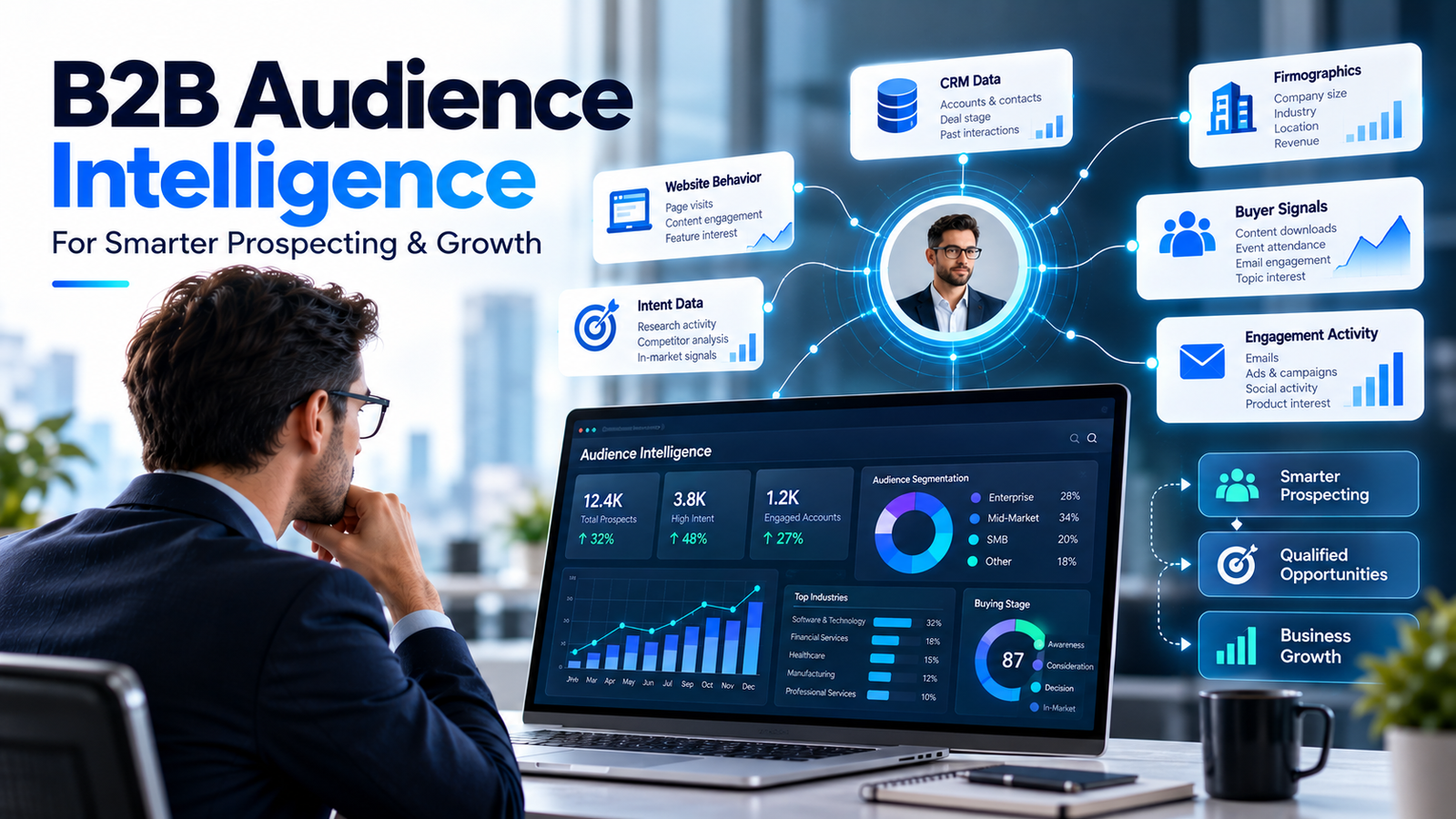
A useful audience intelligence framework can bring together several types of information:
- CRM data: accounts, contacts, opportunities, previous interactions, and sales activity.
- Firmographic data: company size, industry, location, revenue, and organizational structure.
- Website behavior: pages visited, content consumed, product interest, and engagement patterns.
- Intent data: research activity and signals that indicate interest in a business topic or solution.
- Technographic data: technologies and platforms used by a company.
- Engagement data: email interactions, event participation, content downloads, and other activities.
- Prospect information: job role, seniority, responsibilities, and buying-stage information.
When these signals are viewed separately, they provide pieces of information. When they are connected, they can provide a much more useful account or prospect view.
Why B2B Audience Intelligence Matters for Business Growth
B2B buyers often research solutions, compare vendors, and consult multiple stakeholders before speaking with a sales representative. This means businesses cannot rely on contact lists alone to understand their potential customers.
At the same time, useful information is often spread across CRM platforms, marketing automation systems, website analytics, and sales conversations.
B2B audience intelligence helps connect these different sources to support more focused prospecting.
It can help businesses:
- Identify companies that match their ideal customer profile.
- Understand the characteristics of relevant buyers.
- Create more useful audience segments.
- Recognize meaningful engagement patterns.
- Improve the quality of prospect records.
- Coordinate sales and marketing activities.
- Develop more relevant campaigns and follow-up messages.
The value comes from using information to make better decisions, not from collecting the largest possible amount of data.
B2B Audience Intelligence Benefits 7 Key Advantages
1. Build More Complete Prospect Profiles
A name, email address, and job title provide a starting point, but they rarely explain the full business context behind a potential customer.
B2B audience intelligence combines contact details with company characteristics, relevant technology information, previous interactions, and engagement signals. B2B data enrichment helps fill gaps in prospect records and improve the accuracy of available information.
This helps sales teams prepare for more informed conversations.
Example: A sales representative identifies a marketing director at a company that matches the business’s target profile. Additional research reveals that the company is expanding its marketing operations and has engaged with relevant resources. The representative can use this context to prepare a more relevant introduction.
The objective is to understand the prospect’s business context rather than approach every contact with the same message.
2. Improve B2B Audience Segmentation
Not every prospect should receive the same message.
B2B Audience intelligence can help businesses create meaningful segments based on characteristics and behavior.
Useful segmentation criteria include:
- Industry and company size.
- Business model and geographic market.
- Job function and seniority.
- Product or service requirements.
- Previous engagement and content interests.
- Customer status and potential business needs.
For example, a B2B software provider could create separate segments for enterprise accounts, growing mid-market companies, and existing customers exploring additional solutions.
Each segment can receive content and communication suited to its needs.
Effective segmentation makes campaigns more relevant without requiring a completely separate strategy for every prospect.
3. Identify Important Buyer Signals
Buyer behavior can provide valuable context.
For example, one website visit may not tell you much.
But repeated visits to related product pages, content downloads, webinar participation, and other engagement can provide a stronger picture of interest.
This is where audience intelligence can work alongside intent data.
The goal is not to assume that every activity means a prospect is ready to buy.
Instead, teams can use multiple signals to understand engagement and determine appropriate next steps.
For example, a company that matches your ideal customer profile and repeatedly engages with content about a specific business challenge may deserve further research.
The next step is to validate the available signals and decide whether educational content, additional research, or direct sales engagement is appropriate.
4. Strengthen Prospect Records With B2B Data Enrichment
Incomplete or outdated data can make it difficult to identify suitable prospects and personalize outreach.
A form may provide a name, company, email address, and job title, while other useful information is missing.
B2B data enrichment helps fill relevant gaps in existing company and contact records using appropriate data sources.
Depending on the available data sources, enrichment may include:
- Industry
- Company size
- Revenue range
- Location
- Department
- Seniority
- Technology usage
- Company characteristics
This additional information can make audience analysis more useful.
5. Improve Prospect Prioritization
Sales teams have limited time, and every account does not deserve the same level of attention.
Audience intelligence can help teams prioritize prospects by considering both business fit and relevant engagement.
A simple prioritization framework looks like this:
| Account fit | Engagement | Suggested next step |
|---|---|---|
| High | High | Review the account and consider timely sales outreach |
| High | Low | Build awareness through relevant educational content |
| Low | High | Investigate the engagement and validate business fit |
| Low | Low | Assign lower priority or revisit later |
This framework provides a starting point, not an automatic qualification decision. Sales teams should also consider buying roles, business needs, existing relationships, and the quality of available data.
When prioritization criteria are clear, representatives can spend more time on promising opportunities and less time sorting through unqualified records.
6. Create More Relevant B2B Personalization
Personalization is more useful when it is based on relevant business information.
Adding someone’s first name to a generic email is not the same as understanding the challenges that matter to their organization.
Audience intelligence can help marketers tailor content by industry, business size, job role, customer needs, and demonstrated interests.
For example, if an account has repeatedly engaged with content about B2B data quality, a sales or marketing message can focus on data accuracy challenges rather than sending a generic introduction.
The objective is simple:
Use audience information to make communication more useful.
Personalization should not mean adding a prospect’s first name to an otherwise generic message.
It should provide context that is actually relevant to the prospect.
7. Align Sales and Marketing Around Shared Insights
Marketing teams often understand campaign engagement, content interactions, and lead acquisition sources. Sales teams have additional context from conversations, objections, account research, and opportunities.
When these insights remain separate, both teams may work with incomplete or inconsistent information.
A shared audience intelligence framework can help teams agree on:
- Which companies qualify as target accounts.
- Which buyer roles are relevant.
- How leads and accounts should be prioritized.
- Which engagement signals deserve follow-up.
- How audience quality and campaign outcomes should be measured.
This alignment can make lead handoffs more useful and help both teams improve their B2B lead generation efforts and work toward shared pipeline goals.
How to Use B2B Audience Intelligence for Prospecting
Building an audience intelligence strategy does not need to happen all at once.
A simple process can help.
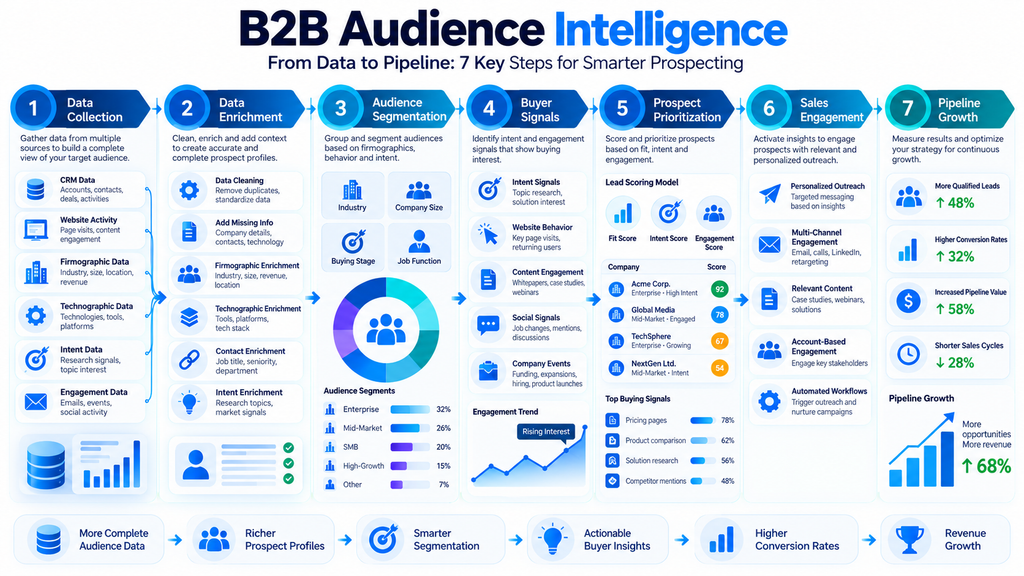
Step 1 Identify Your Ideal Customer Profile
Start by defining the companies you want to reach.
Consider:
- Industry
- Company size
- Location
- Revenue range
- Business model
- Technology environment
- Relevant job roles
This creates a foundation for audience segmentation.
Step 2 Collect Relevant Audience Data
Identify the first-party data your business already has.
This could include:
- Website interactions
- CRM records
- Form submissions
- Content downloads
- Email engagement
- Webinar registrations
- Demo requests
- Sales activity
Focus on data that can support actual business decisions.
Step 3 Enrich Prospect Records
Where appropriate, enrich incomplete prospect and company records.
The goal is to create a stronger understanding of the account rather than simply adding more fields.
Step 4 Create Useful Audience Segments
Build a small number of practical segments.
For example:
Segment A: High-fit target accounts
Segment B: Highly engaged prospects
Segment C: New prospects requiring education
Segment D: Existing customers with expansion opportunities
These segments can then be connected to appropriate campaigns or sales workflows.
Step 5 Add Buyer Intent Signals
Intent data can add another layer of context.
For example, a company that fits your target profile and is also showing relevant research behavior may deserve additional attention.
However, intent signals should be considered alongside other information rather than used as the only qualification factor.
Step 6 Turn Insights Into Action
Audience intelligence only becomes valuable when teams use it.
For example:
Audience data → segmentation → prioritization → personalized content → sales engagement
This creates a practical path from raw data to action.
Common B2B Audience Intelligence Mistakes to Avoid
Relying on Incomplete Data
Incomplete records can make audience analysis less reliable.
Review important data fields regularly and establish processes for maintaining data quality.
Collecting Data Without a Purpose
It can be tempting to collect every available data point.
Instead, ask whether the information will actually help sales, marketing, customer success, or business decisions.
Treating Every Signal as Intent
A content download does not automatically mean a prospect is ready to buy.
Use multiple signals and consider the wider context.
Ignoring Data Quality
Poor-quality data can affect segmentation, reporting, personalization, and sales outreach.
Data accuracy should be treated as an ongoing process.
Keeping Sales and Marketing Data Separate
When important information is locked inside separate systems, teams may have different views of the same prospect.
Connecting relevant data can provide a more consistent picture.
Best Practices for B2B Audience Intelligence
To build a sustainable approach, focus on the following principles.
Start with a business objective. Decide whether you want to improve prospect quality, account prioritization, campaign relevance, or sales efficiency before choosing tools or data sources.
Prioritize data quality. Accurate, relevant information is more useful than a large database filled with outdated records.
Combine complementary signals. Use company characteristics, first-party engagement, validated enrichment, and relevant intent information to build a more complete picture.
Keep the process actionable. Every audience segment should connect to a clear marketing, research, or sales action.
Review results regularly. Monitor segment performance and update targeting criteria as your business goals and customer needs evolve.
Use automation thoughtfully. Once your segments and rules are reliable, automation can help deliver relevant content, update workflows, and notify sales teams when an account merits review.
Maintain responsible data practices. Apply appropriate privacy, consent, access, and data retention controls throughout the process.
How AI Is Shaping the Future of B2B Audience Intelligence
AI is creating new ways for B2B teams to analyze information, identify patterns, and organize prospect research through marketing technology and AI.
Depending on the tools and data available, AI can support:
- Data analysis: Identify patterns across company records and engagement information.
- Audience segmentation: Help group accounts according to relevant characteristics and behavior.
- Account research: Summarize available company information to support preparation.
- Prospect prioritization: Help teams compare account fit and relevant signals.
- Campaign personalization: Assist with developing content for clearly defined audience segments.
However, AI does not remove the need for accurate data, human review, or sound targeting criteria. Incomplete records and misleading signals can lead to poor recommendations, even when sophisticated tools are involved.
The most useful approach combines technology with clear business objectives, reliable data, and human judgment.
Frequently Asked Questions
What is B2B audience intelligence?
B2B audience intelligence is the process of analyzing business, contact, and engagement information to understand target audiences and improve sales and marketing decisions.
How does B2B audience intelligence improve prospecting?
It helps teams identify suitable companies, understand relevant buyer roles, segment audiences, evaluate engagement signals, and prioritize prospect research and outreach.
What is the difference between audience intelligence and intent data?
Audience intelligence combines different types of information to understand an audience. Intent data focuses on signals that may suggest interest in researching a particular topic, product category, or solution.
How does AI support B2B audience intelligence?
AI can help analyze data, identify patterns, summarize account information, and support segmentation and prioritization. The value depends on data quality, appropriate use, and human validation.
Which data sources are useful for B2B audience intelligence?
Common sources include CRM records, company and contact data, website analytics, marketing engagement, technology information, and relevant buyer intent signals. Businesses should choose sources based on their goals and applicable privacy requirements.
Final Thoughts
B2B Audience Intelligence gives sales and marketing teams a way to move beyond basic contact lists and develop a deeper understanding of their target audiences.
By combining prospect data, firmographics, first-party behavior, enrichment, and intent signals, businesses can build more useful audience profiles.
The key is to keep the process practical.
Start with your ideal customer profile. Improve data quality. Connect important signals. Create useful segments. Then turn those insights into relevant marketing and sales actions.
When data is connected to clear business goals, audience intelligence can become an important part of a modern B2B prospecting strategy.