Introduction
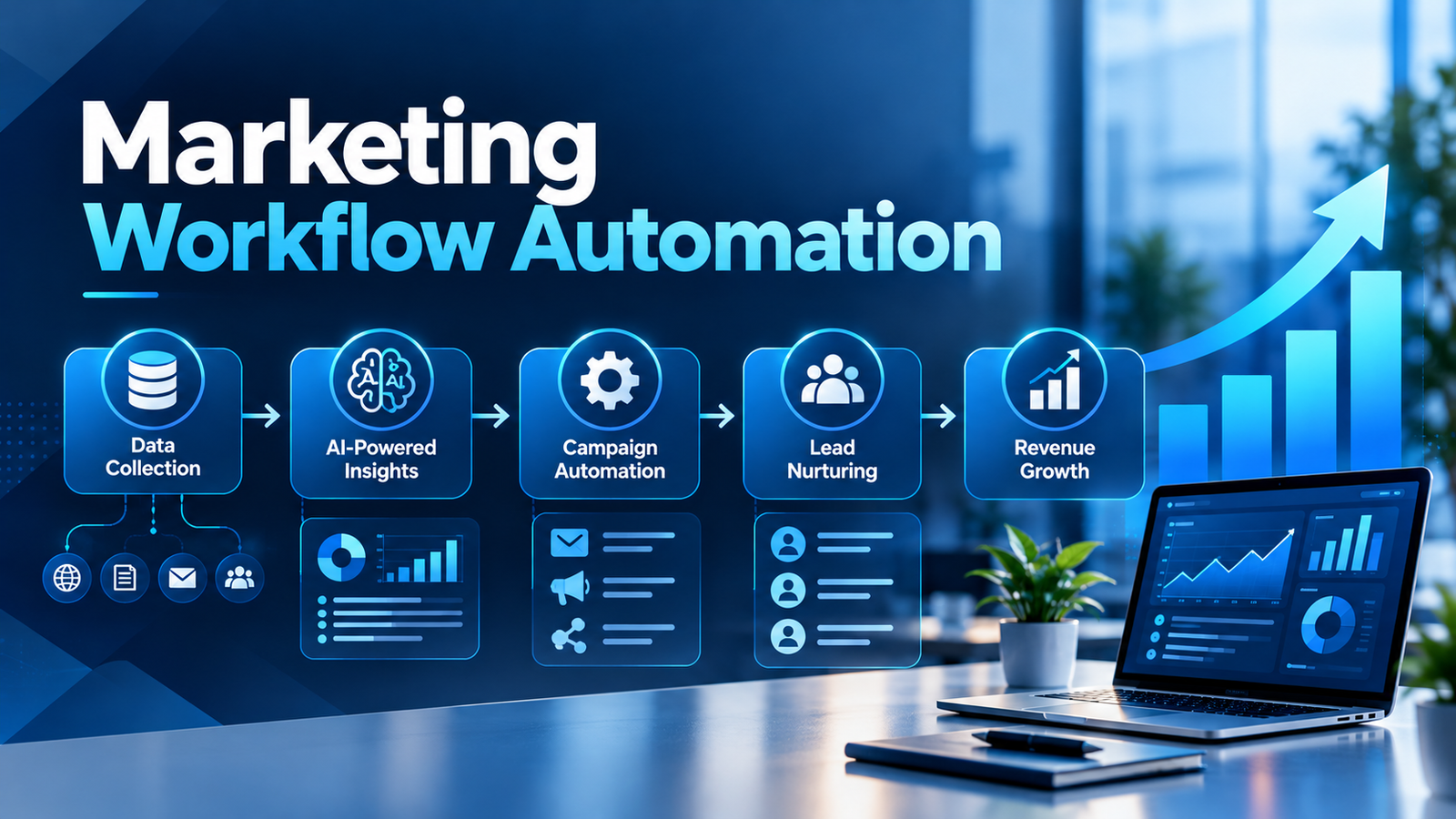
B2B marketing teams manage many activities every day, from collecting prospect data and sending follow-up emails to managing campaigns and analyzing performance. When these tasks are handled manually, even a well-planned marketing strategy can become difficult to execute efficiently.
Marketing workflow automation helps businesses simplify these processes, reduce repetitive work, and create more consistent marketing experiences. With artificial intelligence (AI), teams can go beyond basic automation and use data to improve targeting, personalize communication, and make better campaign decisions.
For B2B companies, the goal is not simply to complete more tasks in less time. It is to help marketing teams focus on qualified prospects, meaningful engagement, and revenue growth.
Let’s explore how marketing workflow automation works, why it matters, and how businesses can apply it effectively.
and create more consistent marketing experiences. With artificial intelligence (AI), teams can go beyond basic automation and use data to improve targeting, personalize communication, and make better campaign decisions.
For B2B companies, the goal is not simply to complete more tasks in less time. It is to help marketing teams focus on qualified prospects, meaningful engagement, and revenue growth.
Let’s explore how marketing workflow automation works, why it matters, and how businesses can apply it effectively.
Table of Contents
What Is Marketing Workflow Automation?
Marketing workflow automation is the process of using software and predefined rules to manage repetitive marketing activities with less manual intervention.
For example, when someone downloads a white paper from your website, an automated workflow could record the interaction, categorize the contact, send a relevant follow-up email, and notify the sales team when the prospect meets agreed qualification criteria.
Instead of managing every step individually, marketers create a workflow that connects these activities.
AI can make these workflows more adaptive by helping teams analyze customer behavior, identify patterns, recommend relevant content, and prioritize prospects.
Common applications include:
- Email marketing and lead nurturing
- Lead scoring and segmentation
- Campaign scheduling and coordination
- Customer data management
- Personalized content delivery
- Marketing performance reporting
Traditional automation generally follows predefined rules. AI-enabled automation can also use data and models to support predictions and recommendations. However, its effectiveness depends on data quality, suitable tools, and human oversight.
Why Marketing Workflow Automation Matters in 2026
B2B buyers often research solutions across multiple channels before speaking with a sales representative. Marketing teams must respond to these interactions while coordinating campaigns, maintaining accurate data, and supporting sales.
Manual processes make this challenging.
Marketing workflow automation helps teams establish repeatable processes, reduce delays, and maintain consistent communication with prospects.
It also helps businesses identify where marketing activities are creating value and where processes need improvement.
For example, a B2B technology company running campaigns across its website, email, and LinkedIn can use connected workflows to organize prospect information, improve AI-powered lead generation, and coordinate follow-ups.
The benefit is not automation for its own sake. It is a more organized process that helps teams spend their time where it matters most.
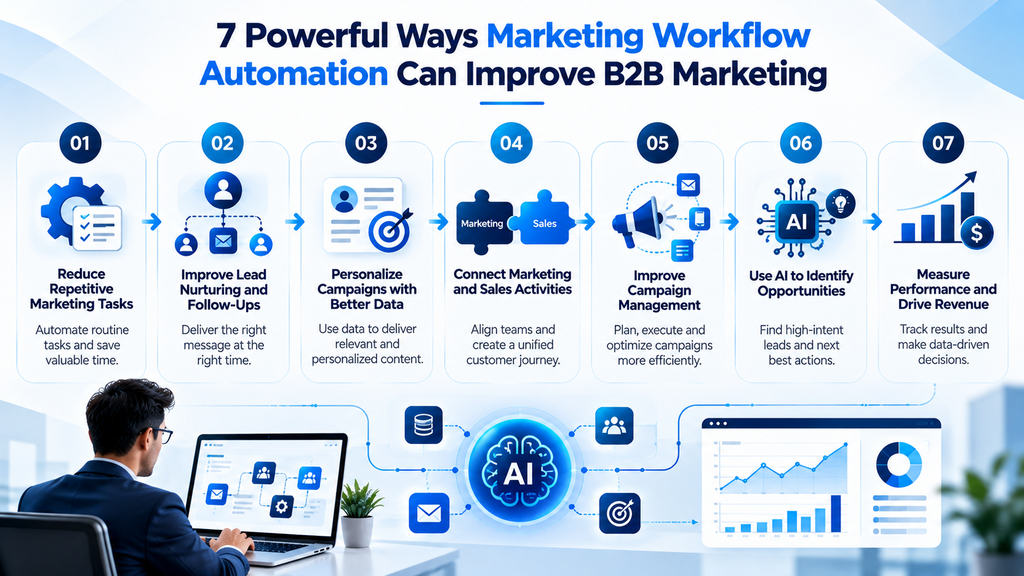
7 Powerful Ways Marketing Workflow Automation Can Improve B2B Marketing
1. Reduce Repetitive Marketing Tasks
Marketing professionals often spend valuable time updating records, scheduling emails, assigning leads, and preparing routine reports.
Automating these activities can reduce repetitive administrative work and make everyday processes more consistent.
For example, a workflow can assign a new lead to the appropriate sales representative based on company size, location, or industry.
Teams can spend less time managing routine tasks and more time improving campaigns, creating useful content, and developing customer relationships.
2. Improve Lead Nurturing and Follow-Ups
Not every prospect is ready to buy when they first interact with a business. Some need educational content, while others may be comparing vendors or preparing an internal business case.
Automated lead nurturing allows marketers to deliver relevant follow-ups based on a prospect’s actions and stage in the buying journey.
For instance, someone who downloads a B2B data enrichment guide could receive a related article or case study before being invited to speak with the sales team.
AI can help recommend content or identify engagement patterns, while marketers define appropriate messaging, timing, and contact preferences.
The result is a more consistent nurturing process without requiring every email to be sent manually.
3. Personalize Campaigns With Better Data
Generic messaging often fails to address the specific problems facing different B2B audiences.
Marketing workflow automation can use available customer information to organize contacts into relevant segments. AI may help identify useful patterns and suggest content based on those segments.
For example, an IT leader may care about integration, security, and implementation, while a marketing director may prioritize campaign performance and lead quality.
A well-designed workflow can help deliver appropriate content to each audience.
However, personalization should rely on accurate, appropriately collected data. Incorrect contact information or assumptions about a prospect can make automated messages less relevant rather than more useful.
4. Connect Marketing and Sales Activities
Marketing and sales teams can lose opportunities when they work with different information or follow different processes.
Automation can help connect lead capture, qualification, assignment, and follow-up activities.
For example, when a prospect meets an agreed qualification threshold, a workflow can notify the relevant sales representative and make the available engagement history accessible.
Both teams should agree on what makes a lead sales-ready, how quickly follow-ups should happen, and how feedback will be recorded.
This creates a clearer handoff and reduces the risk of qualified prospects being overlooked.
5. Make Campaign Management More Efficient
Running multiple campaigns across different channels requires careful coordination.
Marketing workflow automation can help manage campaign schedules, organize approvals, trigger follow-up activities, and collect performance data.
AI tools may also help marketers summarize campaign results, identify changes in engagement, and suggest areas for further investigation.
Consider a company promoting a new software solution through email, its website, and paid campaigns. A connected workflow can help the team coordinate messaging and monitor results in one structured process.
Marketers should still review campaign content, audience targeting, and performance before making significant changes.
6. Use AI to Identify Opportunities for Improvement
Marketing automation becomes more valuable when teams use the information it collects to improve their decisions.
AI can help analyze available campaign and engagement data, highlight patterns, and recommend areas to investigate. Depending on the tools and data available, these insights may help marketers refine audience segments, content choices, or follow-up timing.
For example, if a particular audience segment consistently engages with educational resources but rarely requests a demo, the team could review whether its next-step content is relevant to that audience.
This does not automatically mean the campaign is failing. The team should investigate conversion data, audience intent, and the wider buying journey before deciding what to change.
Use AI-generated insights as decision support rather than treating every recommendation as correct.
7. Measure Performance and Connect Marketing to Revenue
Completing more marketing activities does not necessarily mean generating better business results.
Teams need to measure whether their workflows contribute to meaningful outcomes.
Useful metrics include:
- Time required to process and assign leads
- Email engagement and conversion rates
- Marketing-qualified and sales-qualified leads
- Lead-to-opportunity conversion
- Campaign cost and acquisition efficiency
- Pipeline contribution and revenue outcomes
The most relevant metrics depend on your business model, campaign objectives, and attribution approach.
Marketing workflow automation becomes more valuable when teams use the information it collects to improve their decisions. By applying B2B campaign optimization strategies, marketers can evaluate campaign results, identify areas for improvement, and make more informed decisions about future marketing activities.
For example, a workflow that reduces lead assignment delays may improve sales responsiveness. To determine whether it also improves revenue, the team must examine what happens after assignment.
How to Implement Marketing Workflow Automation
You do not need to automate every marketing activity at once. Start with one process that creates unnecessary work or delays.
Step 1: Identify a Repetitive Process
Review your current marketing activities and identify tasks that are time-consuming, frequent, or prone to errors.
Lead assignment, follow-up emails, data updates, and routine reporting are useful starting points.
Step 2: Define the Desired Outcome
Decide what the workflow should achieve.
For example, you might want to reduce the time between a prospect submitting a form and receiving the first relevant follow-up.
Define a baseline so you can compare performance after implementation.
Step 3: Choose the Right Tools
Select tools that support your existing processes and integrate with your CRM, marketing platform, and reporting systems where necessary.
When selecting the right tools, businesses should understand how AI Search for B2B Brands can help them explore AI-driven search strategies, improve content discoverability, and strengthen their digital marketing efforts.
For marketing-specific activities, evaluate whether your current marketing automation platform already supports the features you need before purchasing additional software.
Step 4: Map the Workflow
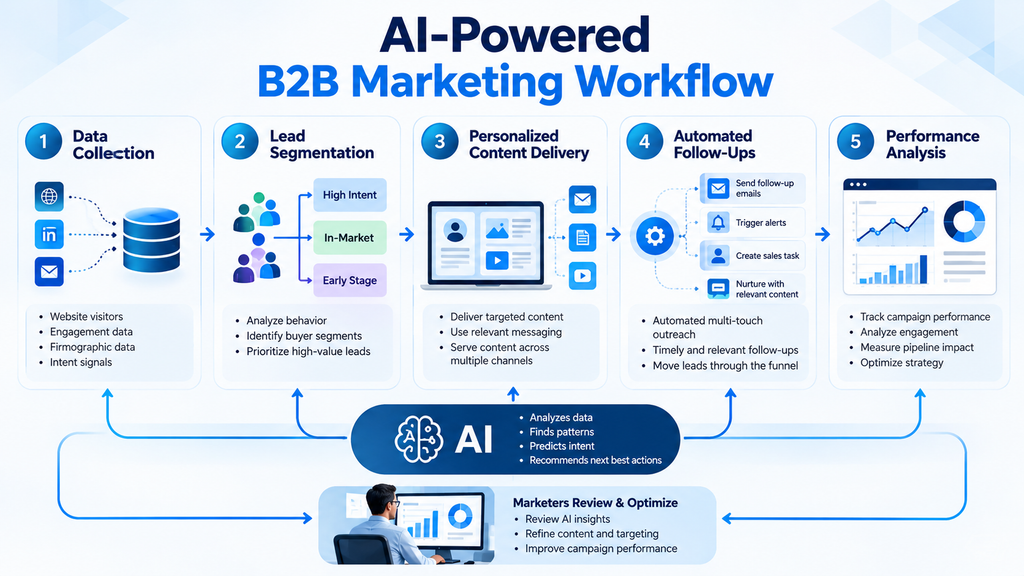
Document the trigger, conditions, actions, and exceptions.
For example:
- A prospect submits a website form.
- The system validates the available information.
- The contact is assigned to an appropriate segment.
- A relevant follow-up is sent, subject to consent and communication preferences.
- The sales team receives a notification if the prospect meets the qualification criteria.
- The outcome is recorded for reporting.
Step 5: Test Before Launching
Test the workflow with sample records and realistic scenarios.
Check for duplicate emails, incorrect assignments, missing data, and contacts who should not receive communications.
Include a way to pause the workflow or correct errors if something goes wrong.
Step 6: Review and Improve
Monitor the results against your original goal.
Ask whether the workflow reduced manual effort, improved response times, or increased qualified conversions. Adjust the rules and content when the evidence supports a change.
Common Marketing Workflow Automation Mistakes to Avoid
Automation can create new problems when it is implemented without a clear plan.
Automating a broken process: Fix unnecessary steps and unclear responsibilities before automating them.
Using inaccurate data: Outdated contact details and incomplete records can lead to poor targeting and irrelevant messages.
Over-automating communication: Too many automated emails can frustrate prospects. Set sensible frequency limits and respect communication preferences.
Ignoring sales feedback: Marketing workflows should reflect what happens after leads reach the sales team.
Relying entirely on AI: AI can make mistakes. Review important recommendations, customer-facing content, and decisions that affect lead qualification.
Measuring activity instead of outcomes: Email volume and the number of automated tasks completed do not, by themselves, demonstrate revenue impact.
Best Practices for Successful Marketing Workflow Automation
To build a workflow that delivers lasting value, keep these principles in mind:
- Start small: Automate one high-impact process before expanding.
- Keep data clean: Establish clear processes for updating and validating customer records.
- Set measurable goals: Choose a specific metric for each workflow.
- Maintain human oversight: Assign responsibility for reviewing results and handling exceptions.
- Respect privacy: Follow applicable privacy requirements and communication consent rules.
- Connect your systems: Reduce unnecessary data duplication between marketing and sales tools.
- Review regularly: Update workflows when customer behavior, business goals, or campaign requirements change.
For broader guidance on creating useful, people-focused content, see Google Search Central’s helpful content guidance. If you are evaluating marketing automation platforms, you can also explore HubSpot’s marketing automation resources and Salesforce’s marketing automation overview.
The right approach combines suitable technology with reliable data, clear processes, and people who understand the business objectives.
Final Thoughts
Marketing workflow automation gives B2B teams a practical way to reduce repetitive work, coordinate campaigns, and manage prospect engagement more consistently.
AI adds further possibilities by helping marketers analyze data, identify patterns, and make more informed decisions. But technology alone does not guarantee better marketing performance.
The real value comes from choosing the right workflows, setting clear goals, and measuring whether the changes improve customer engagement and business outcomes.
For B2B companies looking to build a more efficient marketing operation, the best next step is simple: identify one process that slows your team down, improve it, and expand automation based on what you learn.
Frequently Asked Questions About Marketing Workflow Automation
1. What is marketing workflow automation?
Marketing workflow automation is the use of software to automate repetitive marketing tasks, such as email follow-ups, lead assignment, campaign scheduling, and performance reporting. It helps marketing teams save time and manage activities more efficiently.
2. How does AI improve marketing workflow automation?
AI improves marketing workflow automation by analyzing data, identifying engagement patterns, supporting lead prioritization, and helping marketers personalize content. It can also provide insights that help teams optimize campaigns and make better marketing decisions.
3. What are the benefits of marketing workflow automation for B2B companies?
Marketing workflow automation helps B2B companies reduce manual work, improve lead nurturing, maintain consistent communication, align sales and marketing teams, and track campaign performance. These improvements can support better conversion rates and revenue growth.
4. Which marketing tasks can be automated using AI?
Businesses can automate email sequences, lead segmentation, lead assignment, campaign notifications, data updates, reporting, and selected content recommendations. Human review remains important for customer-facing communication and significant marketing decisions.
5. How can businesses implement marketing workflow automation?
Businesses can start by identifying repetitive tasks, defining measurable goals, choosing suitable tools, mapping workflow steps, testing the process, and monitoring results. Starting with one workflow makes it easier to identify problems before expanding automation.
6. What is the difference between marketing automation and AI-powered marketing automation?
Traditional marketing automation follows predefined rules and triggers to perform tasks. AI-powered marketing automation can additionally analyze data, identify patterns, and support predictions or recommendations. Both approaches can work together to improve marketing processes.
7. How does marketing workflow automation help generate more B2B leads?
Marketing workflow automation helps capture leads, organize prospects into relevant segments, deliver timely follow-ups, and notify sales teams when leads meet qualification criteria. These processes can improve lead management and help teams focus on promising opportunities.
8. How can businesses measure the success of marketing workflow automation?
Businesses can measure success through time saved, lead response time, email engagement, lead-to-opportunity conversion, campaign efficiency, and pipeline contribution. The most useful metrics depend on the workflow’s objectives and the company’s business goals.