Introducation
B2B demand generation is about more than generating leads. It helps businesses build awareness, earn buyer trust, and create interest among the right potential customers before they are ready to speak with sales.
In 2026, B2B buyers are doing more independent research, comparing vendors across multiple channels, and expecting relevant information at every stage of their buying journey. Businesses that rely only on lead forms and outbound outreach may miss opportunities to influence these buyers early.
A strong B2B demand generation strategy connects useful content, targeted campaigns, buyer intent signals, marketing technology, and sales alignment to create a more consistent path from awareness to revenue.
This guide explains seven practical B2B demand generation strategies, how to measure their performance, and how to improve your approach for sustainable growth.
Table of Contents
What Is B2B Demand Generation?
B2B demand generation is the process of creating awareness, interest, and trust in a company’s products or services among potential business buyers.
It involves activities such as content marketing, search engine optimization (SEO), paid campaigns, email marketing, webinars, account-based marketing (ABM), and buyer intent analysis.
Unlike a strategy focused only on collecting contact details, demand generation aims to help buyers understand their challenges, explore possible solutions, and recognize the value of your offering. For more information, explore this guide to B2B demand generation.
Demand generation can include:
- Educational content
- Search engine optimization
- Thought leadership
- Social media
- Account-based marketing
- Webinars and events
- Email nurturing
- Content syndication
- Paid advertising
- Intent data
- Marketing automation
- Research and whitepapers
The objective is not simply to obtain an email address.
For example, a B2B marketing technology company might publish an educational guide, promote its research on LinkedIn, and use relevant website content to help marketing leaders understand how better intent data can improve campaign targeting.
As buyers progress through their research, the company can provide more specific information and connect qualified opportunities with its sales team.
Learn how demand generation differs from lead generation and how both approaches support B2B growth.
Why Is B2B Demand Generation Important in 2026?
B2B purchasing decisions often involve multiple stakeholders, extended research, and several interactions before a vendor is selected. Marketing teams need to influence that process well before a prospect submits a contact form.
A well-planned demand generation strategy helps businesses:
- Reach relevant buyers: Focus marketing resources on the industries, companies, and decision-makers most likely to benefit from the offering.
- Build trust before the sales conversation: Provide educational content that answers questions and demonstrates expertise.
- Improve lead quality: Attract prospects whose needs align with the company’s solutions.
- Coordinate sales and marketing: Give both teams a shared understanding of target accounts, engagement, and pipeline goals.
- Make better use of marketing data: Identify which channels and activities contribute to meaningful engagement and qualified opportunities.
The objective is not simply to generate more activity. It is to create demand that can develop into qualified pipeline and business revenue.
How B2B Demand Generation Works
A typical B2B buyer may encounter a company several times before taking any meaningful action.
For example, a marketing director could:
- Discover an article through Google.
- Read a LinkedIn post from the company.
- Download an industry report.
- Attend a webinar.
- Receive a relevant email.
- Visit a product or service page.
- Compare the company with competitors.
- Share information with colleagues.
- Request a demonstration or sales conversation.
Demand generation supports this entire journey.
Instead of expecting the first interaction to generate a sales-ready lead, marketers create multiple opportunities for buyers to learn, engage, and build confidence.
A strong demand generation program generally follows this flow:
Target audience → Awareness → Education → Engagement → Intent → Qualification → Sales opportunity → Revenue
Each stage requires different content, channels, and measurements.
B2B Demand Generation Strategy for 2026
A successful B2B demand generation strategy starts with understanding your ideal customers and creating relevant experiences across the channels they use to research business solutions.
In 2026, marketing teams should focus on the following priorities:
- Define your ideal customer profile: Identify target industries, company sizes, business challenges, and decision-makers.
- Create valuable content: Publish educational blogs, original research, case studies, and practical guides that answer buyer questions.
- Improve organic search visibility: Target relevant keywords and optimize existing content to help potential buyers discover your business.
- Use buyer intent signals: Combine available intent data with company fit and engagement to prioritize promising accounts.
- Apply AI and automation thoughtfully: Use technology to support audience segmentation, campaign analysis, and relevant follow-up.
- Align sales and marketing: Establish shared qualification criteria and clear processes for engaging promising opportunities.
- Measure business outcomes: Evaluate qualified opportunities, pipeline contribution, and revenue alongside engagement metrics.
Rather than implementing every tactic at once, start with the channels and activities most relevant to your audience. Review performance regularly and use the findings to improve your approach.
Demand Generation vs Lead Generation
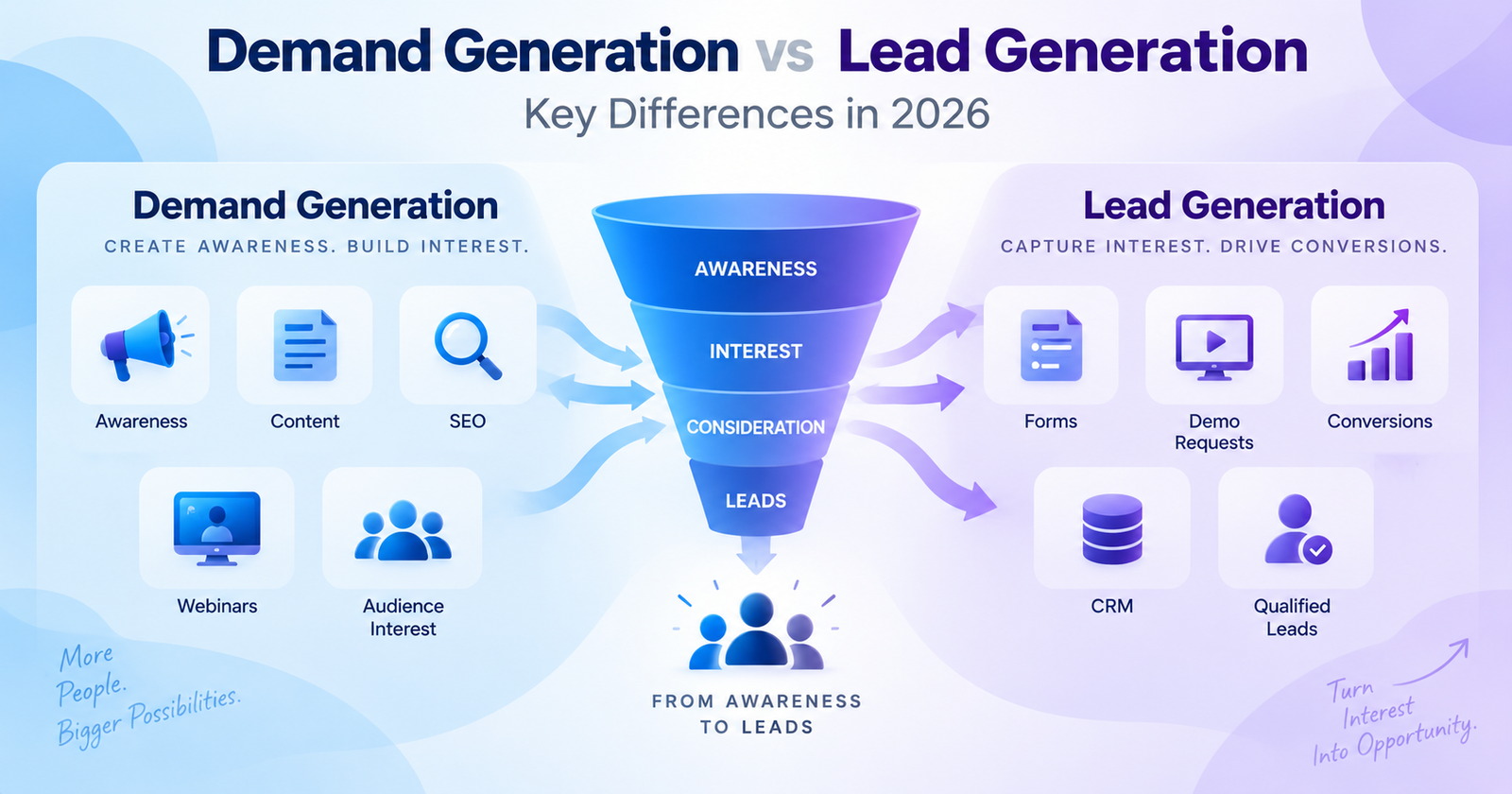
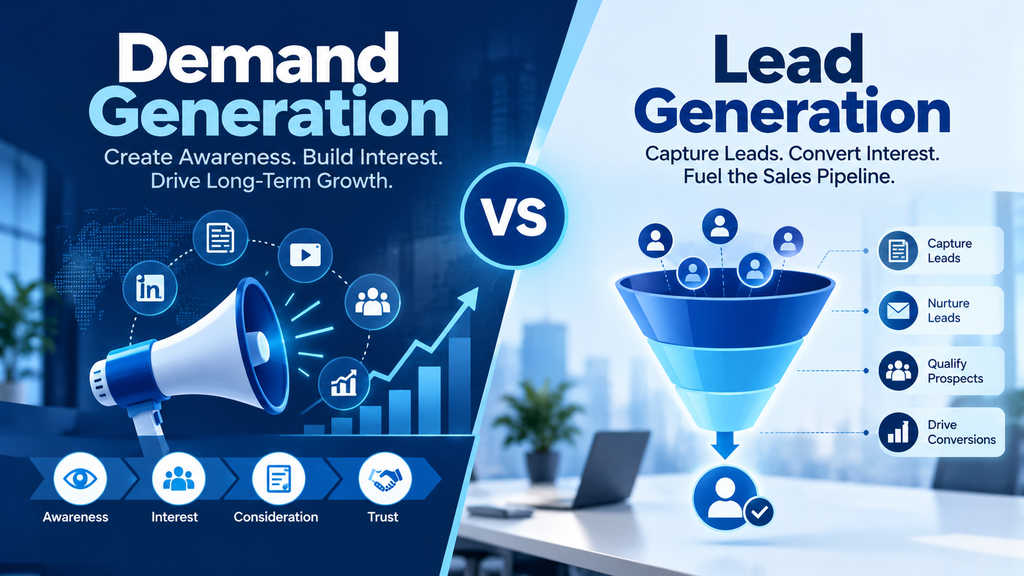
Demand generation and lead generation work together, but they serve different purposes in B2B marketing.
Demand generation focuses on building awareness, interest, and trust among potential buyers. Lead generation focuses on identifying prospective customers and capturing their information when they take a relevant action.
For example, an educational blog that helps marketing leaders understand buyer intent data supports demand generation. A downloadable report with a registration form can support lead generation by capturing contact information from interested readers.
Key differences between demand generation and lead generation
| Comparison | Demand Generation | Lead Generation |
|---|---|---|
| Primary goal | Build awareness, interest, and trust | Identify and capture prospective customers |
| Main focus | Educating and engaging target buyers | Generating identifiable prospects |
| Common activities | SEO, thought leadership, social content, webinars | Forms, gated resources, registrations, demo requests |
| Typical measures | Reach, engagement, branded search, pipeline influence | Leads, conversion rate, lead quality |
| Role in the buyer journey | Often supports early and ongoing research | Helps identify prospects for further engagement |
Neither approach should operate in isolation. Demand generation creates opportunities for buyers to discover and evaluate your business, while lead generation helps your team identify interested prospects and determine appropriate next steps.
The strongest B2B marketing programs connect both approaches and evaluate their contribution to qualified pipeline and revenue.
How to Measure B2B Demand Generation Performance
Measuring B2B demand generation performance helps businesses understand whether their marketing activities are reaching the right audience and contributing to meaningful business outcomes.
Start by establishing a baseline, selecting metrics aligned with your objectives, and reviewing performance consistently.
Organic search performance
Use Google Search Console to monitor:
- Impressions: How often your website appears in Google search results.
- Clicks: How many visits your pages receive from those search results.
- Click-through rate (CTR): The percentage of impressions that result in clicks.
- Average position: Your site’s average ranking position for selected queries.
These metrics can reveal which topics attract visibility and which pages need improvements to their content, search intent alignment, or search-result presentation.
Lead and conversion performance
Track the percentage of relevant visitors who complete meaningful actions, such as requesting a consultation, registering for a webinar, or downloading a resource.
Review conversion quality as well as conversion volume. A campaign that produces fewer but more relevant prospects may contribute more value than one that generates a large number of poorly qualified leads.
Pipeline and revenue contribution
Measure qualified opportunities, opportunity progression, sales outcomes, and revenue associated with marketing activities. Use consistent attribution definitions and recognize that multiple channels may influence the same buying decision.
Campaign efficiency
Evaluate campaign spending against meaningful outcomes, including qualified opportunities and customer acquisition cost where the necessary data is available.
How to Build a B2B Demand Generation Strategy
A successful program begins long before choosing advertising channels.
Define Your Ideal Customer Profile
Start by identifying the organizations most likely to benefit from your solution.
An ideal customer profile can include:
- Industry
- Company size
- Revenue
- Geography
- Technology environment
- Business model
- Growth stage
- Common challenges
The goal is to avoid marketing to everyone.
The more clearly the target market is defined, the easier it becomes to create relevant campaigns.
Identify the Buying Group
B2B purchases often involve multiple people rather than one decision-maker.
A buying group may contain:
- Executive sponsor
- Department leader
- Technical evaluator
- Finance stakeholder
- Procurement
- End user
- Influencer
Each person may care about different outcomes.
For example, a CMO may care about pipeline growth, while an IT leader may care about integration and security.
Demand generation content should address those different concerns.
Understand the Buyer Journey
Map the questions buyers ask at different stages.
At the awareness stage:
What is causing this problem?
During consideration:
What solutions are available?
During evaluation:
Which provider is the best fit?
During decision:
Can we justify this purchase internally?
Content should help buyers answer each of these questions.
Create Content for Every Stage
Different content formats serve different purposes.
Awareness
- Educational blog posts
- Research
- Social content
- Videos
- Industry insights
Consideration
- Guides
- Whitepapers
- Webinars
- Comparison articles
- Case studies
Evaluation
- Product information
- ROI calculators
- Technical documentation
- Customer stories
- Demonstrations
The best demand generation programs do not force every visitor directly toward a sales form.
They provide the next most useful piece of information.
Align Marketing and Sales
Demand generation becomes significantly more effective when marketing and sales agree on:
- Ideal customer profile
- Target accounts
- Lead definitions
- Qualification criteria
- Sales handoff
- Follow-up expectations
- Pipeline stages
- Revenue measurement
Without alignment, marketing can celebrate lead volume while sales complains about lead quality.
A shared definition of success prevents this problem.
Best B2B Demand Generation Strategies
There is no single channel that works for every company. Strong programs usually combine several strategies.
Content Marketing
Useful content can attract buyers while they are researching problems and solutions.
Examples include:
- Guides
- Research reports
- Industry analysis
- Tutorials
- Comparisons
- Templates
- Case studies
Content should answer a real buyer question rather than existing simply to target a keyword.
Search Engine Optimization
SEO allows useful content to continue attracting buyers long after publication.
B2B SEO should focus on topics relevant to commercial problems rather than chasing unrelated high-volume keywords.
For example, a demand-generation technology company may benefit more from ranking for:
B2B demand generation strategy
than from ranking for a very broad phrase such as:
marketing tips
Search intent and audience relevance matter more than raw search volume.
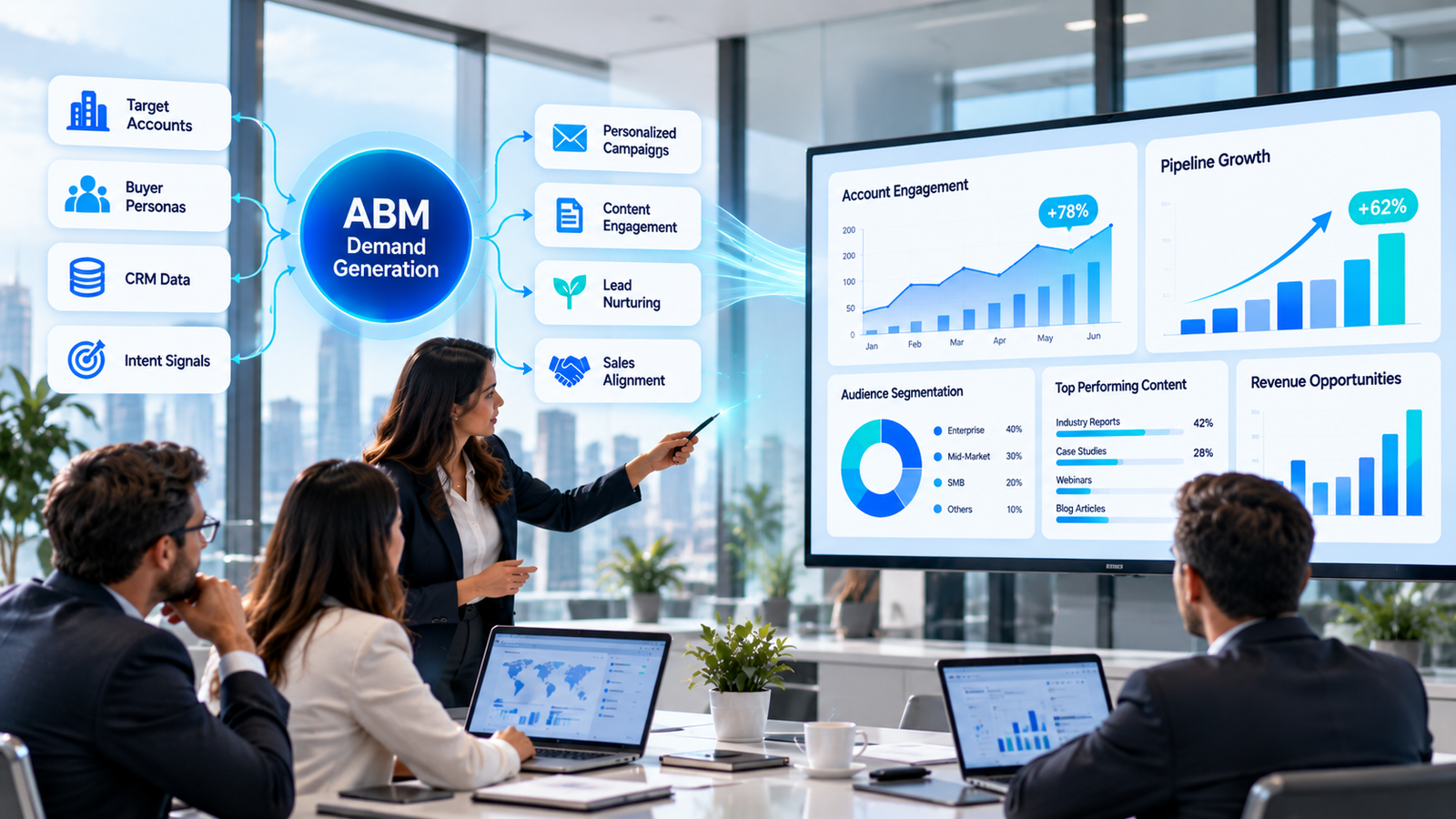
Account-Based Marketing
Account-based marketing focuses resources on a defined group of high-value companies.
Instead of sending identical messages to a huge database, teams can customize:
- Advertising
- Content
- Outreach
- Landing pages
- Events
- Sales engagement
ABM can work particularly well when deal values are high and buying groups are complex.
Content Syndication
Content syndication distributes valuable content through external platforms or partners to reach audiences beyond a company’s existing website visitors.
Common assets include:
- Whitepapers
- Research reports
- Guides
- Industry studies
The objective should not be to collect as many contacts as possible.
Effective syndication requires:
- Appropriate targeting
- Accurate data
- Clear consent
- Lead validation
- Follow-up strategy
- Performance measurement
Email Marketing and Lead Nurturing
Email remains useful when messages are relevant to the recipient’s interests and stage of the buying journey.
Instead of sending the same promotional message repeatedly, nurture programs can deliver:
- Educational insight
- Related research
- Practical guide
- Case study
- Webinar invitation
- Product information when appropriate
The objective is progression, not inbox volume.
Webinars and Virtual Events
Webinars can help companies demonstrate expertise while capturing stronger engagement signals.
Topics should focus on problems buyers genuinely want to understand.
After the event, marketers can reuse the content as:
- Video clips
- Blog articles
- Social posts
- Email content
- Slides
- Quotes
- On-demand recordings
One strong webinar can therefore support multiple demand-generation channels.
Paid Media
Paid campaigns can accelerate distribution through platforms such as:
- Google Ads
- LinkedIn Ads
- Industry publications
- Retargeting networks
However, paid media works best when it promotes something buyers actually want.
Sending cold audiences directly to a generic sales page often produces weaker results than promoting useful research, guides, events, or other valuable content.
Intent Data
Intent data helps marketers identify accounts showing signs of interest in particular subjects or solutions.
Signals may include:
- Content consumption
- Website activity
- Topic research
- Product comparisons
- Campaign engagement
Intent data should not be treated as proof that a company is ready to purchase. Explore our guide to B2B intent data in 2026 to learn how buyer signals can help marketing teams prioritize relevant accounts.
Instead, it can help prioritize accounts and determine when more relevant engagement may be appropriate.
AI and Marketing Automation
AI can assist demand-generation teams with activities such as:
- Audience segmentation
- Content research
- Personalization
- Lead prioritization
- Campaign analysis
- Email optimization
- Workflow automation
- Predictive insights
However, AI is only as useful as the strategy and data supporting it.
Salesforce’s 2026 research highlights this challenge: marketers are adopting AI rapidly, but disconnected data continues to limit personalization and engagement.
B2B Demand Generation Funnel Explained
A simple B2B demand-generation funnel can be divided into five stages.
1. Awareness
The buyer recognizes a problem or discovers your brand.
Useful metrics include:
- Search impressions
- Website visitors
- Content reach
- Video views
- Brand searches
2. Engagement
The buyer begins interacting with your content.
Metrics can include:
- Engaged sessions
- Article readership
- Webinar registrations
- Newsletter subscriptions
- Whitepaper downloads
3. Intent
The buyer demonstrates stronger interest.
Possible signals include:
- Repeated visits
- High-value page views
- Multiple content downloads
- Pricing-page activity
- Product comparisons
- Event attendance
4. Qualification
Marketing and sales determine whether the account is a suitable opportunity.
Qualification might consider:
- Company fit
- Job role
- Need
- Engagement
- Buying timing
- Account intent
5. Pipeline and Revenue
Qualified interest becomes:
- Meetings
- Opportunities
- Pipeline
- Closed revenue
- Expansion revenue
The purpose of demand generation is ultimately to support business growth—not simply increase form submissions.
Important Demand Generation Metrics and KPIs
Different stages require different measurements.
Awareness Metrics
- Organic impressions
- Website traffic
- Social reach
- Branded search growth
- Video views
Engagement Metrics
- Engaged sessions
- Average engagement time
- Content downloads
- Event registrations
- Newsletter subscriptions
Lead and Account Metrics
- Marketing-qualified leads
- Qualified accounts
- Lead-to-opportunity rate
- Account engagement
- Sales acceptance rate
Pipeline Metrics
- Marketing-sourced pipeline
- Marketing-influenced pipeline
- Opportunity conversion rate
- Pipeline velocity
- Customer acquisition cost
Revenue Metrics
- Closed-won revenue
- Customer lifetime value
- Return on marketing investment
- Revenue by channel
The right KPI depends on the campaign objective.
A thought-leadership article should not necessarily be judged by immediate sales meetings.
Likewise, a high-intent campaign should not be evaluated only by impressions.
Common B2B Demand Generation Challenges
Poor Data Quality
Incorrect job titles, outdated contact information, duplicated records, and incomplete company information can reduce campaign effectiveness.
Targeting Too Broadly
Trying to reach everyone often creates generic messaging that resonates with nobody.
Focusing Only on Lead Volume
Large lead numbers can look impressive while contributing very little pipeline.
Weak Content
Publishing generic material that repeats what already exists gives buyers little reason to remember the brand.
Disconnected Technology
CRM systems, marketing automation, analytics, advertising platforms, and data tools can create fragmented customer views if they are not properly connected.
Weak Sales Follow-Up
Even excellent marketing cannot compensate for slow or irrelevant sales engagement.
Measuring the Wrong Outcomes
Clicks and impressions are useful signals, but they should eventually connect to qualified opportunities and revenue.
B2B Demand Generation Best Practices
Prioritize Relevance Over Volume
A smaller audience of highly relevant accounts can be more valuable than a large audience with little purchase potential.
Create Original Value
Publish information competitors cannot easily reproduce.
Examples include:
- Original research
- Benchmark data
- Expert analysis
- Practical frameworks
- Templates
- Proprietary insights
Build Topic Authority
Rather than publishing unrelated articles, create connected content clusters.
For example:
B2B Demand Generation
can connect to detailed guides about:
- Demand generation vs lead generation
- Demand generation strategy
- Demand-generation metrics
- Content syndication
- Intent data
- ABM
- AI in demand generation
This helps readers explore a subject in greater depth while creating a stronger internal content structure.
Make Content Easy to Understand
Use:
- Clear headings
- Short paragraphs
- Tables
- Examples
- Bullet points
- Definitions
- Visuals
Complex B2B topics do not require complicated writing.
Keep Improving Existing Content
SEO content should not be treated as finished forever.
Review important pages periodically and update:
- Outdated statistics
- Broken links
- Examples
- Screenshots
- Recommendations
- Product or industry changes
How AI Is Changing B2B Demand Generation
Artificial intelligence is changing both how marketers work and how buyers research.
Marketing teams can use AI to accelerate:
- Research
- Data analysis
- Campaign planning
- Personalization
- Lead scoring
- Workflow automation
- Content repurposing
At the same time, buyers increasingly use AI-assisted search and conversational tools during research.
LinkedIn’s 2026 B2B marketing research identifies AI as one of the forces redefining marketing workflows, while also emphasizing continued importance of human creativity, trust, measurement, and data quality.
For demand-generation teams, this means the goal should not be to generate the maximum amount of AI-created content.
The stronger opportunity is to use AI to make marketing more informed, responsive, efficient, and relevant while maintaining human expertise and original insight.
How to Improve Your B2B Demand Generation Strategy
Use the following practical checklist to strengthen your program:
- Define your ideal customer profile and priority buying groups.
- Review existing content and identify gaps in buyer education.
- Use keyword research and Google Search Console to prioritize SEO improvements.
- Connect relevant blogs, landing pages, research reports, and service pages with internal links.
- Improve campaign targeting using reliable company data and relevant intent signals.
- Test landing-page messaging, calls to action, and conversion paths.
- Coordinate sales and marketing qualification criteria.
- Establish baseline metrics and review progress consistently.
- Use campaign results and sales feedback to refine the next set of activities.
Start with a small number of high-priority improvements. Measure the results, learn what works, and expand the approach based on evidence.
Frequently Asked Questions About B2B Demand Generation
What is B2B demand generation?
B2B demand generation is the process of building awareness, interest, trust, and buying intent among businesses that may eventually purchase a company’s products or services.
What is the difference between demand generation and lead generation?
Demand generation creates awareness and interest, while lead generation captures information from prospects who demonstrate interest. Lead generation is therefore one component of a broader demand-generation strategy.
What are examples of B2B demand-generation activities?
Common activities include SEO, content marketing, LinkedIn marketing, webinars, account-based marketing, email nurturing, content syndication, paid advertising, intent-data activation, research, and marketing automation.
How do you measure B2B demand generation?
Measurement can include website traffic, engagement, qualified leads, account engagement, opportunities, marketing-sourced pipeline, conversion rates, acquisition cost, and revenue.
How long does B2B demand generation take?
Results depend on industry, sales cycle, market awareness, budget, competition, and strategy. Some paid campaigns can create engagement quickly, while SEO, thought leadership, brand awareness, and organic demand typically develop over a longer period.
Can AI improve B2B demand generation?
Yes. AI can support segmentation, research, campaign analysis, personalization, workflow automation, lead prioritization, and content operations. However, effective results still depend on accurate data, clear positioning, useful content, and human oversight.
Final Thoughts
B2B demand generation is not simply a campaign or a collection of marketing tools.
It is a coordinated approach to creating awareness, educating buyers, building trust, identifying intent, and helping qualified accounts move toward a purchase decision.
The strongest demand-generation strategies combine:
Relevant audiences + valuable content + accurate data + effective distribution + technology + sales alignment + meaningful measurement.
In 2026, AI and marketing technology can make these processes faster and more sophisticated, but successful demand generation still depends on understanding real buyers and giving them useful reasons to engage.
For B2B organizations, the goal should therefore move beyond generating more leads.
The goal is to create better demand, stronger buying intent, healthier pipeline, and measurable business growth.