Introduction
Marketing is becoming more intelligent, automated, and data-driven. In 2026, businesses are moving beyond basic automation toward systems that can analyze information, make decisions, take action, and learn from campaign results.
This is where AI Agents in Marketing are becoming increasingly important.
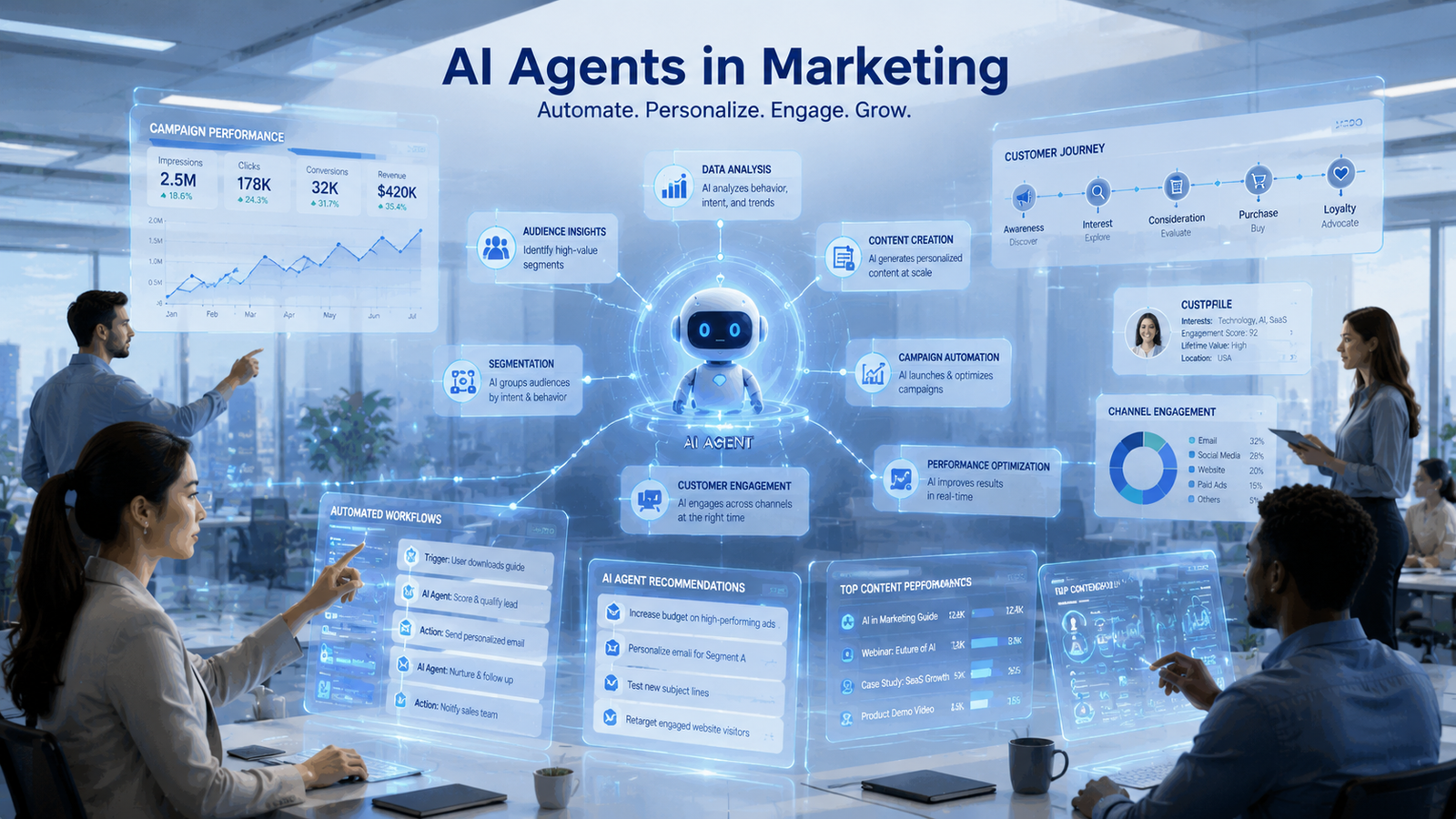
Unlike traditional automation, which usually follows predefined rules, AI agents can handle more complex marketing tasks. They can analyze customer behavior, identify opportunities, personalize content, support lead nurturing, monitor campaign performance, and recommend what marketers should do next.
For B2B companies managing multiple channels, audiences, campaigns, and customer signals, this can significantly change how marketing teams work.
In this guide, we will explore 7 powerful ways AI agents can transform marketing campaigns in 2026, along with practical ways businesses can use them.
Table of Contents
What Are AI Agents in Marketing?
AI Agents in Marketing are intelligent software systems designed to perform tasks with a certain level of autonomy.
Traditional marketing automation usually works through predefined rules.
For example:
If a customer downloads an ebook, send a follow-up email.
An AI agent can go further.
It may analyze the customer’s company, previous interactions, website activity, content interests, and engagement patterns before recommending the next best action.
Depending on how it is designed, an AI agent can help with tasks such as:
- Researching prospects
- Segmenting audiences
- Identifying customer intent
- Creating campaign drafts
- Personalizing messaging
- Monitoring campaign performance
- Updating marketing systems
- Recommending next actions
The important difference is intelligence and context.
Instead of simply completing one predefined action, AI agents can support a sequence of connected tasks.
Why AI Agents in Marketing Matter in 2026
Marketing technology stacks have become increasingly complex.
Many businesses use separate platforms for:
- CRM
- Email marketing
- Social media
- Analytics
- Advertising
- Customer data
- Content management
- Sales engagement
The problem is not always a lack of technology. Often, it is the difficulty of connecting all these systems.
Marketing teams can spend significant time moving between platforms, checking dashboards, exporting data, and performing repetitive tasks.
AI Agents in Marketing can help reduce this operational complexity.
An AI agent can potentially act as an intelligent layer between systems and workflows.
For example, instead of manually reviewing campaign performance every morning, a marketing team could use an AI agent to monitor results and highlight unusual changes.
Instead of manually researching every new lead, an AI agent could gather relevant business information and prepare a summary.
This allows teams to spend more time making decisions and less time collecting information.
Marketing Is Moving From Automation to Intelligent Action
Traditional automation remains valuable.
However, the next stage is more intelligent automation.
Basic automation follows instructions.
AI-powered systems can analyze context and recommend actions.
This shift is one reason why AI Agents in Marketing are gaining attention.
The goal is not to automate everything blindly. The goal is to automate the right tasks while maintaining human oversight.
7 Powerful B2B Use Cases for AI Agents in Marketing
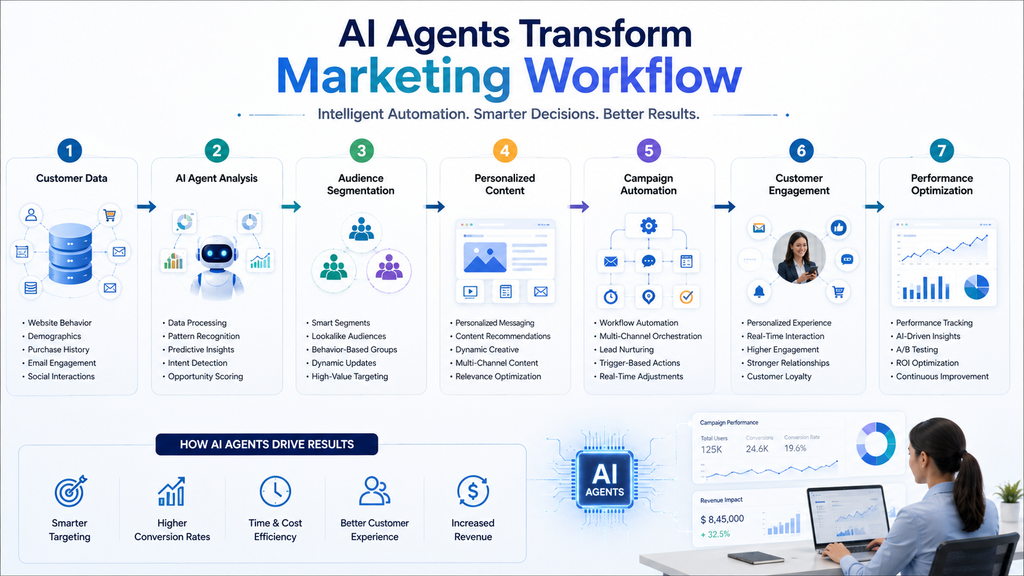
1. Smarter Campaign Planning
Campaign planning often requires marketers to analyze customer data, identify target audiences, select channels, and create messaging.
AI agents can help organize this information.
For example, an agent could review historical campaign data and identify patterns such as:
- Which content formats generated engagement
- Which audience segments responded best
- Which channels performed well for specific campaigns
- Which topics attracted high-intent prospects
Marketers can then use these insights when developing future campaigns.
The final strategy should still involve human judgment, but AI can reduce the time needed to gather information.
2. Better Audience Segmentation
Effective marketing depends on understanding the audience.
However, manual segmentation can become difficult when businesses manage thousands of contacts.
AI Agents in Marketing can help analyze customer information and identify meaningful groups.
Segmentation may consider:
- Industry
- Company size
- Job role
- Website activity
- Content engagement
- Purchase history
- Product interest
This can help marketers create more relevant campaigns.
Instead of sending the same message to everyone, businesses can create communication based on customer needs and interests.
3. Improved Content Personalization
Personalization has become an important part of customer engagement.
AI can assist marketers by creating different content variations for different audience segments.
For example, a company may need to communicate with:
- CEOs
- Marketing leaders
- IT managers
- Sales teams
Each audience may care about different business challenges.
An AI agent can help prepare personalized messaging based on the target audience.
However, marketers should review AI-generated content before publishing it.
Brand voice, accuracy, and strategic messaging should remain under human control.
4. Automated Marketing Workflows
One of the strongest applications of AI agents is workflow automation.
Consider a typical B2B workflow:
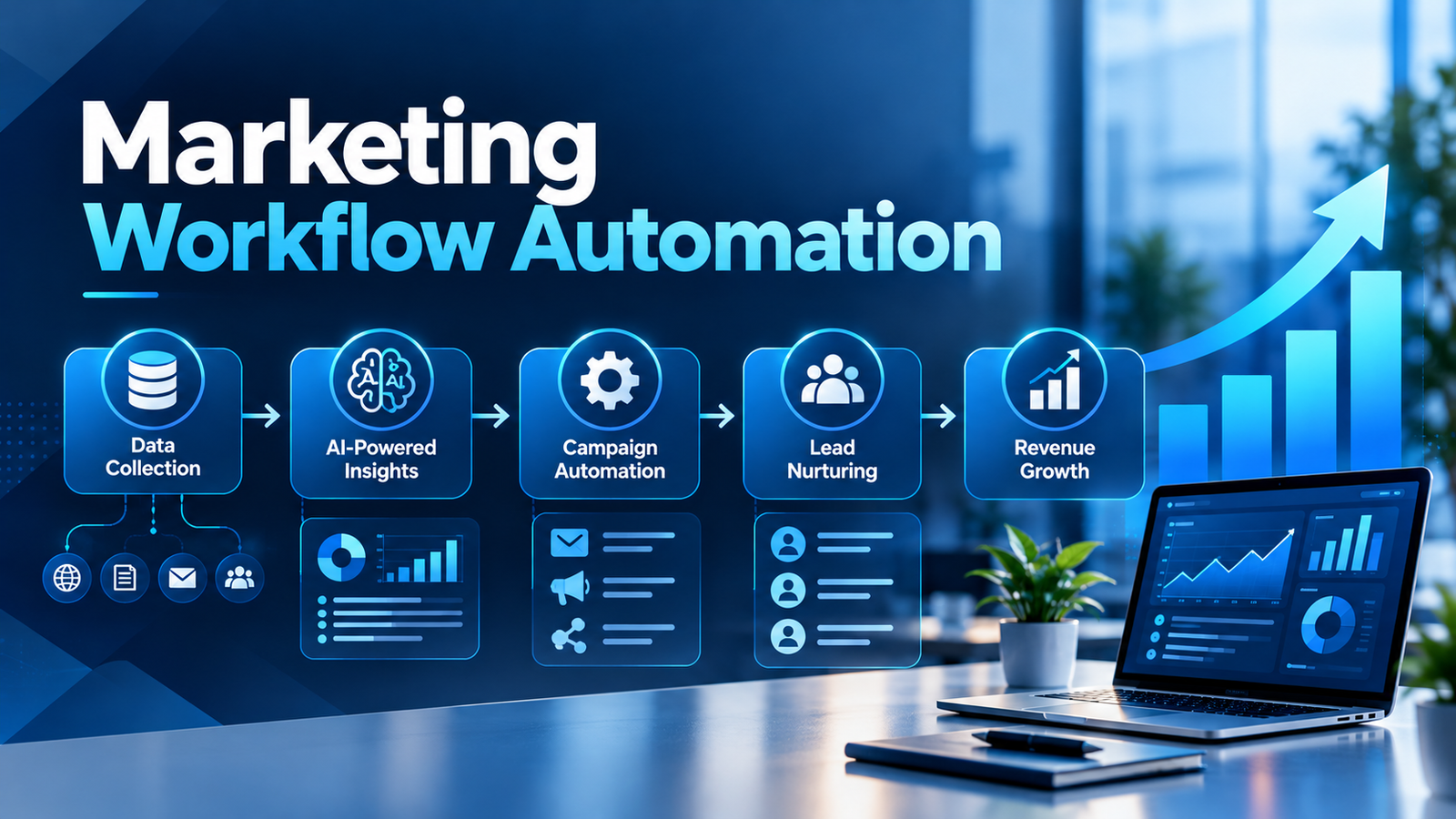
New Lead → Data Enrichment → Intent Analysis → Lead Scoring → Audience Segmentation → Personalized Campaign → Sales Notification
Without connected automation, multiple people may need to manage these steps.
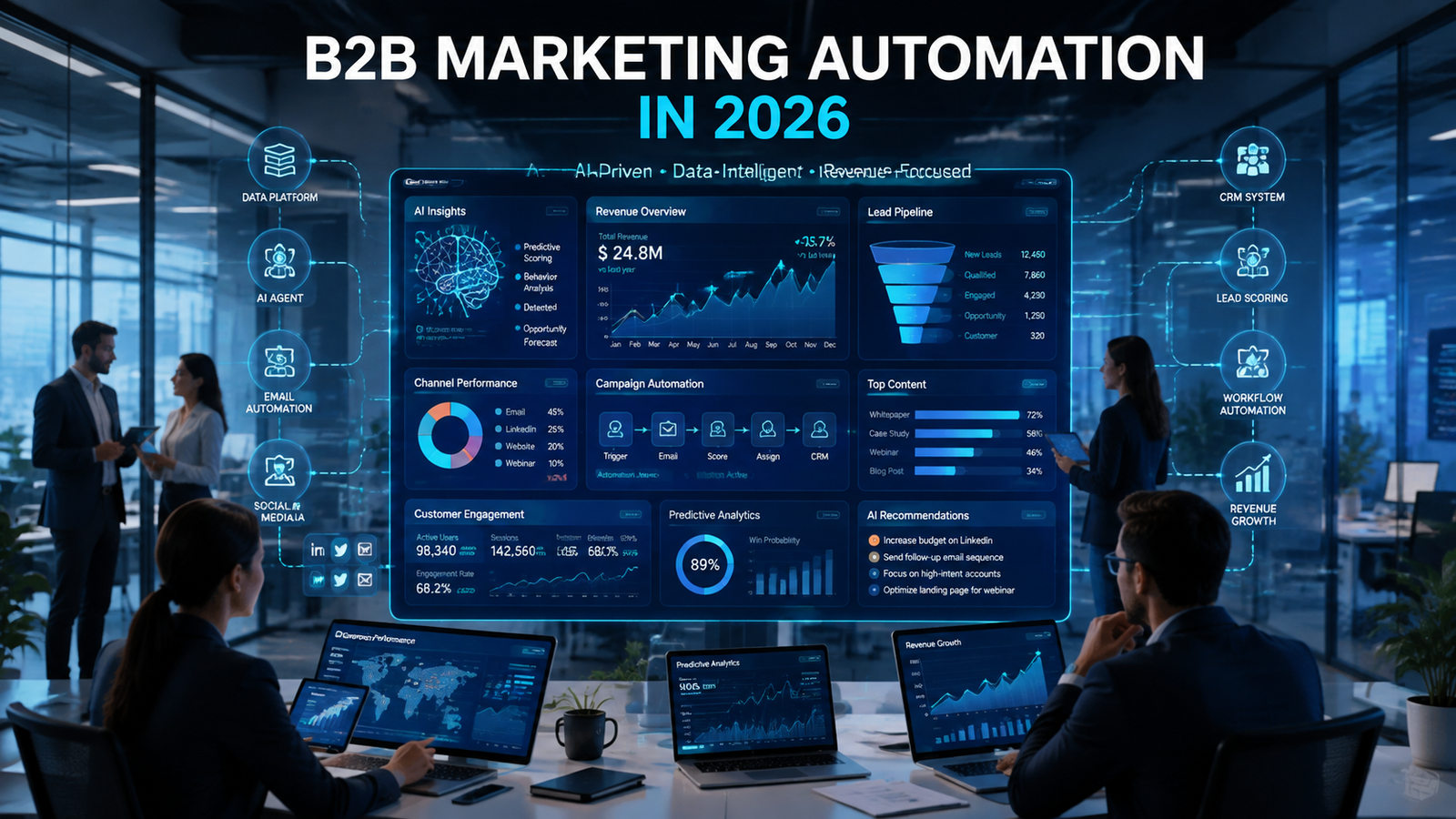
AI agents can support the workflow by analyzing information and triggering appropriate actions. You can also learn more about B2B Marketing Automation.
This can improve speed and reduce manual work.
5. Faster Customer Engagement
Customers expect timely responses.
If someone shows strong interest in a product, waiting several days to respond may reduce the opportunity.
AI-powered systems can monitor engagement signals and help teams respond faster.
For example, an AI agent may identify when a prospect:
- Repeatedly visits a pricing page
- Downloads multiple resources
- Attends a webinar
- Engages with product content
The system can then recommend an appropriate next step.
This does not mean every customer interaction should be fully automated.
Complex conversations still benefit from human involvement.
The best approach is using AI to identify opportunities while allowing people to build meaningful relationships.
6. Continuous Campaign Optimization
Campaign optimization is usually an ongoing process.
Marketers need to monitor:
- Engagement
- Conversion
- Audience behavior
- Channel performance
- Content effectiveness
AI agents can assist by continuously reviewing available data.
They may identify patterns or performance changes that require attention.
For example, an agent could flag:
- A sudden drop in email engagement
- An audience segment with strong conversion
- A campaign generating poor-quality leads
- Content receiving unexpected interest
This gives marketers faster access to useful insights.
7. Better Sales and Marketing Alignment
Sales and marketing alignment remains a major challenge.
Marketing teams may focus on engagement and lead generation, while sales teams focus on opportunities and revenue.
A shared AI-powered system can help both teams access better customer context.
For example, when a lead is transferred to sales, an AI agent could provide a summary including:
- Company information
- Recent engagement
- Content consumed
- Product interests
- Possible buying signals
This gives sales representatives more context before starting a conversation.
How to Use AI Agents in Marketing
Businesses do not need to transform every process immediately.
A better approach is to start with one clear use case.
Step 1: Identify Repetitive Tasks
Look for activities that consume time but do not require constant human creativity.
Examples include:
- Lead research
- Data enrichment
- Campaign reporting
- Audience segmentation
- Follow-up workflows
- Performance monitoring
These tasks may be good candidates for AI assistance.
Step 2: Define Clear Goals
Every AI agent should have a purpose.
For example:
- Improve lead qualification
- Reduce reporting time
- Improve personalization
- Increase campaign efficiency
- Identify customer intent
Avoid implementing AI simply because it is a popular trend.
Step 3: Connect Reliable Data Sources
AI performance depends heavily on data quality.
Relevant systems may include:
- CRM platforms
- Marketing automation platforms
- Website analytics
- Customer data platforms
- Sales engagement tools
Before adding AI agents, businesses should review data quality and system integrations.
Step 4: Start With Human Oversight
AI should initially support decisions rather than make every decision independently.
Marketing teams should review outputs and monitor performance.
This is especially important for:
- Customer communication
- Brand messaging
- Budget decisions
- Sensitive customer data
Step 5: Measure Results
Track whether the AI implementation is actually improving business outcomes.
Useful metrics may include:
- Time saved
- Workflow efficiency
- Lead quality
- Campaign performance
- Conversion rates
- Sales response time
Common Mistakes to Avoid
Using AI Without a Clear Strategy
Adding AI tools without a clear purpose can create unnecessary complexity.
Start with a business problem.
Expecting Fully Autonomous Marketing
AI agents are powerful, but they are not perfect.
They can misunderstand context or produce inaccurate results.
Human review remains important.
Ignoring Data Quality
Poor data can lead to poor recommendations.
Duplicate, outdated, or incomplete information should be addressed.
Automating Every Customer Interaction
Not every interaction should be automated.
Customers still value authentic communication.
Use automation for repetitive tasks while keeping human interaction for important conversations.
Forgetting About Integration
An isolated AI tool may provide limited value.
The greatest benefits often come when AI works with existing marketing and sales systems.
Best Practices for AI Agents in Marketing
Start Small
Choose one workflow and test it before expanding.
Keep Humans in Control
AI should support marketing teams, not operate without appropriate oversight.
Focus on Data Governance
Create clear rules around how customer data is collected, stored, and used.
Review AI Performance Regularly
Monitor outputs and improve workflows over time.
Prioritize Customer Value
Do not use AI only to increase automation.
Use it to create better and more relevant customer experiences.
Build Connected Workflows
AI becomes more useful when connected to the broader marketing ecosystem.
The Future of AI Agents in Marketing
The future of marketing will likely involve teams working alongside increasingly capable AI systems.
AI agents may take on more responsibilities across:
- Campaign planning
- Customer research
- Lead qualification
- Content operations
- Workflow management
- Performance analysis
Instead of replacing marketers, this technology may change how marketing roles operate.
Marketers will likely spend less time on repetitive operational tasks and more time on:
- Strategy
- Creative direction
- Customer understanding
- Brand building
- Business decisions
The most successful organizations will not simply adopt the largest number of AI tools.
They will build connected systems where people, data, automation, and AI work together.
Frequently Asked Questions About AI Agents in Marketing
What are AI agents in marketing?
AI agents in marketing are software systems that can analyze data, make recommendations, and perform marketing tasks with some level of autonomy while working within defined rules and human oversight.
How are AI agents different from marketing automation?
Traditional marketing automation follows predefined workflows, while AI agents can analyze context, adapt actions, and recommend next steps based on changing customer and campaign data.
How can B2B companies use AI agents?
B2B teams can use AI agents for prospect research, lead qualification, audience segmentation, personalization, campaign monitoring, CRM updates, and sales handoff.
Can AI agents replace marketers?
AI agents can automate repetitive work and support decisions, but strategy, brand judgment, customer relationships, and oversight still require human involvement.
Final Thoughts
AI Agents in Marketing represent an important step beyond traditional marketing automation.
They can help businesses connect data, analyze customer behavior, automate workflows, and support faster decision-making.
However, successful implementation requires more than technology.
Businesses need clear goals, reliable data, connected systems, and human oversight.
The best use of AI Agents in Marketing is not replacing marketers. It is removing repetitive work and giving teams better information to make smarter decisions.
As AI capabilities continue to develop, marketing teams that learn how to combine human creativity with intelligent automation will be better prepared for the future.