Introduction
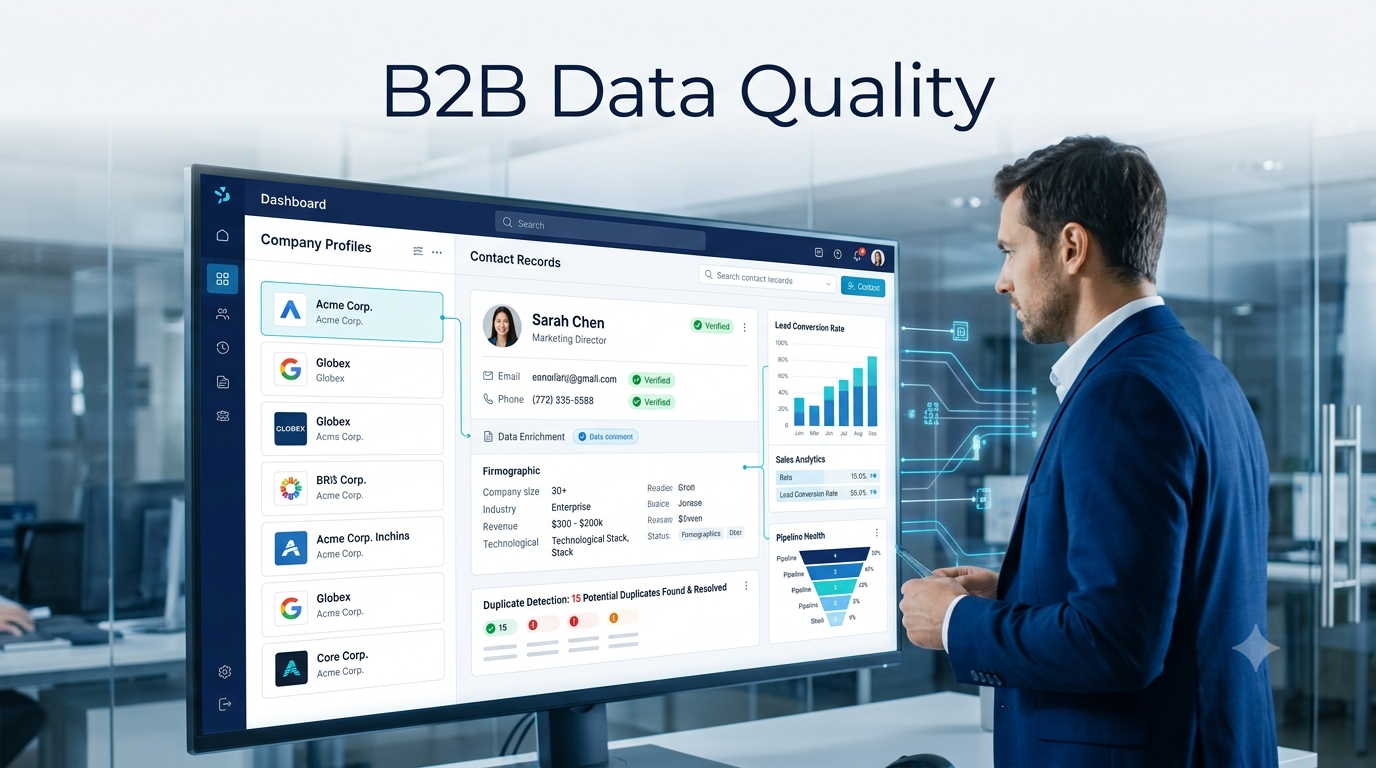
B2B data quality measures how accurate, complete, consistent, current and useful a company’s prospect and customer data is.
The most important areas of B2B data quality include data accuracy, data freshness, completeness, consistency, uniqueness and relevance. For sales teams, these factors determine whether contact and account information can actually be trusted during prospecting and outreach.
Strong data quality improves lead validation, segmentation, sales targeting, automation and reporting.
But what happens when that data is outdated, incomplete, duplicated, or inaccurate?
The answer is simple: teams waste time.
A sales representative may contact someone who has already left a company. A marketing campaign may be sent to invalid email addresses. Multiple records for the same prospect may create confusion inside the CRM. These small problems can quickly affect campaign performance and sales productivity.
Strong B2B Data Quality helps businesses avoid these issues. By validating, enriching, cleaning, and maintaining prospect information, companies can give their sales teams more reliable data and help them focus on genuine opportunities.
In this guide, we will explore what B2B data quality means, why it matters in 2026, how it improves lead validation, and the practical steps businesses can take to build a more reliable prospect database. You can also show more about B2B Data Enrichment.
Table of Contents
What Is B2B Data Quality?
B2B data quality refers to how accurate, complete, consistent, relevant, and up-to-date business data is.
B2B databases commonly contain information such as:
- Company names
- Business email addresses
- Job titles
- Phone numbers
- Industry
- Company size
- Revenue information
- Location
- Website domains
- Technology usage
- Buying signals
- Account ownership
High-quality data means this information is reliable enough to support sales, marketing, customer success, and business decisions.
Poor-quality data creates the opposite effect. A company may have thousands of records in its CRM, but if many are outdated or incorrect, the database may be far less useful than it appears.
Key dimensions of B2B data quality
There are several important dimensions businesses should monitor:
| Dimension | What it means |
| Accuracy | Information is correct |
| Completeness | Required fields are populated |
| Consistency | Data follows the same format across systems |
| Freshness | Information is current |
| Uniqueness | Duplicate records are controlled |
| Relevance | Data is useful for business decisions |
These dimensions work together. A database can be accurate today but become unreliable if it is not regularly maintained.
B2B Data Freshness: Why Current Data Matters
B2B data freshness measures how recently contact and company information has been verified or updated.
A record can be accurate when it is first created and still become unreliable later.
Common changes include:
- Employees changing companies
- Job-title changes
- Email addresses becoming invalid
- Company mergers or acquisitions
- Domain changes
- Office relocations
- Changes in account ownership
For sales teams, stale data can lead to wasted outreach, incorrect routing and poor personalization.
Businesses should therefore track when important fields were last verified instead of relying only on a single overall database accuracy score.
Why B2B Data Quality Matters in 2026
B2B buying journeys are becoming more complex. Marketing teams use CRM systems, marketing automation platforms, intent data, enrichment tools, analytics platforms, and AI-powered solutions to understand potential customers.
All these systems depend on data.
If the underlying information is unreliable, automation can simply make bad decisions faster.
For example, an inaccurate database could cause an automated campaign to:
- Contact the wrong person
- Send irrelevant content
- Target companies outside the ideal customer profile
- Assign leads to the wrong sales representative
- Waste sales development resources
- Produce misleading campaign reports
Strong B2B data quality creates a more dependable foundation for these activities.
B2B Data Accuracy vs Data Freshness
| Metric | What It Measures |
| Data Accuracy | Whether the information is correct |
| Data Freshness | Whether the information is still current |
| Completeness | Whether required fields are available |
| Consistency | Whether data follows the same standards |
| Uniqueness | Whether duplicates are controlled |
How Should Sales Teams Handle Outdated Contact Information?
Sales teams should identify outdated records, verify current employment and contact information, update CRM fields, remove or suppress invalid contacts, and reassign accounts when ownership or company details change.
A practical process includes:
- Flag records that have not been verified recently.
- Revalidate email addresses and domains.
- Check job title and company changes.
- Update enrichment fields.
- Remove duplicates.
- Suppress invalid contacts.
- Record the latest verification date.
This helps sales representatives avoid wasting time on contacts who are no longer relevant or reachable.
How to Measure B2B Data Quality
Improving B2B data quality starts with measuring it.
Without clear metrics, it can be difficult to understand whether a database is actually becoming more accurate, complete, and useful over time.
Businesses can monitor several practical data quality indicators.
1. Data Accuracy Rate
Data accuracy measures how much of your database contains correct information.
This can include:
- Correct company names
- Valid job titles
- Accurate business email addresses
- Correct phone numbers
- Updated company information
A simple formula is:
Data Accuracy Rate = Verified Correct Records ÷ Total Records × 100
For example, if 900 out of 1,000 reviewed records are accurate, the data accuracy rate is 90%.
2. Data Completeness Rate
Data completeness measures how many important fields are properly filled in.
For B2B databases, important fields may include:
- Company name
- Email address
- Job title
- Industry
- Company size
- Location
- Website domain
- Account owner
A database may contain valid contacts, but if key fields are missing, it can still be difficult to segment, qualify, or personalize campaigns.
3. Duplicate Record Rate
Duplicate records can create confusion across marketing and sales systems.
Businesses can measure the percentage of duplicate contacts or accounts inside the CRM.
Duplicate Rate = Duplicate Records ÷ Total Records × 100
A high duplicate rate can affect lead ownership, campaign reporting, sales outreach, and customer records.
4. Email Validity Rate
Email validity measures how many business email addresses are active and deliverable.
This can help teams reduce:
- Email bounces
- Invalid outreach
- Wasted campaign sends
- Poor database hygiene
Businesses can regularly validate email addresses before adding new contacts to the CRM.
5. Data Freshness
B2B information changes constantly.
Employees change companies, job titles change, businesses relocate, and companies merge or rebrand.
Data freshness measures how recently a record was verified or updated.
For example, businesses may track the percentage of records verified within the last:
- 30 days
- 90 days
- 6 months
- 12 months
The ideal review period depends on the type of data and how frequently the database changes.
6. Enrichment Coverage
Enrichment coverage measures how many records contain the additional business information needed for targeting and qualification.
This may include:
- Industry
- Employee range
- Revenue range
- Seniority
- Headquarters location
- Technology usage
- Company size
Higher enrichment coverage can support better segmentation, lead scoring, and campaign personalization.
7. CRM Data Error Rate
CRM data error rate measures records that contain problems such as:
- Missing required fields
- Invalid formatting
- Incorrect account ownership
- Outdated lifecycle stages
- Inconsistent company names
- Incorrect status values
Tracking these issues can help businesses identify where data-entry or process problems are happening.
Key B2B Data Quality Metrics to Monitor
A practical B2B data quality dashboard can track:
- Accuracy rate
- Completeness rate
- Duplicate rate
- Email validity rate
- Data freshness
- Enrichment coverage
- CRM error rate
The goal is not necessarily to achieve perfect data.
The goal is to continuously improve the reliability of the information used by marketing, sales, operations, and leadership teams.
By monitoring these metrics regularly, businesses can identify weak areas in their database and improve the processes used to validate, clean, enrich, and maintain B2B data.
7 Powerful Benefits of Better B2B Data Quality
1. Improve Lead Validation
Lead validation helps businesses determine whether a prospect is genuine, relevant, and worth pursuing.
A validated lead should have useful information that allows marketing and sales teams to understand who the prospect is and whether the company fits their target market.
Data quality supports this process by helping teams verify details such as:
- Company information
- Professional email addresses
- Job roles
- Industry
- Company size
- Geographic location
- Account status
Instead of treating every new record as an equally valuable lead, businesses can use reliable information to prioritize the right opportunities.
2. Increase Sales Accuracy
Sales teams rely heavily on account and contact information.
If a salesperson has the wrong job title, outdated company information, or an incorrect contact record, outreach can quickly become ineffective.
Accurate data allows sales representatives to understand accounts more clearly before starting a conversation.
For example, knowing that a prospect recently moved into a senior decision-making role may help a salesperson personalize outreach more effectively.
Better information does not replace good sales skills, but it gives salespeople a stronger starting point.
3.What Is Sales Data Quality?
Sales data quality refers to the reliability of customer, prospect and account information used by sales teams.
High-quality sales data should be accurate, current, complete and relevant enough to support:
- Prospecting
- Account research
- Territory planning
- Lead routing
- Personalization
- Pipeline reporting
- Sales forecasting
Poor sales data quality can reduce productivity because representatives spend more time correcting records instead of engaging relevant prospects.
4. Reduce Duplicate and Outdated Records
Duplicate records are a common problem in B2B databases.
A single company might appear several times because of:
- Different company name formats
- Multiple website domains
- Data imported from different platforms
- Employees changing roles
- Manual CRM entry
- Merged or acquired businesses
Regular deduplication can create a cleaner customer and prospect database.
Businesses should also identify inactive contacts and outdated company records instead of allowing them to remain indefinitely.
5. Strengthen Audience Segmentation
Accurate data makes segmentation more useful.
Marketing teams can create audiences based on factors such as industry, company size, location, job role, technology usage, or account characteristics.
For example, a software company might create separate campaigns for:
- Enterprise technology companies
- Mid-market financial organizations
- Small professional-services firms
Reliable firmographic information makes these segments more meaningful.
6. Make Intent Data More Useful
Intent data can help businesses identify organizations showing potential interest in a topic, product, or solution.
However, intent signals become much more valuable when they are connected to accurate account information.
Imagine an organization showing strong interest in a particular solution. If the underlying account data is incomplete or incorrectly matched, sales teams may struggle to act on the signal.
Combining reliable account data with intent signals can provide a clearer picture of which companies deserve attention.
7. Improve Marketing Automation
Marketing automation depends on rules, triggers, workflows, and customer information.
When CRM records are accurate, businesses can create better workflows.
For example:
- A new prospect enters the database.
- The company is matched against the ideal customer profile.
- Contact information is validated.
- Relevant firmographic information is added.
- The prospect is assigned to an appropriate segment.
- A personalized campaign begins.
Reliable data helps reduce unnecessary manual work and improves the consistency of automated campaigns.
8. Support Better Revenue Decisions
Data quality is not only a marketing or sales issue.
Leadership teams also use business data to evaluate pipeline performance, market opportunities, customer segments, and revenue trends.
If reports are based on inconsistent or outdated records, business decisions can become less reliable.
Maintaining clean data therefore supports better decision-making across the entire revenue organization.
How to Improve B2B Data Quality
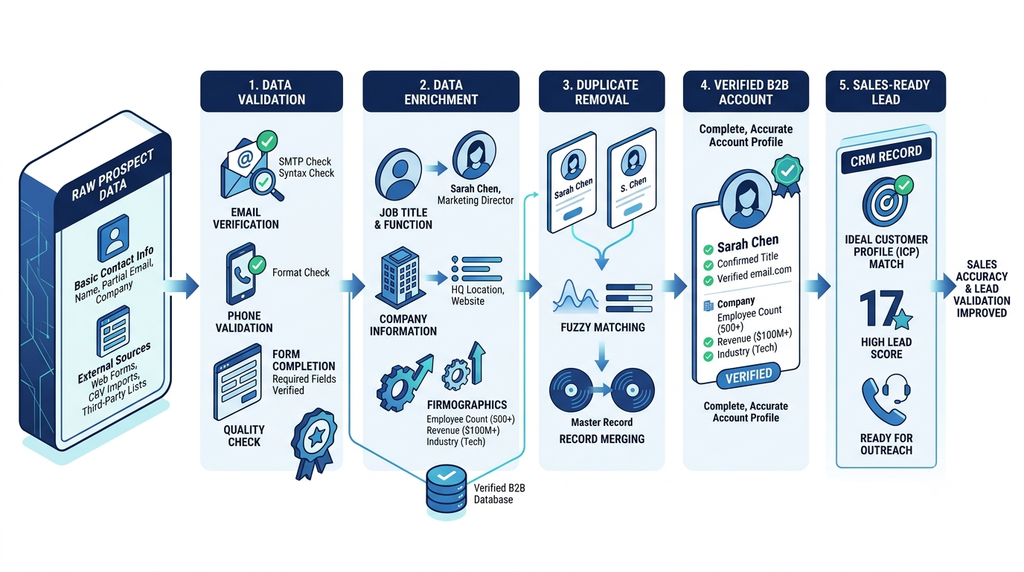
Improving data quality does not require fixing an entire database overnight.
A practical approach is to create a repeatable data management process.
Step 1: Define Your Data Standards
First, decide what a high-quality record looks like.
Create rules for required fields, naming conventions, email formats, company information, job titles, and account ownership.
For example, decide whether your CRM should store company names using legal names, brand names, or standardized business names.
Clear standards make future data maintenance easier.
Step 2: Validate New Leads Before They Enter Your CRM
Prevention is often easier than cleaning thousands of records later.
Use lead validation processes to check important information before records are added to your main database.
Depending on your business, validation may include:
- Email verification
- Domain matching
- Company verification
- Duplicate detection
- Job-title checks
- Firmographic matching
Step 3: Enrich Incomplete Records
Some prospects may have valid contact information but limited company information.
Data enrichment can help fill important gaps.
For example, an existing contact record might be enriched with:
- Industry
- Employee range
- Company revenue range
- Headquarters location
- Website
- Technology information
- Seniority level
Enrichment should focus on information that supports real business decisions rather than collecting unnecessary fields.
Step 4: Create a Regular Data-Cleaning Process
Data quality should not be treated as a one-time project.
Set a regular schedule for checking:
- Duplicate records
- Invalid emails
- Outdated job titles
- Closed companies
- Missing fields
- Incorrect account ownership
- Inconsistent formatting
The frequency can depend on the size and speed of your database.
Step 5: Connect Data Quality With Your CRM Strategy
Your CRM should have clear ownership and rules for data management.
Teams should understand:
- Who creates records
- Who validates records
- Who updates account information
- How duplicates are handled
- Which fields are required
- When inactive records should be reviewed
This creates accountability and reduces the chances of the database becoming messy again.
Common B2B Data Quality Mistakes to Avoid
Relying on Manual Data Entry Alone
Manual entry can introduce spelling errors, duplicates, missing fields, and inconsistent formatting.
Automation and validation can reduce these problems.
Buying Data Without Validation
A purchased database is not automatically a high-quality database.
Businesses should evaluate the source, freshness, coverage, and relevance of external data before using it.
Collecting Too Much Information
More data does not always mean better data.
Focus on the fields that genuinely support prospecting, segmentation, personalization, and decision-making.
Ignoring Data Decay
People change jobs. Companies grow, merge, relocate, rebrand, or close.
B2B data therefore changes over time. Regular verification is essential.
Measuring Database Size Instead of Data Value
Having one million records may sound impressive, but database size alone does not indicate quality.
A smaller, highly relevant, well-maintained database can be more valuable than a much larger collection of unreliable records.
Best Practices for Maintaining B2B Data Quality
Businesses can create a stronger data foundation by following a few practical principles.
Establish ownership: Assign responsibility for data governance and maintenance.
Standardize fields: Use consistent formats across your CRM and marketing systems.
Validate continuously: Check new records before they become part of the permanent database.
Remove duplicates: Use matching rules and regular database audits.
Enrich strategically: Add information that helps sales and marketing teams take action.
Monitor data freshness: Review records regularly instead of assuming they remain accurate forever.
Connect data sources carefully: Make sure CRM, marketing automation, enrichment, and analytics platforms use compatible information.
Measure quality: Track indicators such as duplicate rates, missing fields, invalid contacts, and records requiring review.
Want a Deeper B2B Data Quality Framework?
Explore our B2B Data Quality & Revenue Intelligence in 2026 white paper for a deeper look at building trusted data foundations for marketing, sales, AI and revenue operations.
Frequently Asked Questions
1. What is B2B data quality?
B2B data quality refers to how accurate, complete, consistent, relevant, unique, and up-to-date business information is. High-quality B2B data helps sales and marketing teams work with reliable company and contact information.
2. Why is B2B data quality important for lead generation?
B2B data quality improves lead generation by helping businesses identify valid prospects, remove duplicate records, verify contact information, and focus sales efforts on leads that match their target audience.
3. How does B2B data quality improve lead validation?
Good data quality helps businesses verify details such as company name, professional email address, job title, industry, company size, location, and account status before a lead is passed to sales.
4. What causes poor B2B data quality?
Common causes include outdated contact information, manual data-entry errors, duplicate records, incomplete fields, inconsistent formatting, job changes, company mergers, and unverified third-party data.
5. How often should B2B data be cleaned?
B2B data should be reviewed regularly because business information changes frequently. The right schedule depends on the size and activity of the database, but businesses should continuously validate new records and perform periodic database audits.
6. What is the difference between B2B data cleaning and data enrichment?
Data cleaning focuses on correcting, removing, or standardizing inaccurate and duplicate information. Data enrichment adds useful missing information such as industry, company size, revenue range, seniority, location, or technology usage.
7. How can businesses reduce duplicate CRM records?
Businesses can reduce duplicates by using standardized naming rules, email and domain matching, duplicate-detection tools, CRM validation rules, and regular database audits.
8. Can bad data affect marketing automation?
Yes. Poor-quality data can cause marketing automation systems to send content to the wrong contacts, assign leads incorrectly, create inaccurate segments, and trigger irrelevant campaigns.
9. How does B2B data quality help sales teams?
Reliable data gives sales representatives better information about prospects and accounts. This can improve targeting, personalization, lead prioritization, account research, and overall sales productivity.
10. What B2B data fields should businesses validate?
Important fields usually include business email address, company name, website domain, job title, industry, company size, location, phone number, account ownership, and other information used for segmentation or qualification.
Final Thoughts
B2B Data Quality is no longer just about keeping a database organized. It has become an important part of effective lead generation, sales operations, marketing automation, and customer engagement.
When prospect information is inaccurate, sales teams waste time, campaigns become less effective, and reporting becomes less reliable.
A strong process for validation, enrichment, duplicate removal, and ongoing maintenance can help businesses build more reliable prospect databases.
The goal is not simply to collect more contacts.
The real goal is to give sales and marketing teams the right information at the right time.
Businesses that invest in B2B Data Quality can create cleaner CRM systems, improve lead validation, support more accurate sales decisions, and build stronger foundations for revenue growth.