Introduction
Search is changing quickly. B2B buyers are no longer relying only on traditional search results to research software, services, vendors, and business solutions.
AI-powered search experiences can summarize information, answer detailed questions, compare options, and help buyers discover companies without requiring them to visit dozens of websites.
This shift makes AI Search for B2B Brands an important consideration for modern Marketing Technology teams.
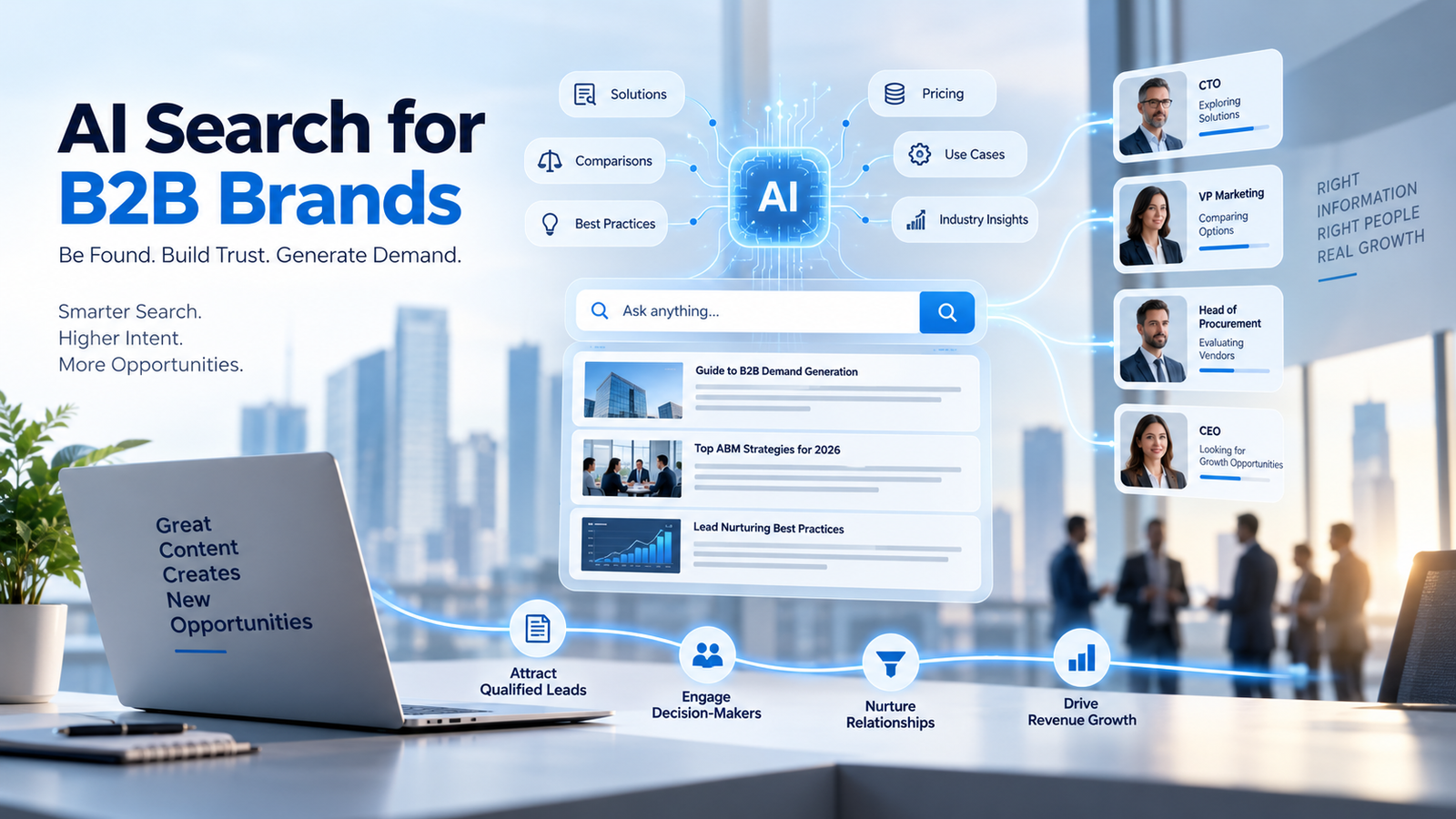
AI search for B2B brands is changing how buyers discover information, research solutions, and evaluate potential vendors.
Your next B2B customer may not start their research with a traditional Google search. They may start with a question:
- How can we improve B2B lead quality?
- What is the best way to identify companies showing buying intent?
- How can AI improve our demand generation strategy?
- What should we look for in a B2B data provider?
These conversational searches create a new visibility challenge for B2B companies.
Traditional SEO still matters, but ranking for a keyword is no longer the entire picture. B2B brands also need content that answers real buyer questions, demonstrates expertise, provides useful context, and helps prospects make better decisions.
This guide explains seven practical strategies B2B brands can use in 2026 to improve their visibility across traditional and AI-powered search.
Table of Contents
What Is AI Search for B2B Brands?
AI Search for B2B Brands refers to the use of AI-powered search and discovery experiences to help business buyers find information about companies, products, services, and solutions.
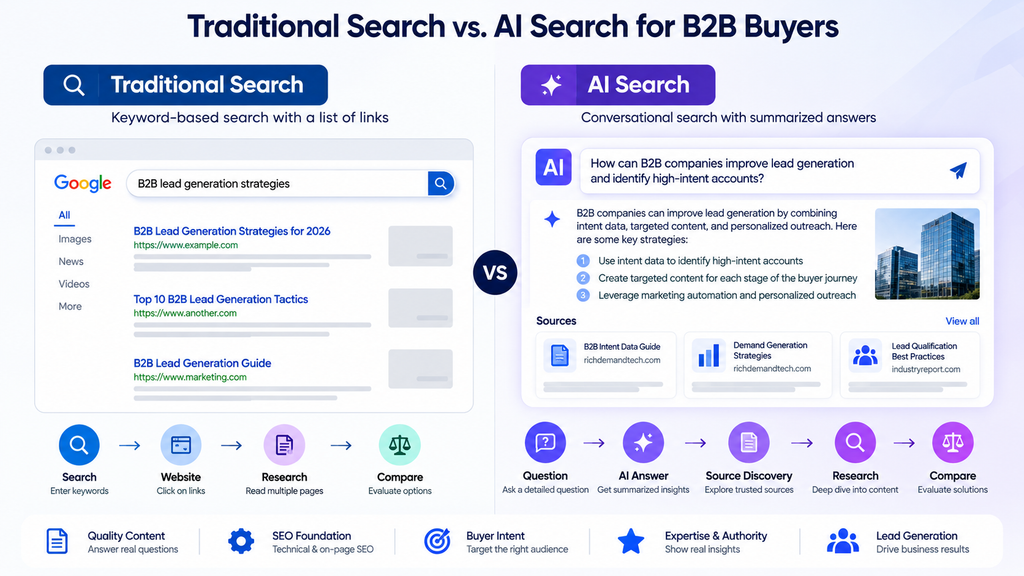
Traditional search generally provides a list of links. AI-powered search can provide a more conversational experience by interpreting a question and presenting a synthesized response.
For example, a buyer might search:
“What are the best ways to improve B2B lead quality?”
Instead of simply receiving a list of articles, the buyer may receive an AI-generated overview that draws information from multiple sources.
This changes how businesses need to think about visibility.
A company should not focus only on ranking a single webpage. It should build a trustworthy digital presence containing useful information that clearly demonstrates expertise.
That includes:
- Helpful educational content
- Strong website architecture
- Clear service and product information
- Reliable business data
- Expert insights
- Original research
- Strong internal linking
- Consistent brand information
- Relevant third-party references
In other words, AI Search for B2B Brands is closely connected to the broader shift from traditional keyword search toward intent-driven information discovery.
Why AI Search for B2B Brands Matters in 2026
B2B purchasing is already research-heavy.
Buyers often investigate a company before speaking with sales. They may compare vendors, read educational content, evaluate use cases, check customer evidence, and look for answers to specific business problems.
AI-powered search can influence this research process.
For Marketing Technology teams, that means the old approach of publishing content simply to target keywords is becoming less effective.
Content needs to answer real questions.
It also needs to demonstrate expertise and provide enough context for readers—and search systems—to understand what the company actually knows.
The rise of AI Search for B2B Brands does not mean traditional SEO is dead.
Instead, SEO becomes part of a broader visibility strategy.
Technical SEO, useful content, structured information, internal linking, website authority, and user experience still provide an important foundation.
How AI Search Is Changing the B2B Buyer Journey
The traditional B2B journey often looks like this:
Search → Website → Research → Comparison → Shortlist → Sales Conversation
AI-assisted research can introduce another layer:
Question → AI-assisted answer → Brand/source discovery → Research → Comparison → Shortlist → Website → Sales Conversation
This means B2B marketers need to think beyond individual keywords.
Instead, they should consider the questions a buyer is likely to ask before, during, and after discovering a company.
AI Search vs. Traditional SEO: What B2B Marketers Need to Know
Instead, B2B companies should build on their existing SEO foundation while creating content that works well for conversational and AI-assisted discovery.
| Area | Traditional SEO | AI Search |
|---|---|---|
| Main focus | Rankings and organic visibility | Useful answers and discovery |
| Search behavior | Keywords and shorter queries | Conversational questions |
| Content strategy | Search intent and keyword relevance | Questions, context, expertise, and usefulness |
| Content structure | Headings, keywords, links, optimized pages | Clear answers, context, examples, related topics |
| Measurement | Rankings, clicks, impressions, traffic | Visibility, engagement, qualified traffic, leads |
| Best approach | Strong SEO foundation | SEO + authoritative, useful content |
The strongest strategy is not choosing between SEO and AI search.
It is building a website that performs well in traditional search while providing information that is genuinely useful to buyers and AI-powered discovery systems.
7 Powerful Benefits of AI Search for B2B Brands
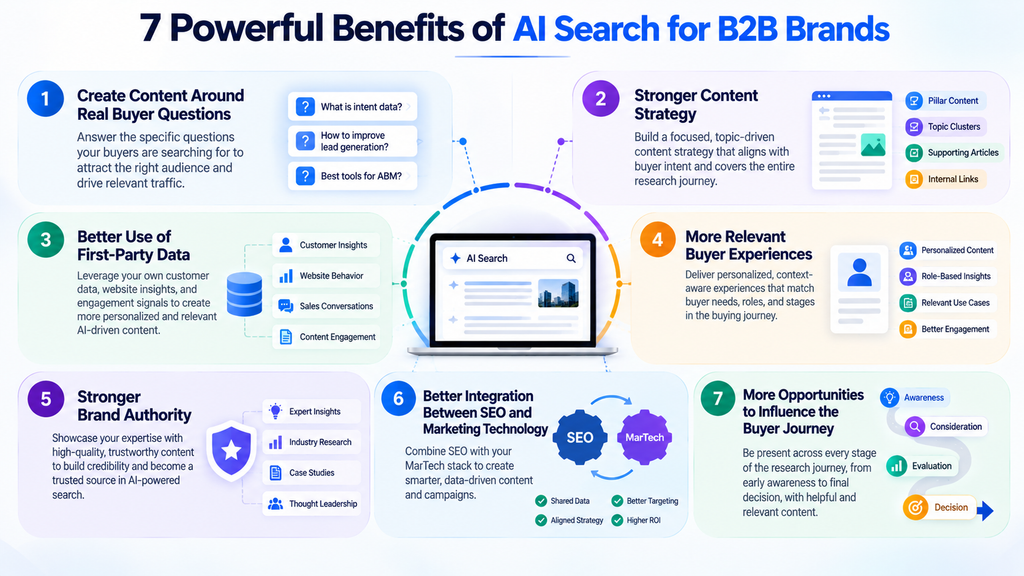
1. Create Content Around Real Buyer Questions
One of the biggest opportunities with AI Search for B2B Brands is becoming visible when buyers ask questions related to your expertise.
A buyer may not initially search for your company name.
They may search for:
- How to improve lead generation
- How to identify high-intent accounts
- How to automate B2B marketing
- How to improve customer data
- How to build an account-based marketing strategy
If your website consistently provides useful answers to these questions, your brand has more opportunities to enter the research journey.
The focus should be on solving the buyer’s problem rather than simply promoting a service.
2. Stronger Content Strategy
AI search makes content quality increasingly important.
Instead of producing dozens of similar articles, Marketing Technology teams should create content around specific buyer needs.
For example, instead of publishing a generic article about “B2B Marketing,” create useful resources such as:
- B2B marketing automation implementation guides
- Intent data strategy guides
- Lead qualification frameworks
- Data quality checklists
- B2B buyer journey examples
- Account prioritization frameworks
This approach gives your website greater topical depth.
For AI Search for B2B Brands, the objective is to create a connected library of content that answers different questions across the buyer journey.
3. Better Use of First-Party Data
AI search strategy should not exist separately from your data strategy.
Marketing Technology teams already work with website analytics, CRM information, marketing automation data, customer interactions, and other first-party signals.
These sources can help teams understand what prospects actually care about.
For example, if sales teams repeatedly receive questions about data enrichment, that could indicate an opportunity to create deeper content around the subject.
The important point is simple: data should inform content decisions.
Instead of guessing what buyers want to read, marketing teams can use real customer and prospect signals to identify useful topics.
4. More Relevant Buyer Experiences
AI-powered discovery is increasingly conversational.
That means buyers can ask longer and more specific questions.
For example:
“Which B2B marketing approach is best for a company targeting enterprise technology buyers?”
A useful content strategy should anticipate these detailed questions.
Marketing Technology teams can create comparison pages, guides, FAQs, use cases, implementation articles, and industry-specific resources.
This makes the website more useful throughout the buyer journey.
It also supports AI Search for B2B Brands by creating content around intent rather than relying entirely on short keywords.
5. Stronger Brand Authority
Being visible in search is not only about traffic.
B2B buyers also need confidence.
A company with detailed educational content, expert opinions, case studies, research, and clear business information can establish greater credibility.
Marketing Technology teams should therefore think beyond rankings.
Ask:
Does our digital presence demonstrate that we understand the problem our buyers are trying to solve?
If the answer is yes, the company has a stronger foundation for AI-powered discovery.
6. Better Integration Between SEO and Marketing Technology
AI search should not be treated as a project owned only by the SEO team.
It can involve:
- SEO
- Content marketing
- Demand generation
- Marketing operations
- CRM
- Analytics
- Product marketing
- Sales enablement
This makes AI Search for B2B Brands a cross-functional marketing initiative.
For example, SEO teams can identify search questions, content teams can develop resources, marketing operations can analyze engagement, and sales teams can provide customer questions.
The result is a more connected content strategy.
7. More Opportunities to Influence the Buyer Journey
The B2B buyer journey rarely starts with a sales conversation.
It often starts with a question.
A potential customer identifies a problem, researches possible solutions, compares approaches, and eventually creates a shortlist.
AI-powered search can become part of this process.
Companies that provide useful information early in the journey can potentially build familiarity before a prospect is ready to contact sales.
That makes AI Search for B2B Brands relevant not only to SEO teams but also to demand generation and revenue teams.
How MarTech Teams Can Apply AI Search Strategies
Start With Real Buyer Questions
The easiest starting point is to collect questions from your customers and sales teams.
Look at:
- Sales calls
- Customer support questions
- Demo questions
- Search queries
- Website searches
- Product feedback
- Sales objections
- Frequently asked questions
Turn these questions into useful content.
This is usually more valuable than simply generating articles around random keywords.
Build Topic Clusters
Create groups of related content around important business topics.
For example:
Main Topic: B2B Intent Data
Supporting content could include:
- What is B2B intent data?
- First-party vs. third-party intent data
- How intent data supports lead prioritization
- Intent data use cases
- Intent data implementation challenges
This gives your website a stronger topical structure.
It also creates opportunities for internal links between related resources.
Make Content Easy to Understand
Clear writing matters.
Use:
- Short paragraphs
- Descriptive headings
- Bullet points
- Tables
- Examples
- Definitions
- FAQs
- Clear conclusions
Avoid unnecessary jargon.
If a buyer cannot understand the page quickly, the content is not doing its job.
Strengthen Your Website’s Technical Foundation
AI search does not remove the importance of technical SEO.
MarTech teams should continue monitoring:
- Page speed
- Mobile usability
- Crawlability
- Indexing
- Internal links
- Metadata
- Structured data
- Broken links
- Canonical URLs
- Site architecture
Create Original and Trustworthy Information
Generic content is easy to produce.
Useful expertise is harder to replicate.
B2B brands should consider publishing:
- Original research
- Customer insights
- Expert commentary
- Proprietary frameworks
- Case studies
- Industry analysis
- Practical checklists
- Detailed implementation guides
This can give your content more value than generic articles that simply repeat information already available online.
Common AI Search Mistakes B2B Brands Should Avoid
1. Keyword Stuffing
Repeating the same keyword throughout an article doesn’t make the content more valuable.
Use natural language and related terminology.
2. Publishing Generic AI-Generated Content
AI can help with research and drafting, but publishing generic content without expert review can make an article sound interchangeable with thousands of others.
Add real examples, experience, data, and useful analysis.
3. Writing Only for Search Engines
Your primary audience is still people.
If an article is difficult to read, excessive optimization won’t fix the problem.
4. Ignoring Existing Content
Before creating another article, review what you already have.
Some pages may be better candidates for updating, expanding, combining, or internally linking.
5. Focusing Only on Rankings
A ranking is useful, but it isn’t the final business objective.
Look at whether organic visitors engage with your content and eventually become qualified prospects.
6. Chasing Every New AI Search Trend
AI search is developing quickly.
Don’t rebuild your entire SEO strategy every time a new acronym appears.
Best Practices for B2B Brands Adapting to AI Search
A strong AI search for B2B strategy should follow these principles:
Write for people first.
Make every article useful even if the reader never sees it in an AI-generated answer.
Answer specific questions.
Detailed buyer questions often reveal stronger intent than broad keywords.
Build topical depth.
Cover important subjects from multiple angles instead of publishing disconnected articles.
Use clear structure.
Headings, lists, definitions, examples, and concise explanations make content easier to understand.
Support important claims.
Use credible sources when discussing market trends, technical developments, or research.
Show real expertise.
Add original examples, practical experience, case studies, and opinions where appropriate.
Keep information current.
Review important pages regularly, especially in fast-changing areas such as AI and Marketing Technology.
Connect content with conversion paths.
Every important article should provide an appropriate next step for the reader.
Use AI responsibly.
AI can assist with research and content production, but human review and added value remain essential.
Frequently Asked Questions About AI Search for B2B Brands
1. What is AI search for B2B brands?
AI search for B2B brands refers to search experiences that use artificial intelligence to understand conversational queries and provide more direct, contextual answers to buyers researching business products, services, and solutions.
2. How is AI search different from traditional SEO?
Traditional SEO focuses heavily on improving visibility and rankings in search engines. AI search places greater emphasis on conversational questions, context, useful answers, and information that can support a buyer’s research process.
3. Is SEO still important for AI search?
Yes. Technical SEO, crawlability, indexing, content structure, internal linking, and search relevance remain important foundations. AI search should be treated as an extension of a broader search strategy rather than a replacement for SEO.
4. How can B2B brands improve AI search visibility?
Start by creating useful content around real buyer questions. Build topic clusters, demonstrate expertise, provide original insights, maintain a technically sound website, and create content that helps buyers make informed decisions.
5. What is AEO?
AEO stands for Answer Engine Optimization. It generally focuses on creating content that provides clear, direct answers to questions asked through search and answer-oriented experiences.
6. What is GEO?
GEO commonly refers to Generative Engine Optimization, which focuses on improving the likelihood that content and brands are surfaced or referenced in generative AI search experiences. The terminology and practices are still evolving.
7. How do you measure AI search visibility?
Use a combination of search visibility metrics and business outcomes. Monitor impressions, clicks, rankings, organic traffic, qualified visits, conversions, leads, and opportunities rather than relying on a single metric.
8. How long does AI search optimization take?
There is no fixed timeline. Results depend on factors such as website authority, competition, content quality, technical SEO, search demand, and how consistently the content strategy is implemented.
Final Thoughts
AI Search for B2B Brands represents a major shift in how companies think about digital visibility.
The opportunity is bigger than simply trying to appear in another type of search result.
B2B companies need to become useful sources of information throughout the buyer journey.
That means creating clear content, answering real questions, strengthening SEO foundations, using first-party data, building authority, and connecting marketing technology with content strategy.
For Marketing Technology teams, the best approach is not to chase every new AI trend.
Instead, build a strong digital foundation that helps buyers find, understand, and trust your brand.
Companies that consistently provide useful information will be better positioned as search continues to become more conversational, contextual, and AI-powered.