

Artificial intelligence is becoming an important force in international business. AI and global trade are increasingly connected as companies invest in advanced computing, semiconductor chips, data centers, and digital infrastructure. These investments are creating new opportunities while adding pressure to technology supply chains.
AI is no longer just a software trend. Its growing infrastructure requirements are influencing investment decisions, technology policies, and the way businesses evaluate suppliers and markets.
The relationship between AI and global trade is becoming increasingly important as businesses invest in advanced computing, digital infrastructure, and international technology partnerships.
Governments are also paying closer attention to access to advanced chips, computing capacity, and other critical technologies. As a result, companies operating across borders must consider both commercial opportunities and geopolitical risks.
For business leaders, the key question is simple: how can they prepare for a global economy in which AI and technology are becoming increasingly important to trade?
Table of Contents
How AI and Global Trade Are Connected
AI systems depend on more than software. They require computing hardware, electricity, networking equipment, data centres, and reliable supply chains.
These resources often come from different countries. A company may develop AI software in one market, source chips from another, use cloud infrastructure in a third, and serve customers around the world.
This creates an international network of suppliers, technology providers, and business partners.
Understanding AI and global trade helps companies evaluate technology suppliers, assess international market opportunities, and prepare for changes in global supply chains.
When demand for AI infrastructure grows, it can affect investment priorities and competition for critical components. Trade policies and restrictions can also influence where businesses source products and build new facilities.
For companies, understanding these connections is becoming an important part of strategic planning.
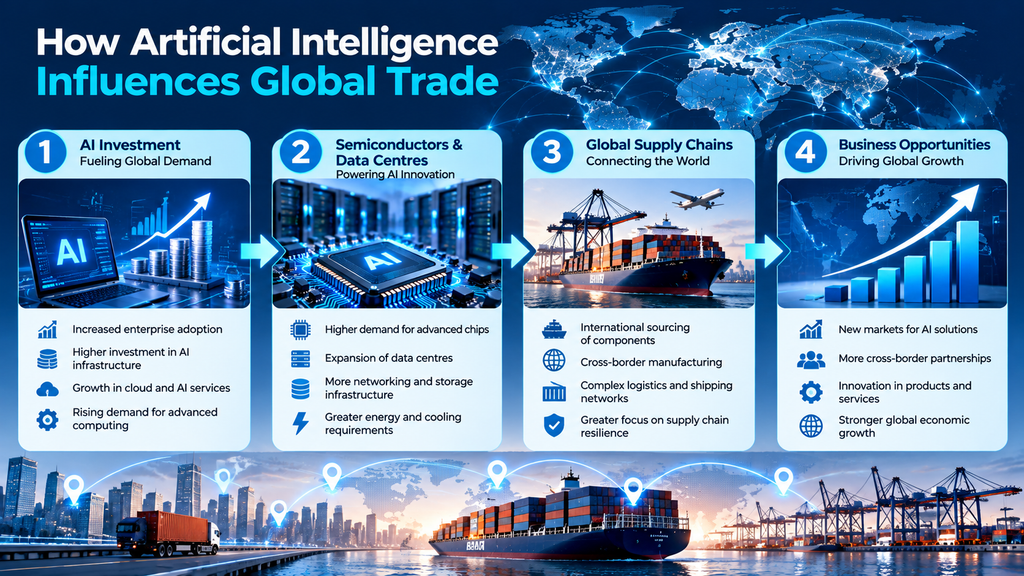
7 Powerful Shifts Reshaping AI and Global Trade
1. AI Infrastructure Is Creating New Business Demand
Companies across industries are exploring AI to improve productivity, automate routine work, analyse information, and support customer service.
Meeting this demand requires investment in computing capacity and supporting infrastructure. Data centres, networking equipment, specialised processors, and energy systems are therefore important parts of the wider AI economy.
This creates opportunities for hardware manufacturers, cloud providers, software companies, and infrastructure businesses.
However, investment also brings challenges. Organisations must evaluate costs, expected returns, and the practical value AI can deliver before committing significant resources.
What businesses should do: Identify where AI can solve a real operational problem. Start with a defined objective rather than investing in technology simply because competitors are doing so.
2. Semiconductor Supply Chains Are Becoming More Strategic
Semiconductors are essential to modern computing, including many AI applications. Producing advanced chips involves specialised manufacturing equipment, materials, technical expertise, and international suppliers.
This makes semiconductor supply chains particularly important to global technology competition.
The connection between AI and global trade is especially visible in the semiconductor industry, where advanced chips and manufacturing equipment depend on international supply networks.
Export restrictions, trade disputes, manufacturing disruptions, or limited access to components can affect businesses that depend on advanced computing hardware.
Companies may respond by diversifying suppliers, maintaining appropriate inventory, or evaluating alternative technology providers.
What businesses should do: Review critical technology dependencies and understand where supply disruptions could affect operations. Avoid relying on a single supplier for components that are essential to business continuity.
3. US–China Technology Competition Is Influencing Business Decisions
The United States and China are major participants in the global technology economy. Competition involving advanced semiconductors, AI capabilities, manufacturing, and technology exports can influence international business decisions.
Government policies may affect which products can be exported, where certain technologies can be supplied, and how companies structure their operations.
Competition involving AI and global trade can influence export policies, technology partnerships, and decisions about where companies source critical products.
For businesses working across multiple markets, these developments can create additional compliance requirements and uncertainty.
Companies should avoid assuming that a product or service available in one country can automatically be sold or deployed in another.
What businesses should do: Monitor official trade announcements, understand applicable export-control rules, and consult qualified legal or compliance professionals when operating in affected markets.
4. Countries Are Competing to Attract Technology Investment
Governments increasingly view AI infrastructure and advanced technology capabilities as important economic priorities.
Countries may seek to attract investment through infrastructure development, research support, workforce programmes, and incentives for technology manufacturing.
These efforts can influence where companies build facilities, establish partnerships, and hire skilled employees.
However, investment decisions depend on more than incentives. Businesses must also consider energy availability, talent, infrastructure, regulations, operating costs, and access to customers.
What businesses should do: Evaluate potential markets using a broad set of commercial factors. Government incentives may be useful, but they should not replace a clear business case.
5. India Has Opportunities in the Expanding AI Economy
India’s technology services industry, software expertise, and large business market create opportunities for participation in the AI economy.
Businesses can explore AI-enabled services, enterprise software, analytics, automation, and solutions that help organisations operate more efficiently.
India can benefit from developments in AI and global trade through technology services, software development, analytics, and international business partnerships.
India can also serve as a base for companies seeking technology talent and international service delivery capabilities.
Realising these opportunities will depend on skills, infrastructure, investment, reliable digital systems, and the ability to build solutions that meet customer needs.
What businesses should do: Look for practical AI applications in software development, customer operations, analytics, and business process improvement. Measure success through productivity, service quality, and customer outcomes.
6. AI Is Changing How Companies Evaluate Business Opportunities
International expansion has always required companies to assess customer demand, competitors, operating costs, and market conditions. AI can help teams analyse large volumes of information and identify patterns that may otherwise be difficult to detect.
For example, an organisation may use analytics to compare market demand, review customer behaviour, or prioritise potential business opportunities.
In B2B marketing, these capabilities can support account research, segmentation, campaign planning, and buyer-intent analysis.
AI does not eliminate uncertainty or guarantee accurate predictions. Results depend on data quality, suitable methods, and human judgement.
What businesses should do: Combine reliable market information with AI-assisted analysis. Validate important findings before using them to make investment or market-entry decisions.
7. Supply-Chain Resilience Is Becoming a Competitive Advantage
Businesses can be affected by changes in trade rules, shipping routes, access to materials, energy costs, and technology availability.
These risks can become more complicated when companies depend on international suppliers or specialised AI infrastructure.
Some organisations may diversify sourcing, develop alternative supplier relationships, or move selected operations closer to important markets. Others may focus on improving visibility into their existing supply chains.
There is no single approach that works for every company. The right strategy depends on cost, risk exposure, product requirements, and customer expectations.
What businesses should do: Identify the suppliers and resources that are most important to operations. Create contingency plans for significant disruptions and review them as business conditions change.
What AI-Driven Global Trade Means for Businesses
The relationship between AI and global trade creates both opportunities and risks. Companies do not need to become AI infrastructure specialists to respond effectively, but they do need to understand how technology developments could affect their industry.
Here are four practical priorities.
Review technology dependencies. Identify critical software, hardware, cloud services, and suppliers. Understand which parts of the business could be affected by restrictions or disruptions.
Track relevant policy changes. Monitor official announcements related to trade, technology exports, data protection, and AI regulation in the markets where your organisation operates.
Invest with clear objectives. Connect AI projects to measurable business outcomes, such as reducing manual work, improving customer service, or increasing operational efficiency.
Improve decision-making with reliable data. Use trusted market information and appropriate analytics to evaluate opportunities. Treat AI-generated insights as inputs to decisions rather than unquestionable facts.
Businesses that understand AI and global trade can make better-informed decisions about technology investments, supplier relationships, and market expansion.
For B2B organisations, these priorities can also support more focused marketing and sales strategies. Better market understanding helps teams identify relevant audiences, develop useful content, and allocate resources more effectively.
How Businesses Can Prepare for the Next Phase of AI and Global Trade
Preparation does not require predicting every geopolitical event or technology breakthrough. It requires building a process for evaluating change.
Start by identifying the developments most likely to affect your organisation. A manufacturer may prioritise component availability, while a software company may focus on cloud infrastructure, data rules, and customer demand.
Next, assign responsibility for monitoring important developments. Depending on the organisation, this may involve procurement, finance, IT, legal, sales, or marketing teams.
Finally, review the information regularly and adjust plans when there is a clear business reason to do so.
Companies that connect technology investment with sound risk management are better positioned to evaluate opportunities without ignoring potential costs.
The Bigger Picture
AI is becoming an important factor in global economic competition, influencing investment decisions, supply-chain strategies, and international business relationships.
For companies, the opportunity lies in using AI to create measurable value while preparing for the risks associated with an increasingly interconnected technology economy.
As demand continues to develop, businesses that combine technology investment with sound planning and a clear understanding of global trade conditions will be better equipped to respond to change.
Final Thoughts
AI and global trade are becoming increasingly connected through semiconductor demand, data-centre investment, international technology competition, and changing business priorities.
These developments can create new opportunities for technology providers and businesses that use AI effectively. They can also introduce supply-chain, regulatory, and investment risks that require careful planning.
As technology markets evolve, AI and global trade will remain important considerations for companies planning international growth and evaluating emerging business opportunities. For more insights into how businesses can use marketing technology and AI to improve decision-making, strengthen customer engagement, and support sustainable growth
For business leaders, the goal should not be to follow every AI headline. It should be to understand which changes matter to their organization and respond with reliable information, practical technology choices, and a clear strategy.
As AI continues to influence international commerce, businesses that combine innovation with disciplined planning will be better prepared to navigate the opportunities ahead.