AI investment concerns are putting global technology stocks under renewed pressure as investors question whether the enormous sums being invested in artificial intelligence (AI) infrastructure will generate sustainable returns. Rising borrowing costs, high company valuations, and uncertainty over future revenue are making investors more cautious about the sector.
According to Reuters, higher interest rates and market sell-offs have created a more challenging funding environment for companies building AI data centres. Some businesses in the data-centre infrastructure sector have also faced project delays or withdrawals as market conditions weaken.
The shift does not necessarily mean that demand for AI is disappearing. Instead, investors are paying closer attention to the cost of building AI infrastructure and how quickly companies can turn that investment into reliable profits.
Table of Contents
Why AI Investment Concerns Are Affecting Technology Stocks
These AI investment concerns reflect a growing focus on financial returns rather than investment announcements alone. Investors want to understand whether spending on advanced chips, cloud computing, and data centres can translate into sustainable revenue and profits.
The AI boom has encouraged technology companies and infrastructure providers to invest heavily in computing capacity, advanced chips, cloud platforms, and data centers. These investments are intended to support the growing use of AI across business operations and consumer services.
However, building this infrastructure requires substantial capital. Companies must pay for servers, specialised semiconductors, electricity, land, cooling systems, and network capacity—often before the full financial benefits become clear.
When investors become less confident about future returns, companies with high valuations or significant financing requirements can come under pressure.
Recent market reporting has highlighted a combination of rising financing costs, inflation concerns, and questions about the sustainability of AI-related spending.
Five Key Factors Behind the Market Pressure
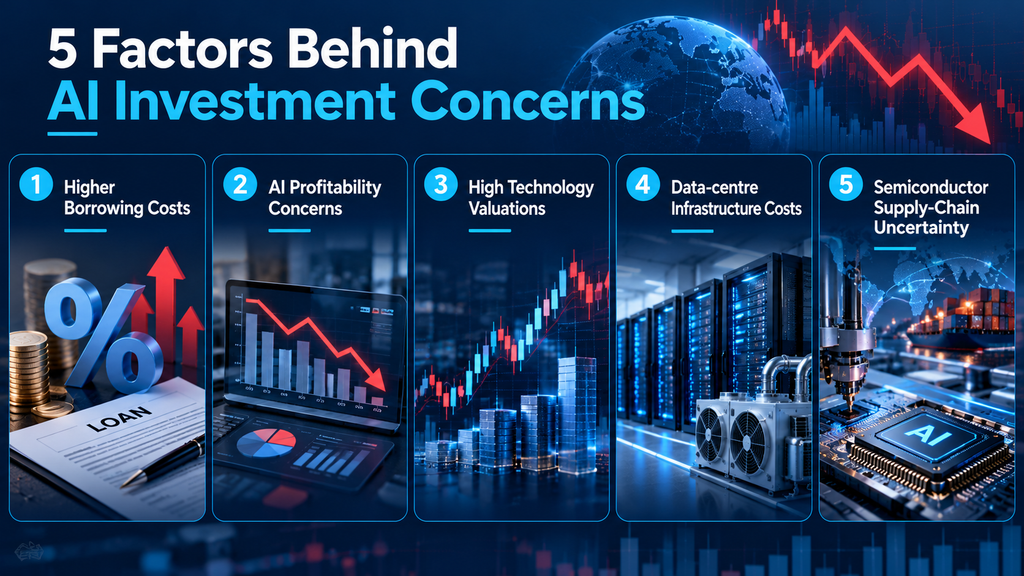
Several factors are contributing to AI investment concerns, including financing costs, questions about profitability, high market valuations, infrastructure expenses, and uncertainty across the semiconductor supply chain.
1. Higher borrowing costs
AI infrastructure projects can require large amounts of upfront funding. When interest rates rise or are expected to remain elevated, financing becomes more expensive.
This can reduce the expected returns on projects that take years to complete. Businesses that depend heavily on borrowed money may face greater pressure to control spending and demonstrate that their investments can generate sufficient revenue.
2. Questions about AI profitability
Businesses are adopting AI for customer service, software development, data analysis, marketing, and other activities. But adoption alone does not guarantee that every AI provider will become profitable.
Investors want clearer evidence that AI products can attract paying customers, retain them over time, and generate revenue that justifies development and operating costs.
For B2B companies, AI-powered B2B marketing offers another example of how emerging AI capabilities can support buyer discovery and engagement.
Companies that demonstrate measurable commercial results may be better positioned than those relying mainly on expectations of future growth.
3. High expectations built into technology valuations
AI-related companies have attracted significant investor attention because of their potential to transform industries. However, when share prices reflect very optimistic growth expectations, even a small change in sentiment can trigger a sharp market reaction.
This creates a challenge for businesses: strong long-term prospects may not always prevent short-term share-price declines if investors believe the expected growth is already reflected in the valuation.
4. Rising data-centre infrastructure costs
AI data centres require computing equipment, reliable electricity, cooling systems, land, and connectivity. Delays, higher construction costs, or changes in financing conditions can affect project economics.
Reuters reported that funding conditions for AI infrastructure developers have become more challenging, while higher energy and land costs add further pressure.
For infrastructure providers, securing customers is only part of the equation. They must also manage operating costs, use capacity efficiently, and maintain a viable financial model.
5. Uncertainty across the semiconductor supply chain
The AI industry depends on a complex international network of chip designers, semiconductor manufacturers, equipment suppliers, cloud providers, and data-centre operators.
If investor confidence weakens or major customers reconsider their spending plans, the effects can spread across this network. Semiconductor businesses may face changing demand expectations, while infrastructure providers may need to reassess expansion plans.
This does not mean that semiconductor demand will necessarily fall over the long term. It means that companies and investors are paying closer attention to how future demand translates into actual orders, revenue, and profits.
What Does This Mean for the Global Technology Industry?
The current market pressure highlights a distinction between the long-term potential of AI and the financial performance of individual companies.
For technology businesses, AI investment concerns highlight the need to balance innovation with financial discipline. Companies that connect AI spending to measurable business outcomes may be better placed to explain their investment decisions to customers, shareholders, and other stakeholders.
AI can create opportunities in automation, enterprise software, cloud computing, cybersecurity, and data analytics. However, businesses must still show that their products solve real problems and deliver value at a sustainable cost.
For technology companies, the priorities are becoming clearer:
- Prove commercial value: Show how AI products improve productivity, reduce costs, or increase revenue.
- Manage capital spending: Match infrastructure investment with realistic demand forecasts.
- Protect financial flexibility: Evaluate borrowing requirements and the risks of expensive long-term projects.
- Build customer confidence: Connect AI capabilities to measurable business outcomes rather than relying on broad promises.
- Prepare for uncertainty: Consider how financing costs, energy prices, and supply-chain changes could affect business plans.
For B2B marketers, this environment reinforces the importance of communicating business value. A clear demand generation strategy can help marketing teams connect their activities with qualified demand, measurable results, and business growth.
Is the AI Investment Boom Coming to an End?
The latest sell-off is not, by itself, proof that the AI investment boom is ending. It reflects growing scrutiny of the relationship between investment, risk, and expected returns.
AI adoption can continue expanding even while some technology stocks decline. Different companies face different financial conditions, competitive pressures, and opportunities to generate revenue.
Developments in marketing technology and AI also illustrate how businesses are exploring practical applications of AI while evaluating performance and returns.
The next important signals will include corporate earnings, spending plans from major technology companies, demand for AI computing capacity, and evidence that businesses are turning AI adoption into measurable financial results.
Investors are likely to distinguish more carefully between companies with sustainable business models and those whose future success depends on ambitious growth assumptions.
What Businesses Should Watch Next
Over the coming weeks, technology companies and business leaders will be watching three developments closely: whether borrowing costs ease, whether major technology firms maintain their AI spending plans, and whether demand for AI products translates into stronger earnings.
For businesses considering AI adoption, the lesson is not to abandon investment. It is to evaluate projects carefully, establish clear objectives, and measure results against the cost of implementation.
For investors, the focus is likely to remain on financial strength, credible revenue forecasts, and the ability to manage risk in a changing market.
As market conditions evolve, AI investment concerns will remain relevant to decisions about infrastructure spending, technology budgets, and business growth. Companies should focus on realistic forecasts, clear investment objectives, and measurable returns rather than assuming that every AI investment will produce the same results.
Final Thoughts
AI remains an important force in the global technology industry, but AI investment concerns show that investors are becoming more selective about how its growth is funded. As companies face greater scrutiny over spending and profitability, sustainable business models and measurable returns will matter alongside innovation.
The companies best positioned to navigate this period may be those that combine innovation with sustainable spending, sound financial management, and clear commercial value.
The key question is no longer just how much companies are investing in AI. It is whether that investment can deliver lasting business results.