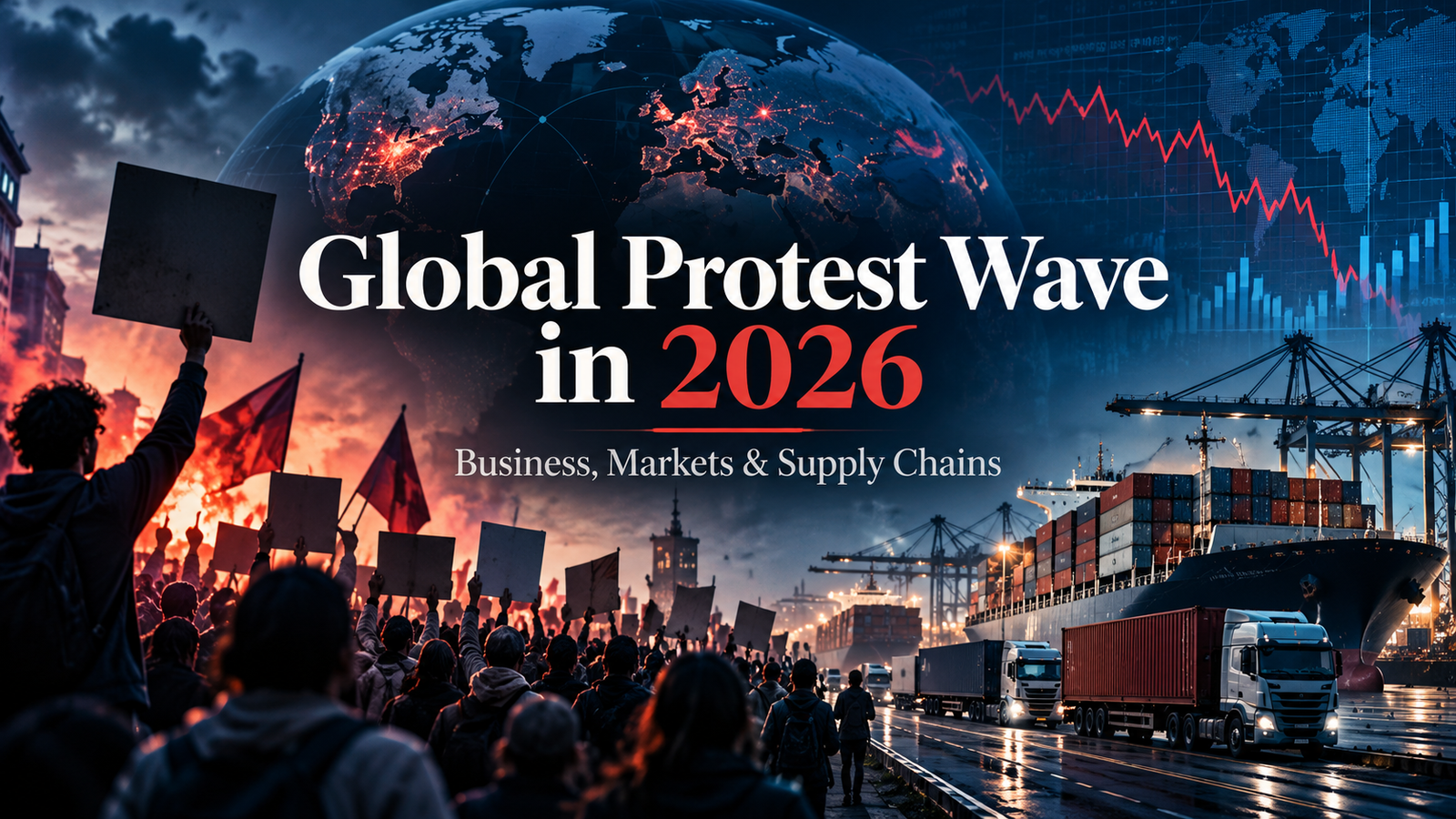
The global protest wave in 2026 is becoming an important geopolitical and business story, with demonstrations, strikes and unrest affecting several countries and creating new risks for companies, markets and supply chains.
Recent demonstrations in France, Belgium and Italy have been driven by different local issues, including rising living costs, education costs, deteriorating public services and broader concerns about economic pressure. Ireland has also experienced a major public-sector strike over wages and the cost of living.
These movements are not one unified global protest campaign.
However, they do highlight a broader challenge facing governments and businesses: economic pressure can quickly become social and political pressure.
For companies operating across multiple markets, rising unrest can affect transport, retail activity, employee mobility, logistics, tourism, investment sentiment and supply-chain planning.
In this article, we examine what is driving recent protest activity in 2026 and what businesses should watch as political and economic uncertainty grows.
Table of Contents
What Is Driving the Global Protest Wave in 2026?
There is no single explanation for the demonstrations taking place across different countries.
Each movement has its own political, economic and social context.
However, several recurring themes are appearing.
1. Cost-of-Living Pressure
Rising prices remain one of the most visible sources of public frustration.
In France, large nationwide demonstrations in October focused on rising living costs and declining public services. More than half a million people joined marches across the country, although parts of the demonstrations later turned violent.
Belgium has also experienced anti-austerity demonstrations linked to rising living costs and government budget measures.
When households face higher costs for food, housing, transport and energy, dissatisfaction can spread beyond economics and become a broader political issue.
2. Education Costs and Public Services
Young people and students have played an important role in several recent protests.
In France, a student movement that began around school funding and deteriorating educational conditions expanded into a much broader national protest movement.
In Belgium, students have protested rising education costs, overcrowded classrooms and difficulties accessing study materials. Demonstrations in Brussels and Liège were partly inspired by events in neighboring France.
This shows how dissatisfaction with one public service can sometimes become connected to wider concerns about inequality, opportunity and government spending.
3. Wages and Employment Pressure
Economic pressure is also appearing through labor action.
In Ireland, hundreds of thousands of teachers, doctors and civil servants joined a one-day strike in October after wage negotiations stalled. Unions argued that workers were struggling with the rising cost of living.
For businesses, labor unrest can become important even when protests are not directed at companies themselves.
Strikes can interrupt transportation, healthcare, education and public administration, creating operational challenges for employees and employers.
4. Economic Uncertainty
High borrowing costs, expensive energy and pressure on household finances can increase social tension.
Global markets in 2026 have already been dealing with higher oil prices, elevated borrowing costs and concerns about economic growth. Reuters has also reported that political instability in France has contributed to broader market anxiety.
Economic problems do not automatically create protests.
But prolonged financial pressure can make existing political and social disagreements more difficult to manage.
Why Businesses Should Pay Attention
Political protests may appear to be primarily a government issue.
But widespread demonstrations can have direct consequences for companies.
The global protest wave in 2026 matters to businesses because social unrest can quickly become an operational issue through transport disruption, labor action, retail closures and supply-chain delays.
Transport and Logistics Disruption
Large demonstrations can block roads, shut railway stations and disrupt public transport.
During student unrest in Liège, authorities temporarily closed the city’s main train station and warned businesses to close early.
For companies moving goods through affected cities, even short disruptions can create:
- Delivery delays
- Higher logistics costs
- Missed appointments
- Employee travel problems
- Warehouse scheduling issues
- Last-mile delivery disruption
Businesses with highly time-sensitive supply chains may be especially exposed.
Retail and Local Business Impact
Prolonged unrest can also affect physical businesses directly.
In France, hundreds of shops were damaged during the October protests and riots, with losses running into tens of millions of euros for some retailers.
Italian cities including Milan, Bologna, Brescia, Bergamo and Turin also experienced clashes and property damage during demonstrations connected to living costs and public services.
Even businesses that are not physically damaged may experience lower customer traffic when people avoid city centers.
Supply-Chain Risk
Social unrest can create another layer of uncertainty for global supply chains.
Companies already monitor:
- Wars and geopolitical conflict
- Shipping disruption
- Energy prices
- Currency movements
- Trade restrictions
- Natural disasters
Large-scale protests and strikes should increasingly be included in that risk picture.
For multinational companies, the global protest wave in 2026 adds another layer of uncertainty to already complex supply-chain planning.
A major demonstration in a strategically important city may delay transportation or distribution even if the country’s wider supply chain continues operating normally.
Businesses therefore need to understand not only national political risk but also local operational risk.
Rising Costs Can Create a Feedback Loop
One important issue businesses should monitor is the relationship between prices and social pressure.
Global food inflation is expected to remain elevated as supply shocks from conflict, shipping disruption, climate conditions and higher fertilizer and fuel costs affect production and transportation.
When essential goods become more expensive, households feel the pressure directly.
Governments may then face greater demands for:
- Wage increases
- Subsidies
- Tax relief
- Public spending
- Price controls
- Social assistance
Those responses can affect business regulation, government budgets and labor costs.
This creates a feedback loop:
Higher costs → Household pressure → Social dissatisfaction → Political response → New economic policies
Businesses need to understand all parts of that cycle.
What the Global Protest Wave in 2026 Means for Markets
Financial markets usually react less to individual demonstrations than to what those demonstrations suggest about economic or political stability.
Investors may pay closer attention when unrest begins affecting:
- Government policy
- Budget negotiations
- Public debt
- Elections
- Interest-rate expectations
- Consumer confidence
- Business investment
For example, political instability in France has already become part of the broader market conversation around the country’s fiscal outlook and bond market.
The important issue for companies is not whether every protest moves markets.
It is whether sustained unrest begins changing policy or business expectations.
Why Supply Chains Are Increasingly Sensitive to Political Risk
Modern supply chains are deeply interconnected.
A company may have:
- Suppliers in Asia
- Manufacturing in Europe
- Customers in North America
- Logistics providers in the Middle East
- Cloud infrastructure in several regions
This creates efficiency, but it also creates exposure.
A disruption in one location can affect several stages of the business.
Companies should therefore include political and social instability alongside traditional supply-chain risks.
A useful risk-monitoring framework can include:
Country risk
Political stability, regulation and government policy.
City-level risk
Transport disruption, demonstrations and strikes.
Supplier risk
Whether important suppliers operate in affected regions.
Logistics risk
Ports, railways, roads and distribution centers.
Workforce risk
Whether employees can safely and reliably reach workplaces.
Customer risk
Whether economic pressure changes consumer or business spending.
What B2B Companies Should Do
Businesses do not need to react dramatically every time a protest occurs.
The better approach is structured monitoring.
Monitor Local Developments
Companies with operations or suppliers in affected markets should monitor credible local and international news sources.
Focus on practical information such as:
- Transport closures
- Strike dates
- Government announcements
- Curfews or restrictions
- Port or railway disruption
- Business district closures
Identify Critical Dependencies
Companies should understand which suppliers, logistics routes or facilities would create the biggest problem if temporarily unavailable.
This makes contingency planning more useful.
Build Alternative Logistics Options
Businesses that rely heavily on one transport route may want alternative suppliers, carriers or distribution options.
Redundancy can reduce the impact of localized disruption.
Communicate With Employees
Employee safety should remain a priority during major demonstrations.
Businesses may need to support:
- Remote work
- Flexible schedules
- Alternative transport
- Temporary office closures
Review Crisis Communication
Companies should know who communicates with employees, customers and suppliers when disruption occurs.
Clear communication can reduce confusion when events change quickly.
Protests and Brand Communication
Political unrest can also create challenges for marketing and communications teams.
Companies should be careful about attempting to capitalize on politically sensitive events.
Customers may interpret opportunistic messaging negatively.
A better approach is to focus communication on practical information when it is relevant.
For example:
- Delivery delays
- Store closures
- Service interruptions
- Employee availability
- Safety-related changes
During politically sensitive situations, clarity is often more valuable than promotional messaging.
Are We Seeing a Global Protest Wave?
It is important not to treat every demonstration as part of one coordinated global movement.
The protests in France, Belgium and Italy have different political contexts, institutions and demands.
However, there are visible similarities.
These include:
- Pressure from rising living costs
- Concerns over public services
- Education affordability
- Wage dissatisfaction
- Economic uncertainty
- Younger protesters demanding change
The similarities make these developments important for business leaders monitoring geopolitical risk.
Rather than asking whether the world is experiencing one single protest movement, a more useful question may be:
Why are similar economic pressures producing political and social tension in several countries at the same time?
What Businesses Should Watch Next
Several factors will determine whether protest activity remains localized or becomes a larger business risk.
Inflation and Food Prices
Higher food, energy and transportation costs can increase household pressure.
Government Budgets
Governments attempting to reduce deficits may face opposition to spending cuts or tax increases.
Education and Youth Employment
Young people are increasingly visible in several protest movements.
Energy Prices
Higher oil and gas prices can affect transportation, manufacturing and household expenses.
Labor Negotiations
Wage disputes can create further strike activity.
Political Responses
How governments respond can influence whether protests decline, expand or change direction.
Frequently Asked Questions
What is causing protests in 2026?
The causes differ by country, but recent protests have included concerns about living costs, education funding, wages, public services, government budgets and economic inequality.
Are the protests around the world connected?
Not necessarily. Many current protests have separate local causes. However, some movements have influenced others, particularly student demonstrations in France and Belgium.
How can protests affect businesses?
Large demonstrations can disrupt transport, retail activity, employee travel, logistics, tourism and public services.
Can protests affect supply chains?
Yes. Road closures, railway disruption, strikes and city-center restrictions can delay goods and affect logistics operations.
Do protests affect financial markets?
Individual demonstrations may have little market impact, but prolonged instability can affect investor confidence, government policy, public finances and business expectations.
How should companies prepare for political unrest?
Businesses can monitor local risks, identify critical suppliers and logistics routes, develop contingency plans, communicate with employees and maintain alternative operating options.
Final Thoughts
Recent protest activity in several countries shows how closely economic pressure, public policy and political stability can become connected.
The demonstrations are not one unified movement, and their causes should not be oversimplified.
But for businesses, the broader lesson is clear.
Social and political risk can quickly become operational risk.
Transport can be disrupted.
Retail activity can decline.
Employees may struggle to travel.
Supply chains may experience delays.
Government policy can change.
And prolonged instability can influence markets and investment decisions.
For companies operating internationally, geopolitical risk management should therefore extend beyond wars, sanctions and trade disputes.
Understanding social pressure, labor action and political unrest is increasingly part of understanding the global business environment.
The global protest wave in 2026 shows why companies need to monitor social and political risk alongside traditional economic and supply-chain indicators.