Introduction
In B2B marketing, having business data is not enough. Companies need accurate, updated, and meaningful information to identify the right prospects and make better marketing decisions.
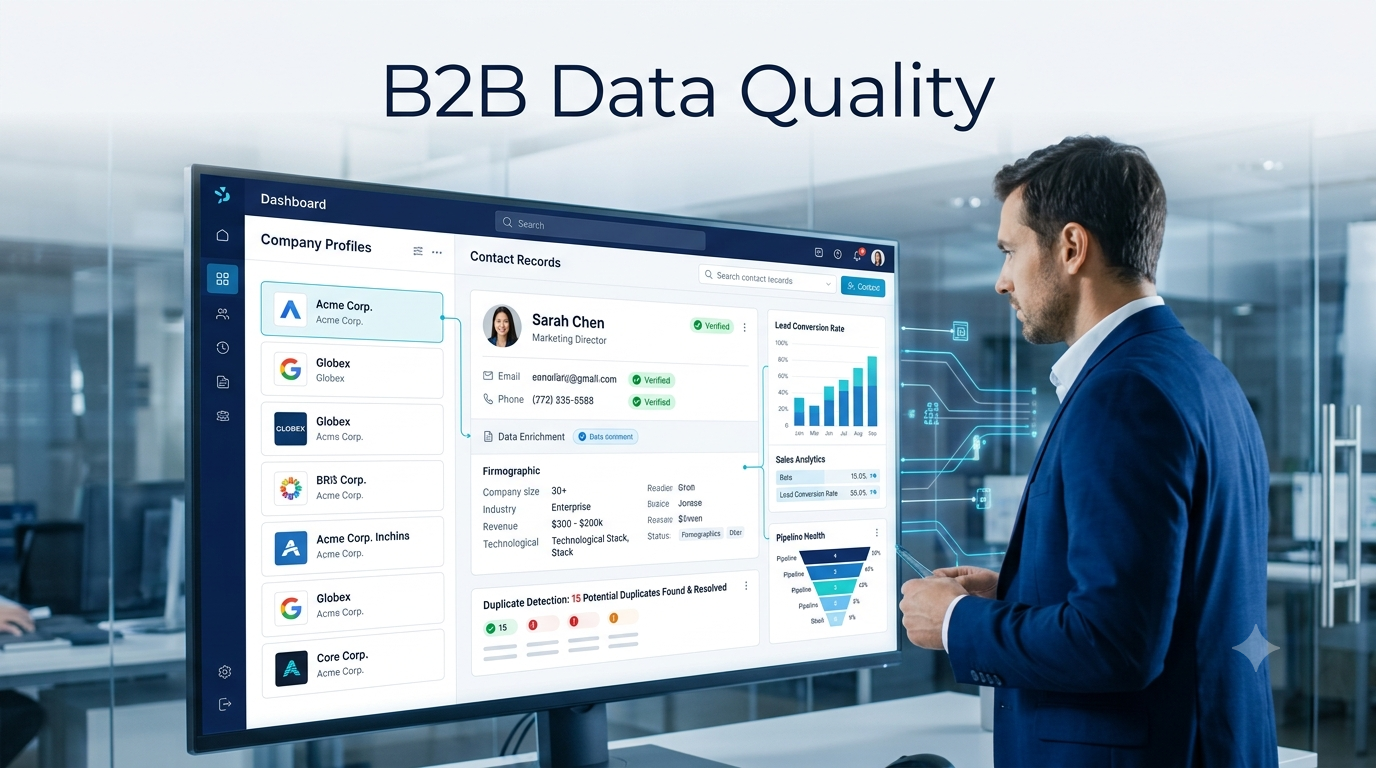
However, many businesses still work with incomplete company records, outdated employee information, incorrect industry details, and duplicate data.
These problems can affect lead generation, audience targeting, and sales performance.
This is where AI-Powered Firmographic Enrichment becomes valuable.
By combining artificial intelligence with firmographic data, businesses can improve company profiles, identify missing information, organize prospect databases, and build more focused marketing campaigns.
Businesses can also use B2B data enrichment to build more complete prospect profiles and improve the quality of their marketing data.
Instead of spending hours manually reviewing business records, marketing teams can use AI-powered tools to support data analysis and enrichment.
In this article, we will explore how this technology works, its key benefits, practical applications, and how businesses can use it to make smarter B2B marketing decisions.
Table of Contents
What Is AI-Powered Firmographic Enrichment?
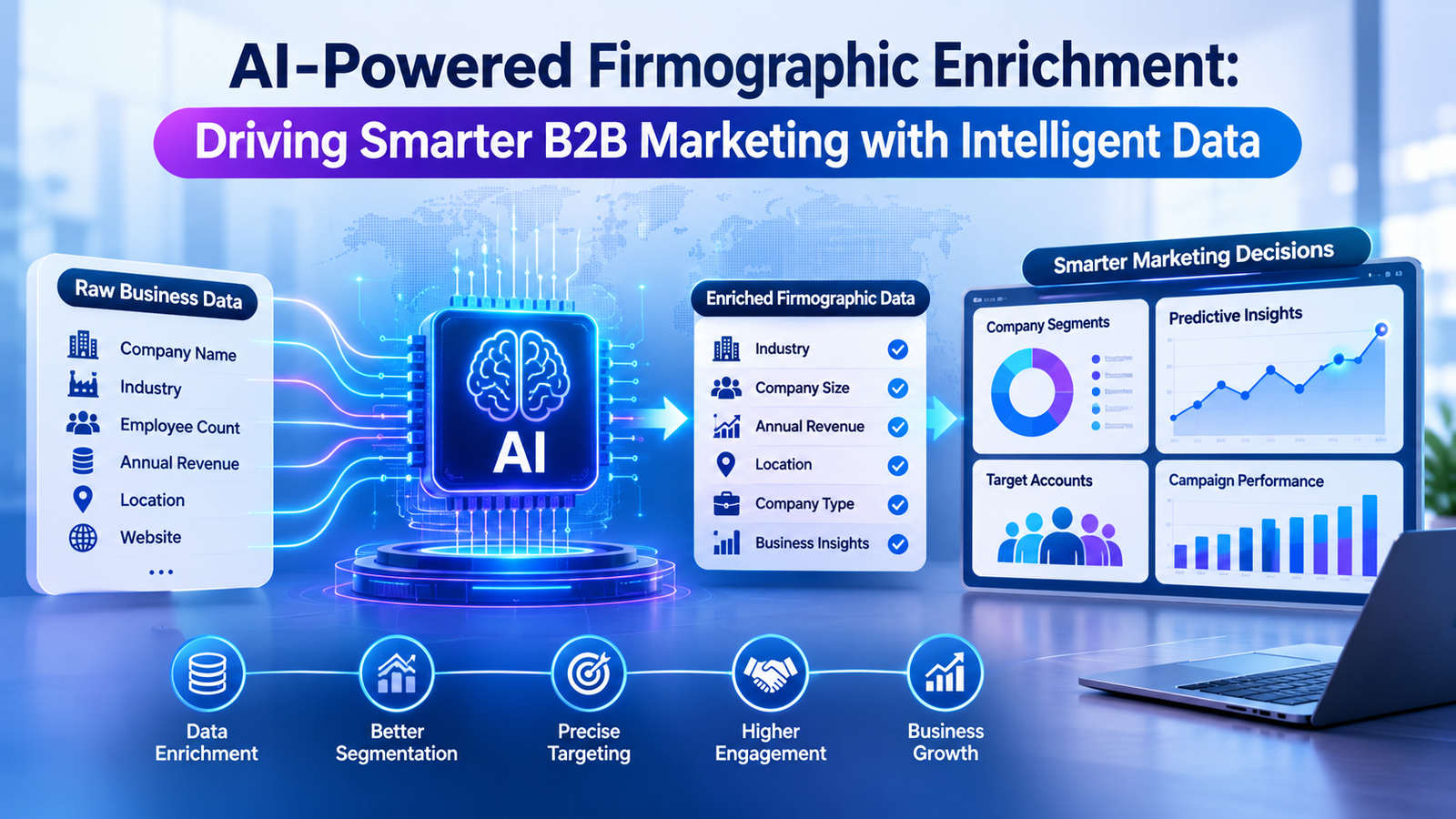
AI-Powered Firmographic Enrichment is the process of using artificial intelligence to improve, update, organize, and expand company information in a B2B database.
Firmographic data describes businesses based on their characteristics.
Common examples include:
- Industry: The sector in which a company operates.
- Company Size: The number of employees working in an organization.
- Annual Revenue: The estimated yearly revenue of a business.
- Location: The country, city, or region where a company operates.
- Company Type: Whether a business is a startup, small business, medium-sized company, or enterprise.
- Business Information: Company website, business activities, and market presence.
AI helps analyze available information, identify potential gaps, detect inconsistencies, and support the process of enriching company records.
Maintaining strong B2B data quality is equally important for keeping company information accurate, complete, and reliable.
For example, imagine a marketing agency has a database containing 2,000 company records.
Some records have missing industry details, outdated employee counts, or incomplete business profiles.
An AI-powered enrichment solution can help identify these gaps and suggest additional information using available data sources.
The result is a more organized database that marketing and sales teams can use for better targeting.
Why AI-Powered Firmographic Enrichment Matters in 2026
B2B marketing is becoming more data-driven. Businesses want to reach relevant companies instead of spending resources on audiences that are unlikely to become customers.
Accurate company information helps marketers understand their target accounts and create campaigns that match business requirements.
Here are some reasons why this approach matters.
1. Better Data Accuracy
Incomplete and outdated company information can create problems during lead qualification and campaign execution.
AI-assisted enrichment helps identify missing fields, inconsistencies, and possible duplicate records.
2. Smarter Audience Targeting
Marketers can use enriched company information to identify businesses that match their ideal customer profile.
For example, a SaaS company may target technology businesses with 100–500 employees instead of reaching every available business.
3. Improved Marketing Efficiency
Manual data research takes time, especially when managing large company databases.
Automation can reduce repetitive work and allow marketing teams to focus more on campaign planning and customer engagement.
4. Better Sales and Marketing Alignment
When both teams use consistent company information, they can work with a shared understanding of target accounts.
This helps sales representatives prioritize suitable prospects and gives marketing teams a clearer audience for their campaigns.
Maintaining strong data quality is essential for reliable business insights. According to IBM’s data quality overview, accurate and consistent data helps organizations make more trustworthy decisions.
7 Key Benefits of AI-Powered Firmographic Enrichment
Let’s explore seven important ways AI-powered enrichment can improve B2B marketing operations.
1. Automated Company Data Enrichment
One of the biggest benefits is the ability to support automated company data enrichment.
AI-powered systems can analyze existing company records and identify missing information that may need to be updated.
For example, a company database may contain a business name and website but no industry classification.
An enrichment tool can analyze available information and suggest an industry category for verification.
This helps businesses maintain more complete company profiles.
2. Improved Ideal Customer Profile Identification
An Ideal Customer Profile (ICP) describes the type of business that is most suitable for a company’s products or services.
AI can help analyze existing customer records and identify common firmographic characteristics.
These may include:
- Industry and business category.
- Company size and employee count.
- Annual revenue range.
- Geographic location.
- Technology usage.
For example, a marketing automation provider may discover that many of its successful customers are mid-sized technology companies.
This insight can help the marketing team refine its ICP and prioritize similar businesses.
3. Smarter B2B Customer Segmentation
Not every company has the same requirements.
A small business may need affordable marketing tools, while a large enterprise may prioritize advanced automation and integration capabilities.
Using B2B audience intelligence can further help marketing teams understand their target audiences and identify relevant business prospects.
Marketing teams can then create different campaigns for each group.
This makes communication more relevant and helps businesses avoid generic marketing messages.
4. Better Lead Qualification and Prioritization
Not every lead represents a valuable business opportunity.
AI-powered enrichment can help sales and marketing teams evaluate companies using firmographic attributes and other available information.
For example, a business selling enterprise software may prioritize companies that match its preferred industry, employee range, and revenue requirements.
The enriched information supports better lead qualification and helps sales teams focus on relevant opportunities.
However, final qualification should also consider actual customer needs, engagement, and buying readiness.
5. Combining Firmographic Data with Intent Data
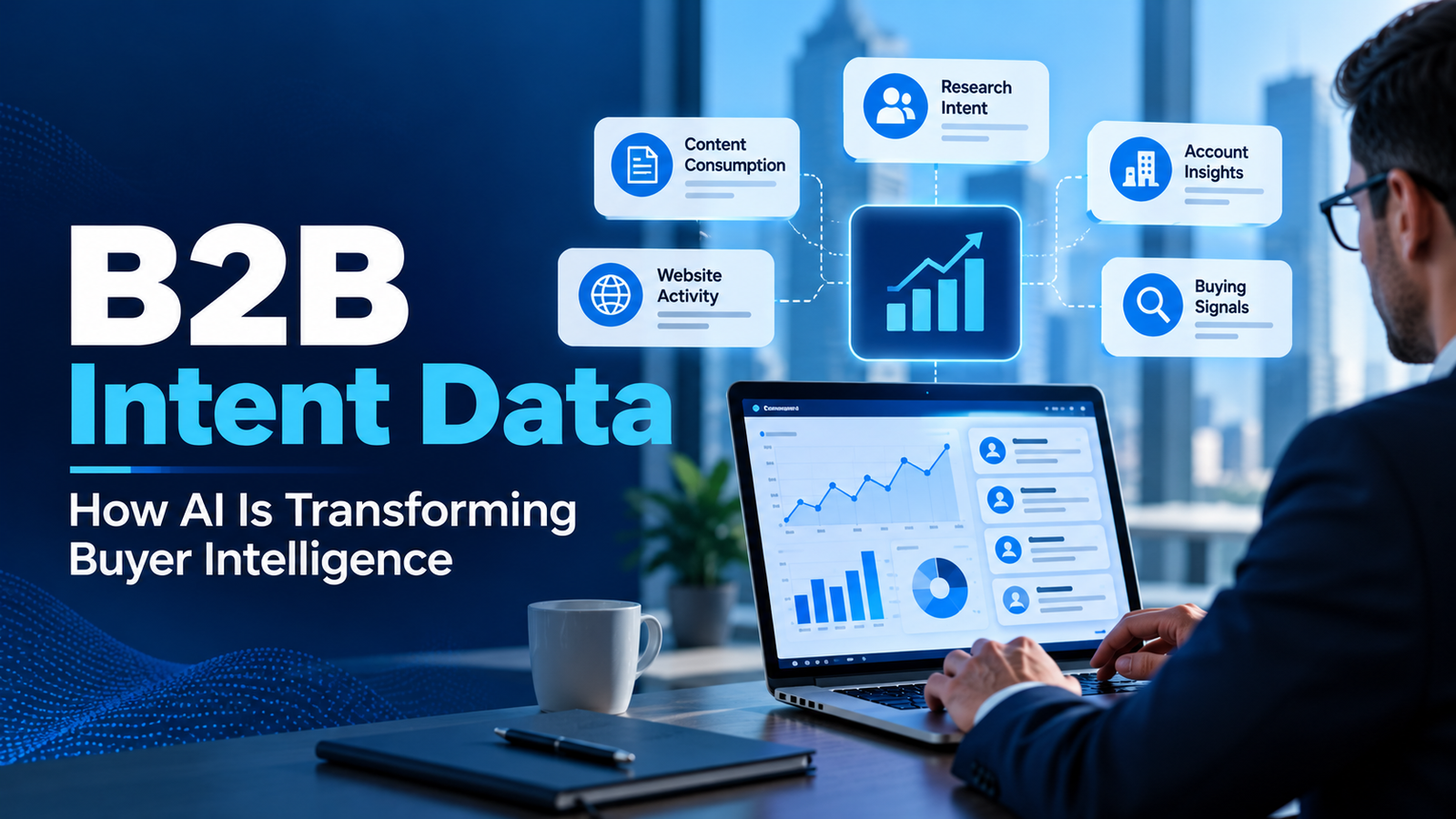
Firmographic data explains what a company looks like, while intent data can provide signals about what a company may be researching or considering.
Combining both creates a more useful view of potential customers.
For example, a software provider may identify a healthcare organization with 1,000 employees using firmographic information.
If relevant intent signals suggest that the organization is researching business automation solutions, the marketing team may prioritize that account.
B2B marketing teams can also explore company firmographic data through platforms such as 6sense’s Company Firmographics API, which provides company information for lead and account enrichment.
6. Predictive Insights for Smarter Decisions
AI can analyze historical customer information and available business signals to identify patterns.
For example, a company can study the characteristics of its existing customers to understand which industries and company sizes have historically generated successful opportunities.
These insights can support account scoring, audience planning, and campaign prioritization.
Predictive insights should be treated as decision-support information rather than guaranteed predictions.
7. More Personalized B2B Marketing Campaigns
Personalization is important in B2B marketing because different businesses face different challenges.
With enriched company information, marketers can develop messages based on industry, company size, location, and business requirements.
For example:
A campaign targeting manufacturing companies could focus on operational efficiency.
A campaign targeting technology businesses could highlight automation and scalability.
This makes marketing communication more relevant to the businesses receiving it.
How to Use AI-Powered Firmographic Enrichment in B2B Marketing
Understanding the benefits is important, but businesses also need a practical process to apply this approach.
Here are six steps to get started.
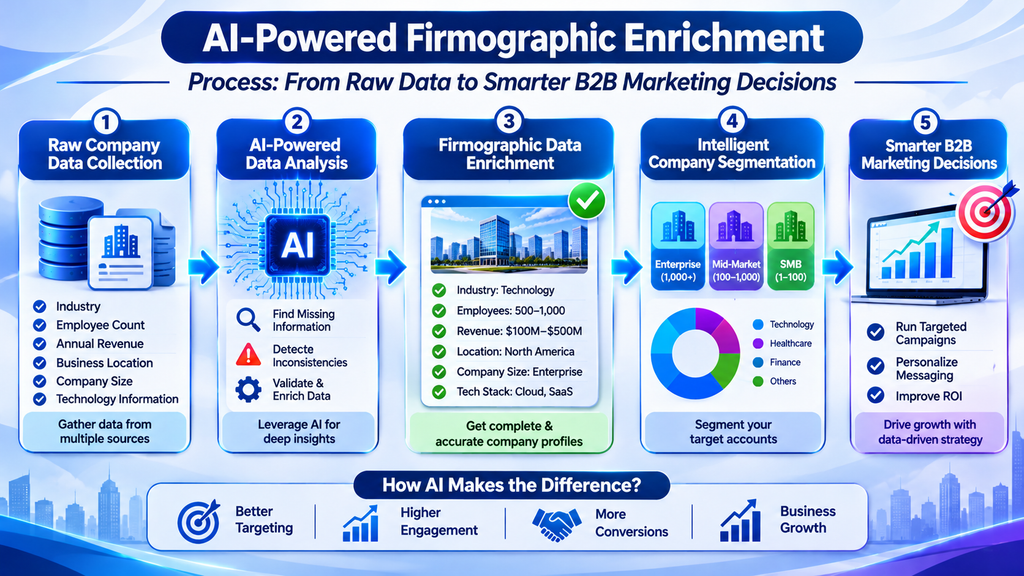
Step 1: Collect Existing Company Data
Start by reviewing your existing CRM records, prospect databases, and business contact information.
Identify which company details are already available and which fields are missing.
Important fields include industry, company size, revenue, location, and website.
Step 2: Identify Missing and Inaccurate Information
Review your database for incomplete company profiles, outdated information, duplicate records, and inconsistent industry classifications.
Create a list of the fields that need attention.
Step 3: Choose the Right AI Enrichment Tools
Select a data enrichment solution that fits your business requirements.
Evaluate its data sources, supported integrations, enrichment fields, accuracy, privacy practices, and pricing.
Some platforms can connect with CRM systems and help enrich company records within existing workflows.
Step 4: Enrich and Verify Company Profiles
Use the selected tools to support the enrichment process.
Review important information before adding it to your database.
Do not assume that every AI-generated suggestion is correct. Verify uncertain or important business details using reliable sources.
Step 5: Segment Your Target Accounts
Once your company records are improved, organize businesses into relevant segments.
For example:
- Technology companies.
- Healthcare organizations.
- Financial services businesses.
- Manufacturing companies.
- Small and medium-sized enterprises.
- Large enterprise accounts.
This makes it easier to build focused marketing campaigns.
Step 6: Measure Marketing Performance
Track the results of your enriched data strategy.
Important metrics include:
- Data completeness.
- Duplicate record rate.
- Target account engagement.
- Lead qualification rate.
- Marketing-qualified leads.
- Sales-qualified opportunities.
- Campaign conversion rate.
Review these metrics regularly to understand whether your enrichment process is improving marketing operations.
Common AI-Powered Firmographic Enrichment Mistakes to Avoid
AI-powered enrichment can be useful, but poor implementation may create new data problems.
Avoid these common mistakes.
1. Depending Completely on AI-Generated Information
AI systems can make incorrect suggestions or use incomplete information.
Always verify important company details before using them in marketing campaigns.
2. Ignoring Data Quality
Adding more information does not automatically improve a database.
Focus on accurate, relevant, and useful company information.
3. Using Unreliable Data Sources
The quality of enrichment depends partly on the information sources being used.
Choose reliable providers and understand how their data is collected and updated.
4. Ignoring Data Privacy
Businesses should review applicable privacy regulations and ensure that their data collection and marketing practices follow relevant requirements.
5. Enriching Data Without a Clear Marketing Goal
Do not collect company information simply because it is available.
Identify which data fields actually help your business improve targeting, segmentation, and lead qualification.
Best Practices for AI-Powered Firmographic Enrichment
To get better results, follow these practical recommendations:
- Define your ICP: Identify the industries, company sizes, revenue ranges, and locations that match your ideal customers.
- Start with important data fields: Prioritize company name, industry, employee count, revenue, and location.
- Use reliable enrichment sources: Select tools that provide transparent information about their data sources.
- Review AI-generated results: Verify important information before updating your CRM.
- Maintain data regularly: Establish a schedule for checking outdated and incomplete company records.
- Combine different data types: Use firmographic, intent, and engagement information where appropriate.
- Monitor performance: Track data quality and marketing outcomes to identify areas for improvement.
- Follow privacy requirements: Handle business and contact information responsibly.
These practices help businesses build a more reliable data foundation for their B2B marketing activities.
Frequently Asked Questions About AI-Powered Firmographic Enrichment
1. What is AI-powered firmographic enrichment?
AI-powered firmographic enrichment is the process of using artificial intelligence to improve, update, and organize company information such as industry, employee count, annual revenue, and business location.
2. How does AI improve firmographic data accuracy?
AI helps identify missing information, detect duplicate records, recognize inconsistencies, and suggest updates to company profiles using available data sources.
3. Why is firmographic data important for B2B marketing?
Firmographic data helps businesses identify their ideal customers, segment target accounts, improve lead qualification, and create more relevant marketing campaigns.
4. What are the key benefits of AI-powered firmographic enrichment?
The key benefits include better data accuracy, automated enrichment, improved customer segmentation, smarter lead qualification, and more effective account-based marketing.
5. What types of data can AI-powered firmographic enrichment collect?
It can help enrich company information such as:
- Industry and business category
- Company size and employee count
- Annual revenue
- Business location
- Company website
- Company type and business activities
6. How does firmographic enrichment improve lead generation?
It helps marketing and sales teams identify businesses that match their ideal customer profile. This allows them to focus on more relevant prospects and improve lead qualification.
7. What is the difference between firmographic data and intent data?
Firmographic data describes a company’s characteristics, such as industry, size, and revenue. Intent data provides signals about the topics or products a company may be researching.
8. Can AI-powered firmographic enrichment improve account-based marketing?
Yes. It helps identify suitable target accounts, organize companies into segments, and support personalized marketing campaigns based on business characteristics.
9. What are the common challenges of AI-powered firmographic enrichment?
Common challenges include outdated information, inaccurate data sources, duplicate company records, privacy concerns, integration difficulties, and incorrect AI-generated suggestions.
10. How often should B2B firmographic data be updated?
B2B firmographic data should be reviewed regularly. The update frequency depends on the business, data source, and importance of each field. Frequently changing information should be checked more often.
Final Thoughts
B2B marketing decisions are only as useful as the information behind them.
Incomplete company profiles, outdated business details, and poor data quality can make it difficult to identify suitable prospects and run effective campaigns.
AI-Powered Firmographic Enrichment helps businesses improve how they organize, analyze, and use company information.
From automated data enrichment and smarter customer segmentation to better lead qualification and personalized campaigns, AI can support several important areas of B2B marketing.
However, successful implementation requires more than choosing an AI tool. Businesses must focus on reliable data sources, regular verification, clear marketing goals, and responsible data management.
Companies that combine accurate firmographic information with intelligent automation can build more focused marketing strategies and make smarter business decisions in 2026 and beyond.