Introduction
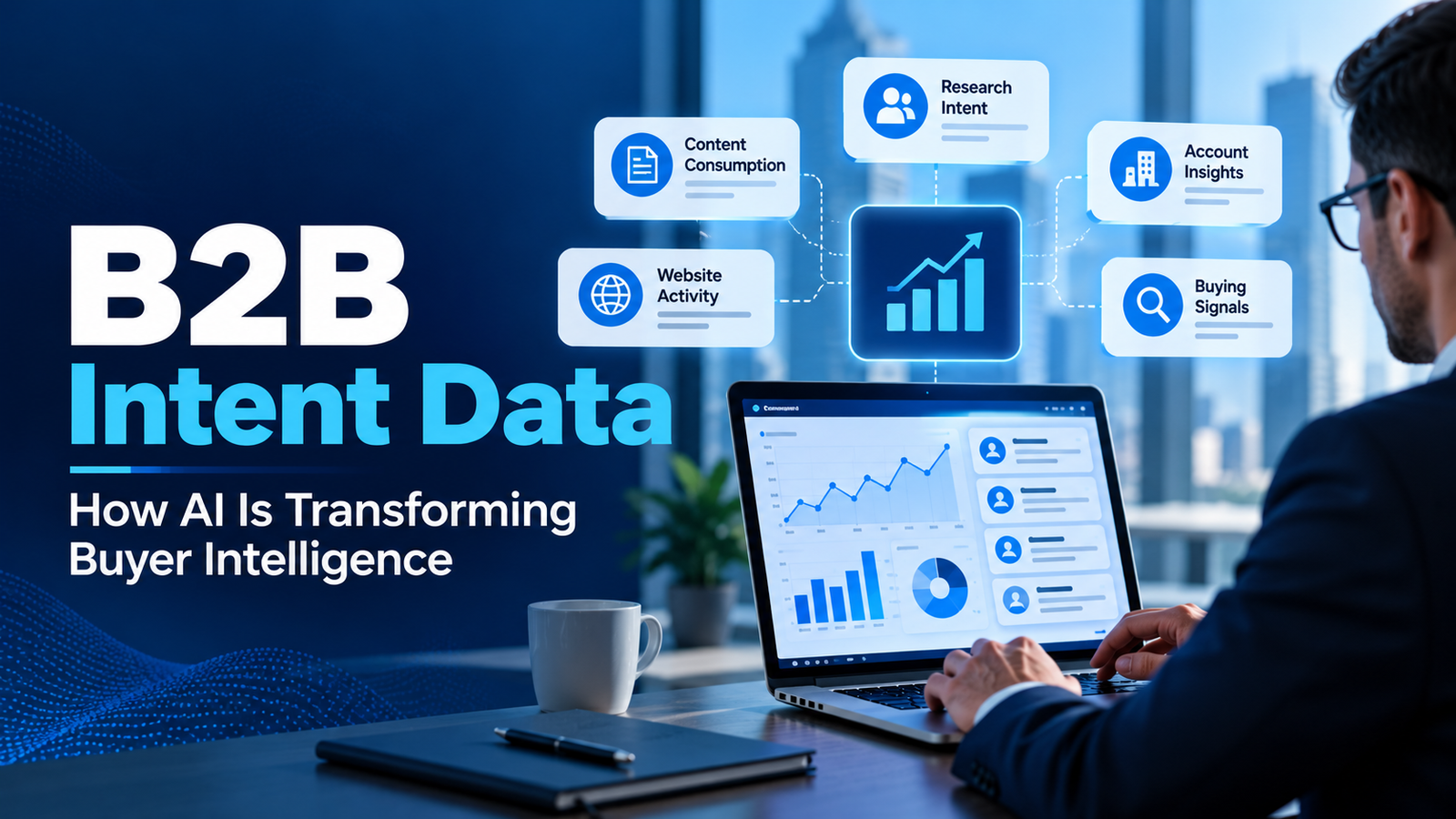
B2B intent data helps marketing and sales teams understand the signals behind buyer behavior so they can identify accounts that may be actively researching a problem, solution, product, or vendor.
Finding the answer is becoming easier with B2B Intent Data. In 2026, businesses are no longer relying only on form submissions, website visits, or cold outreach to understand potential buyers. AI can now analyze large volumes of digital signals and identify patterns that may indicate genuine purchase interest.
AI-powered buyer signals can help businesses identify prospects earlier and improve their B2B lead generation strategy.
A potential customer might research a product category, download industry content, compare vendors, visit pricing pages, or engage with specific topics online. Individually, these actions may not mean much. But when analyzed together, they can reveal valuable buying intent.
Table of Contents
What Is B2B Intent Data?
B2B intent data is information that helps businesses understand whether a company or its employees may be researching a particular product, service, technology, or business challenge.
These signals can include website visits, content consumption, product engagement, research activity, and interactions with relevant industry topics.
For example, imagine a software company selling marketing automation solutions. Several employees from a target account begin researching marketing automation platforms, visiting relevant solution pages, and engaging with content about campaign performance.
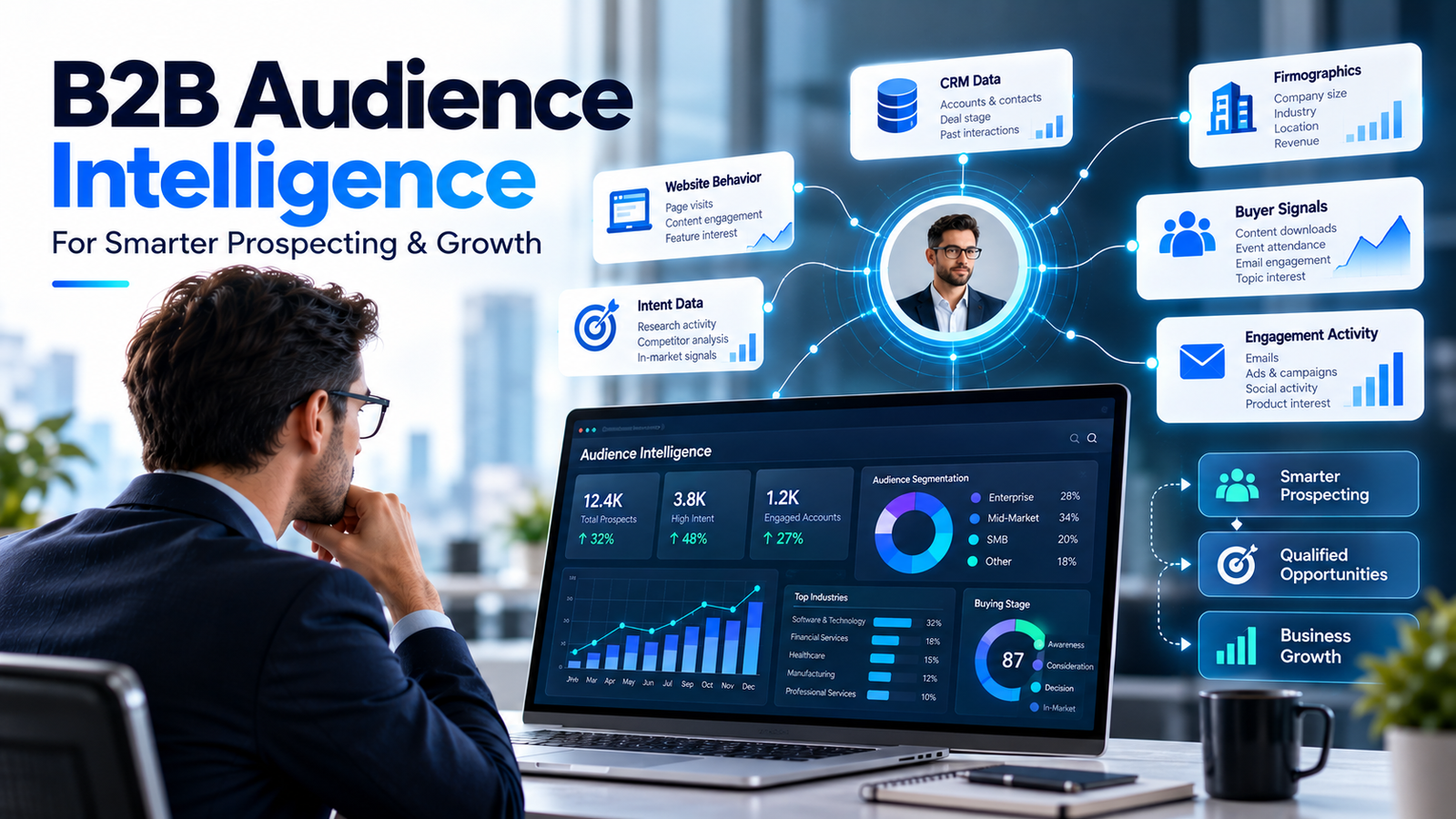
Combining intent signals with B2B audience intelligence can help marketing teams understand target accounts and prioritize relevant prospects more effectively.
Intent data does not confirm that a business is ready to purchase. Instead, it provides additional context that helps teams prioritize accounts, personalize communication, and identify potential opportunities.
Why Does B2B Intent Data Matter?
Traditional lead generation often focuses on the moment a prospect fills out a form.
But the buyer journey starts long before that.
A prospect may spend weeks or months researching a problem before contacting a vendor.
By the time they submit a form, they may already have:
- Identified their problem
- Researched possible solutions
- Compared vendors
- Read reviews
- Discussed the purchase internally
- Built a shortlist
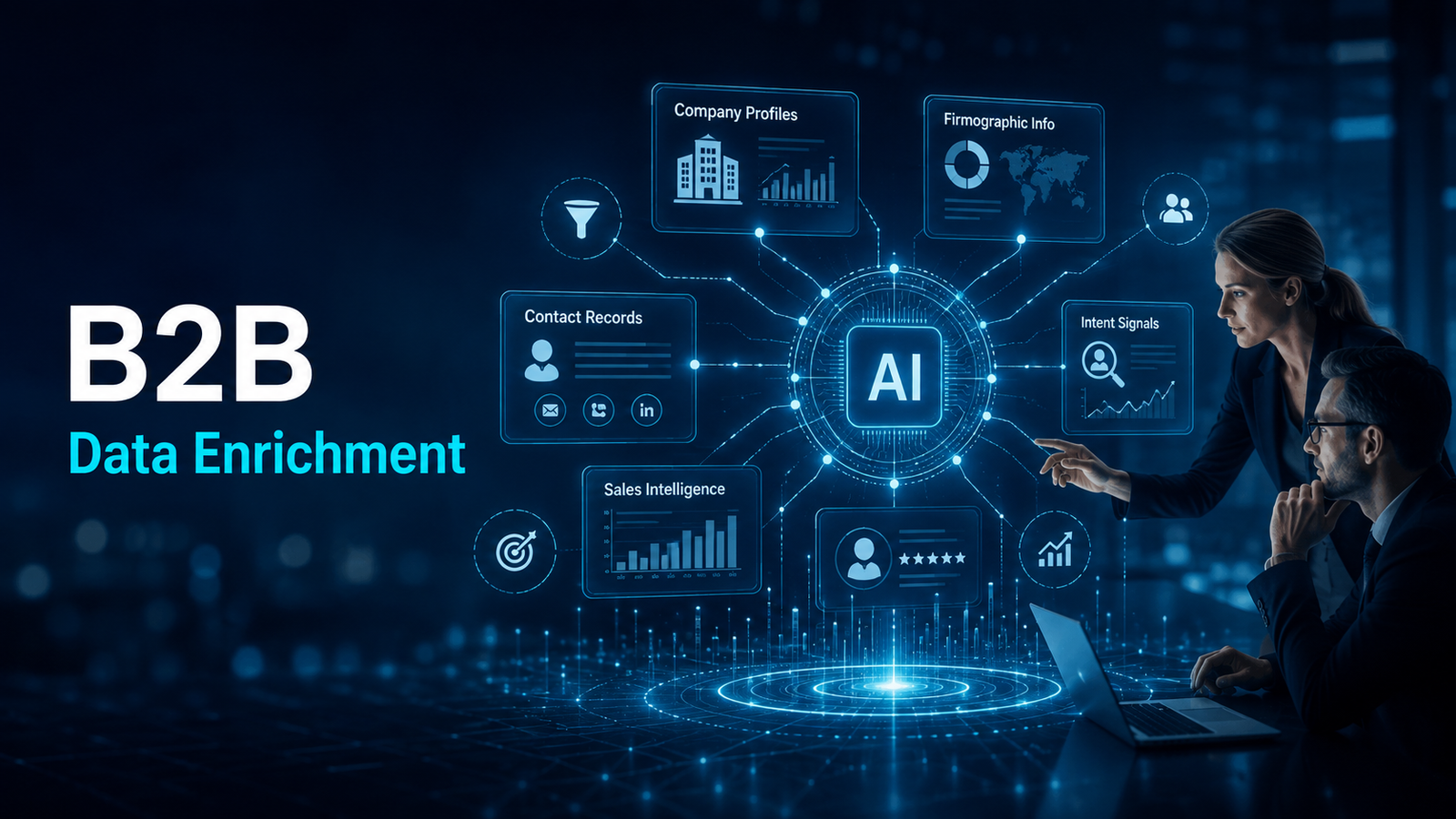
Understanding these research signals becomes easier when businesses use B2B data enrichment to improve prospect information and build a clearer picture of their target accounts.
Intent data can help businesses recognize some of those signals earlier.
Instead of waiting for every prospect to raise their hand, marketing and sales teams can look for changes in buyer behavior.
This creates an opportunity to become more relevant earlier in the buying journey.
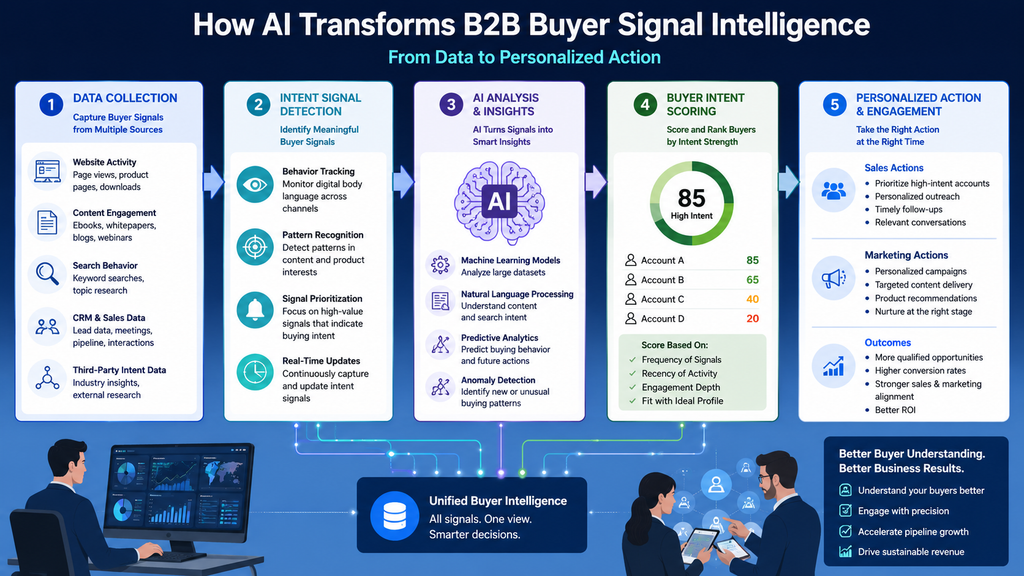
How Does B2B Intent Data Work?
A practical B2B intent-data process can be simplified into six steps:
Identify → Collect → Analyze → Prioritize → Activate → Measure
1. Identify the right accounts
Start with your ideal customer profile.
Consider factors such as:
- Industry
- Company size
- Revenue
- Location
- Technology environment
- Business model
- Common pain points
- Buyer roles
Intent is much more useful when you know which accounts are actually valuable to your business.
2. Collect buyer signals
Next, collect relevant behavioral information.
Signals may include:
- Website activity
- Content engagement
- Search behavior
- Email engagement
- Webinar participation
- Product research
- Pricing-page visits
- Competitor research
- Account-level engagement
3. Analyze the behavior
The next step is understanding what those signals mean.
A single website visit could simply mean someone was curious.
Five visits combined with product research and pricing activity could indicate something very different.
Context matters.
4. Prioritize accounts
Not every account deserves the same amount of attention.
Businesses can prioritize accounts based on a combination of:
Fit + Intent + Recency + Engagement
5. Activate the data
Intent data should lead to an action.
Depending on the situation, that action could be:
- Sending relevant content
- Starting an ABM campaign
- Personalizing website messaging
- Triggering a sales alert
- Recommending a case study
- Offering a consultation
- Inviting the account to a webinar
6. Measure the outcome
Finally, connect intent activity to business results.
Look at:
- Qualified leads
- Meetings
- Opportunities
- Pipeline
- Conversion rates
- Revenue
- Sales-cycle length
The goal isn’t to collect the most intent data.
The goal is to make better decisions because you have it.
B2B Intent Data vs. Lead Data: What’s the Difference?
These two types of information are often used together, but they answer different questions.
Lead data tells you who the prospect is.
Intent data helps you understand what the prospect or account may be interested in.
| Lead Data | Intent Data |
|---|---|
| Name | Research behavior |
| Job title | Topic engagement |
| Company | Website activity |
| Buying signals | |
| Contact information | Changes in behavior |
| Firmographic information | Potential buying interest |
For example, lead data may tell you:
“Sarah is a Marketing Director at Company X.”
Intent data may add:
“Several people from Company X have recently been researching B2B demand generation and visiting related solution pages.”
Together, these datasets provide much more useful context.
7 Powerful Ways AI Is Transforming B2B Intent Data
1. AI Connects Multiple Buyer Signals
One of the biggest challenges with buyer intelligence is data fragmentation.
Marketing platforms, CRM systems, websites, advertising tools, and sales platforms often contain separate pieces of customer information.
AI can help connect these signals.
For example, a prospect may:
- Read an industry article
- Visit a product page
- Attend a webinar
- Open multiple emails
- Return to the website
When viewed separately, these actions may seem ordinary.
AI can analyze them together and identify a stronger pattern of interest. you can also show more about AI-powered lead generation.
This creates a more complete picture of the buyer journey and makes B2B Intent Data more useful for decision-making.
2. AI Improves Intent Scoring
Traditional lead scoring often uses fixed rules.
For example:
- Downloading a report = 10 points
- Visiting a pricing page = 20 points
- Attending a webinar = 15 points
The problem is that buyer behavior does not always follow fixed rules.
AI-powered models can analyze historical patterns and identify which combinations of activities are more likely to result in meaningful engagement or sales opportunities.
Instead of asking, “How many actions did this prospect take?” AI can help answer a better question:
“What does this pattern of behavior suggest?”
This makes intent scoring more dynamic and relevant.
3. AI Identifies Account-Level Buying Patterns
B2B purchases rarely involve one person.
A buying committee may include executives, technical teams, procurement professionals, finance teams, and operational leaders.
This means individual-level activity may not tell the complete story.
AI can help identify account-level patterns.
For example, if multiple people from one organization begin researching similar topics, engaging with related content, and visiting product pages, AI can detect a potential increase in organizational interest.
This is particularly valuable for account-based marketing and enterprise sales.
By understanding account-level activity, teams can focus on organizations showing meaningful engagement rather than chasing isolated leads.
4. AI Makes Buyer Signal Intelligence More Predictive
One of the most important developments in B2B Intent Data is the move from descriptive analysis to predictive intelligence.
Traditional analytics tells businesses what happened.
Predictive models attempt to identify what may happen next.
AI can analyze historical customer journeys and identify patterns associated with future outcomes.
For example, it may help teams recognize:
- Which accounts are increasing their research activity
- Which prospects are likely entering an evaluation stage
- Which customers may be interested in additional services
- Which leads require immediate attention
Predictions are never perfect. However, they can help teams prioritize opportunities more effectively.
The goal should not be to replace human judgment. Instead, AI should provide better signals to support faster decisions.
5. AI Enables Better Content Personalization
Intent data becomes more valuable when businesses use it to deliver relevant experiences.
If a prospect repeatedly researches cloud security, sending generic content about every IT service may not be effective.
AI can help identify topics, interests, and stages of engagement.
Marketing teams can then create more relevant experiences, such as:
- Industry-specific content
- Personalized email campaigns
- Relevant case studies
- Targeted advertisements
- Product recommendations
- Sales outreach based on buyer interests
This is where B2B Intent Data connects directly with personalization.
However, personalization should remain useful rather than intrusive. Businesses should focus on providing value, not making prospects feel constantly monitored.
6. AI Helps Sales Teams Prioritize Their Time
Sales representatives often spend significant time identifying which leads deserve immediate attention.
AI-powered intent analysis can help reduce this challenge.
Instead of reviewing hundreds of leads manually, sales teams can prioritize accounts based on relevant engagement patterns.
For example, an AI system might identify three categories:
High intent: Strong and recent research activity.
Moderate intent: Some engagement but no clear buying pattern yet.
Low intent: Limited or early-stage activity.
This does not mean sales teams should ignore lower-intent prospects. It simply helps them organize their effort more effectively.
The result can be better timing and more relevant conversations.
7. AI Helps Detect Changes in Buyer Intent
Buyer intent is not static.
A prospect may show strong interest one month and become inactive the next. Another account may suddenly increase engagement after months of silence.
AI can continuously analyze behavioral changes.
This allows businesses to identify trends such as:
- Increased research activity
- New topics of interest
- Growing engagement across multiple channels
- Reduced engagement
- Possible movement toward vendor evaluation
In 2026, the ability to understand changing buyer behavior may become just as important as identifying initial interest.
How to Build a B2B Intent Data Strategy
You don’t need to collect every possible signal.
Start with a clear strategy.
Step 1: Define your ideal customer profile
Know exactly which accounts matter most.
Define:
- Industries
- Company sizes
- Locations
- Buyer roles
- Business challenges
- Revenue ranges
- Technology requirements
Step 2: Identify meaningful intent signals
Determine which activities are relevant to your buying journey.
For example:
- Repeated website visits
- Product-page visits
- Pricing-page activity
- Content downloads
- Webinar attendance
- Competitor research
- Multiple employees engaging
Step 3: Create intent levels
You can organize signals into simple categories.
Low intent
General educational engagement.
Medium intent
Repeated engagement with relevant solution content.
High intent
Pricing activity, product research, comparison behavior, or multiple stakeholder engagement.
Step 4: Connect intent data with your CRM
Intent data should not live in a separate dashboard that sales never sees.
Connect relevant signals with your:
- CRM
- Marketing automation platform
- Website analytics
- Lead-scoring system
- ABM platform
This gives teams a more complete account picture.
Step 5: Define what happens next
Create clear actions for each intent level.
For example:
Low intent → Educational content
Medium intent → Nurture campaign
High intent → Personalized ABM engagement
Very high intent → Sales follow-up
This is where intent data becomes actionable.
How to Measure B2B Intent Data Performance
The number of intent signals collected isn’t the most important metric.
What matters is whether those signals improve marketing and sales performance.
Engagement metrics
- High-intent accounts
- Account engagement
- Intent-score changes
- Content engagement
- Website engagement
Lead-generation metrics
- MQLs
- Conversion rates
- Lead quality
- Account engagement rate
Sales metrics
- Meetings booked
- SQLs
- Opportunities created
- Sales acceptance rate
Revenue metrics
- Pipeline generated
- Pipeline influenced
- Opportunity conversion rate
- Revenue generated
- Customer acquisition cost
- Sales-cycle length
The ultimate question is:
Are your intent signals helping you identify and convert better opportunities?
Businesses can use Google Analytics to understand website engagement and evaluate how visitors interact with their content.
Common B2B Intent Data Mistakes
Intent data can be extremely useful, but only when interpreted carefully.
Mistake 1: Assuming every interaction means buying intent
Someone reading a blog post isn’t necessarily looking to buy.
Context matters.
Mistake 2: Relying on one signal
One download or website visit shouldn’t automatically trigger a sales call.
Look for patterns.
Mistake 3: Ignoring recency
A signal from months ago may not be as valuable as a meaningful signal from yesterday.
Mistake 4: Ignoring account fit
A company can show strong interest but still be a poor customer fit.
Intent should be evaluated alongside your ICP.
Mistake 5: Collecting data without taking action
Intent data sitting in a dashboard doesn’t generate pipeline.
Marketing and sales need a clear activation process.
Mistake 6: Sending generic outreach
If you know what an account is researching, your messaging should reflect that context.
Don’t use intent data to send more generic emails.
Use it to make conversations more relevant.
Best Practices for B2B Intent Data in 2026
To build a useful intent-data strategy, focus on the quality of your process rather than the volume of data collected.
Combine intent with account fit. Prioritize relevant engagement from companies that match your target market.
Focus on signal quality. Give greater attention to recent, relevant, and well-supported activity than to isolated or outdated events.
Create a shared sales and marketing process. Define when accounts should be reviewed, who is responsible for follow-up, and how outcomes will be recorded.
Use AI where it adds value. Apply automation and predictive analytics to suitable tasks, but keep transparent rules and human review where needed.
Measure business outcomes. Evaluate qualified opportunities, sales acceptance, conversion, and pipeline contribution rather than relying only on activity metrics.
Continuously improve. Review performance, collect sales feedback, and adjust your criteria as buyer behavior and business priorities change.
The Future of B2B Intent Data
B2B intent data is moving beyond simple activity tracking.
The next stage is about understanding changes in buyer behavior.
Instead of asking:
“Did someone visit our website?”
marketing and sales teams can ask:
“Which accounts are becoming more engaged, what are they researching, and what should we do next?”
AI can help answer those questions by analyzing large amounts of behavioral information and identifying patterns across accounts, channels, and time.
This means the future of intent data is less about collecting more signals and more about turning those signals into useful decisions.
The shift looks like this:
Data collection → Signal analysis → Buyer understanding → Intelligent action → Pipeline
Frequently Asked Questions About B2B Intent Data
1. What is B2B intent data?
B2B intent data is information that indicates a business may be researching a particular product, service, problem, or solution. It can include website activity, content engagement, research behavior, and other buying signals.
2. How does B2B intent data work?
B2B intent data works by collecting buyer signals, analyzing behavioral patterns, identifying accounts showing meaningful interest, and helping marketing and sales teams determine what action to take next.
3. What are B2B intent signals?
B2B intent signals are behaviors that may indicate buying interest. Common examples include repeated website visits, product-page views, pricing-page activity, content downloads, competitor research, webinar participation, and engagement from multiple employees at the same company.
4. What are the types of B2B intent data?
The main types are first-party, second-party, and third-party intent data. First-party data comes from your own digital properties, while second- and third-party data comes from external relationships or providers.
5. How does AI improve B2B intent data?
AI can help connect multiple buyer signals, identify behavioral patterns, improve intent scoring, detect changes in engagement, prioritize accounts, and provide marketing and sales teams with more useful context.
6. How can B2B intent data improve lead generation?
Intent data can help identify companies that are actively researching relevant topics or solutions. Marketing teams can then create more relevant campaigns while sales teams can prioritize accounts showing stronger buying signals.
7. How does intent data support ABM?
Intent data helps ABM teams determine which target accounts are actively researching relevant problems or solutions. This allows businesses to prioritize high-value accounts and personalize engagement.
8. What is the difference between intent data and lead data?
Lead data describes who a prospect is, such as their name, job title, company, and contact information. Intent data provides behavioral context about what that prospect or account may be researching or considering.
9. How accurate is B2B intent data?
Intent data should be treated as an indicator rather than proof that a company is ready to purchase. Accuracy depends on data quality, freshness, methodology, and how multiple signals are interpreted together.
10. How do you measure a B2B intent data strategy?
Measure it using metrics such as high-intent account engagement, qualified leads, meetings, opportunities, pipeline generated, conversion rates, sales-cycle length, and revenue.
Final Thoughts
B2B intent data is becoming an important part of modern buyer intelligence because it helps organizations understand research activity and identify potentially relevant business opportunities.
AI can strengthen this process by connecting signals, identifying patterns, supporting account prioritization, and helping teams respond to changing engagement.
However, successful implementation requires more than technology. Businesses need reliable data, clear scoring criteria, coordinated sales and marketing processes, responsible data practices, and consistent performance measurement.
For B2B organizations, the opportunity is to move beyond collecting buyer signals and use them to make more informed decisions about targeting, content, and sales engagement.