Introduction
B2B buyers today research solutions across search engines, social media, review platforms, websites, reports, and AI-powered tools before they speak with a sales team. They expect relevant information, clear value, credible proof, and a simple path to take the next step.
That is why B2B landing page optimization is becoming an increasingly important part of demand generation and lead generation strategies.
In 2026, successful B2B landing pages are moving beyond static designs. AI, personalization, buyer intent data, campaign optimization, and continuous testing are helping businesses create landing-page experiences that are more relevant to their target audiences.
This guide explains what B2B landing page optimization is, why it matters, the strategies businesses can use, and how AI and personalization are changing the way B2B landing pages generate leads and pipeline.
Table of Contents
What Is B2B Landing Page Optimization?
B2B landing page optimization is the process of improving a landing page’s content, messaging, design, user experience, personalization, and conversion elements to attract the right business buyers and encourage them to take a desired action.
That action might be:
- Requesting a demo
- Booking a consultation
- Downloading a white paper
- Registering for a webinar
- Requesting a quote
- Contacting sales
- Starting a free trial
- Downloading a research report
Unlike a general website page, a B2B landing page is usually created around a specific audience, campaign, offer, keyword, or business objective.
For example, a company running a campaign around AI-powered B2B lead generation should ideally send visitors to a landing page specifically focused on that topic instead of sending them to a generic homepage.
The closer the connection between the visitor’s intent and the landing-page experience, the greater the opportunity to generate meaningful engagement and conversions.
Why B2B Landing Page Optimization Matters
A landing page optimization can receive thousands of visitors and still generate very few qualified leads.
The problem is often not traffic.
It can be:
- Weak messaging
- Poor search intent alignment
- Unclear value proposition
- Too many form fields
- Generic content
- Weak calls to action
- Lack of trust signals
- Slow page performance
- Poor mobile experience
- Lack of personalization
B2B purchases are also more complicated than many B2C purchases. Multiple stakeholders may evaluate the solution, and the buying process can take weeks or months.
10 B2B Landing Page Optimization Strategies for 2026
1. Match the Landing Page With Search Intent
One of the first principles of B2B landing page optimization is understanding why someone arrived on the page.
Consider a person searching for:
“B2B landing page optimization strategies”
They are likely looking for practical guidance.
Someone searching for:
“B2B landing page services”
has a more commercial intent.
These visitors should not necessarily receive the same experience.
Your landing page should reflect the intent behind the visitor’s:
- Search query
- Advertisement
- Social post
- Referral
- Campaign
- Previous interaction
The headline, offer, content, and CTA should make sense in that context.
Example
Instead of:
Transform Your Digital Marketing
Use:
Optimize Your B2B Landing Pages for More Qualified Leads
The second message immediately communicates what the page is about.
2. Create a Clear B2B Value Proposition
Your value proposition should answer one simple question:
Why should the visitor care?
Avoid vague marketing statements such as:
“Unlock the future of digital transformation.”
Instead, communicate a specific benefit.
For example:
Generate More Qualified B2B Leads With AI-Powered Landing Page Optimization
Then explain how you help achieve that outcome.
A strong value proposition usually communicates:
- The target audience
- The problem
- The solution
- The benefit
- The differentiator
Visitors should be able to understand your value within a few seconds.
3. Match Your Landing Page to the Campaign
Your landing page should continue the message that brought the visitor there.
Suppose your LinkedIn advertisement says:
AI-Powered B2B Lead Generation
The landing page should not suddenly focus on:
Complete Digital Marketing Solutions
That creates a disconnect.
Instead:
Advertisement
AI-Powered B2B Lead Generation
Landing Page
Generate Higher-Quality B2B Leads With AI
CTA
Explore Our B2B Lead Generation Approach
This consistency is called message match.
It creates a smoother experience from the initial click to the conversion.
4. Use AI for B2B Landing Page Personalization
AI is changing how businesses approach landing-page personalization.
Traditional landing pages show the same content to everyone.
AI-powered experiences can help marketers identify patterns in visitor behavior and create more relevant experiences for different audience segments.
Personalization can consider factors such as:
- Industry
- Company size
- Job role
- Traffic source
- Previous website activity
- Content engagement
- Buying stage
- Account status
- Intent signals
For example, a technology company may see messaging around:
Scale Your B2B Demand Generation With AI
while an enterprise organization may see:
Build a More Predictable Enterprise B2B Pipeline
The objective isn’t personalization for its own sake.
The objective is to make the visitor feel:
“This page understands what I’m looking for.”
5. Create Campaign-Specific Landing Pages
One of the biggest opportunities for B2B marketers is moving away from a single landing page for every campaign.
Different campaigns often target different:
- Audiences
- Problems
- Keywords
- Industries
- Buying stages
- Offers
For example, a B2B marketing company could create separate landing pages for:
B2B Demand Generation
Focus on:
- Pipeline
- Demand creation
- Qualified accounts
- Revenue growth
B2B Intent Data
Focus on:
- Buyer intent
- Account signals
- Prospect research
- Sales prioritization
AI Lead Generation
Focus on:
- AI
- Automation
- Prospect identification
- Lead quality
Campaign-specific pages make it easier to create relevant messaging and measure campaign performance.
6. Simplify B2B Lead Generation Forms
Your form is one of the most important elements on a lead-generation landing page.
If a visitor is interested but the form asks for too much information, they may leave.
Avoid asking for information you don’t actually need.
Depending on your offer, a form might request:
- Name
- Business email
- Company
- Job title
- Company size
For high-value offers, you may need additional qualification questions.
But every field should have a purpose.
You can also experiment with:
- Short forms
- Multi-step forms
- Progressive profiling
- Different forms for different offers
The goal is to find the right balance between lead qualification and conversion friction.
7. Add Trust and Social Proof
B2B buyers want evidence before engaging with a company.
Your landing page can build credibility through:
- Customer testimonials
- Case studies
- Customer logos
- Industry certifications
- Research
- Results
- Reviews
- Statistics
- Expert insights
For example:
Trusted by B2B marketing teams looking to improve pipeline performance
is more credible when supported by real customer evidence.
If you have measurable results, show them clearly.
Instead of saying:
“We improve marketing performance.”
Consider:
“Helped B2B teams improve qualified pipeline through data-driven demand generation.”
Only use claims that you can substantiate.
8. Optimize for Mobile and Page Speed
A landing page can have excellent messaging and still perform poorly if the experience is slow or difficult to use.
Check:
- Mobile responsiveness
- Page loading speed
- Image sizes
- Font readability
- Button size
- Form usability
- Navigation
- Layout stability
Keep the most important information visible early on the page.
Visitors shouldn’t have to scroll through several screens before discovering what you are offering.
Technical performance also matters because search engines consider page experience signals as part of their broader ranking systems.
9. Test Headlines, CTAs, and Offers
Don’t assume that the first version of a landing page is the best version.
Test different elements systematically.
Headline test
A:
Generate More B2B Leads With AI
B:
Build a More Predictable B2B Pipeline With AI
CTA test
A:
Get Started
B:
Book a Strategy Call
Offer test
A:
Download the Guide
B:
Get the 2026 B2B Landing Page Framework
The objective is not to change everything at once.
Test one meaningful variable at a time when possible and evaluate the results based on statistically meaningful data and business outcomes.
10. Connect Landing Page Performance to Revenue
A landing page should not be judged only by how many forms it generates.
Consider the full journey:
Visitor → Lead → Qualified Lead → Opportunity → Customer → Revenue
For example, imagine two landing pages:
Landing Page A
1,000 visitors
100 leads
5 opportunities
Landing Page B
700 visitors
50 leads
15 opportunities
Landing Page A generates more leads.
But Landing Page B generates more opportunities.
That is why B2B marketers should look beyond lead volume.
Track metrics such as:
- Conversion rate
- Qualified leads
- Account engagement
- Opportunities
- Pipeline
- Deal velocity
- Customer acquisition cost
- Revenue
The ultimate goal is not simply more leads.
It is more valuable business outcomes.
How AI Is Changing B2B Landing Page Optimization
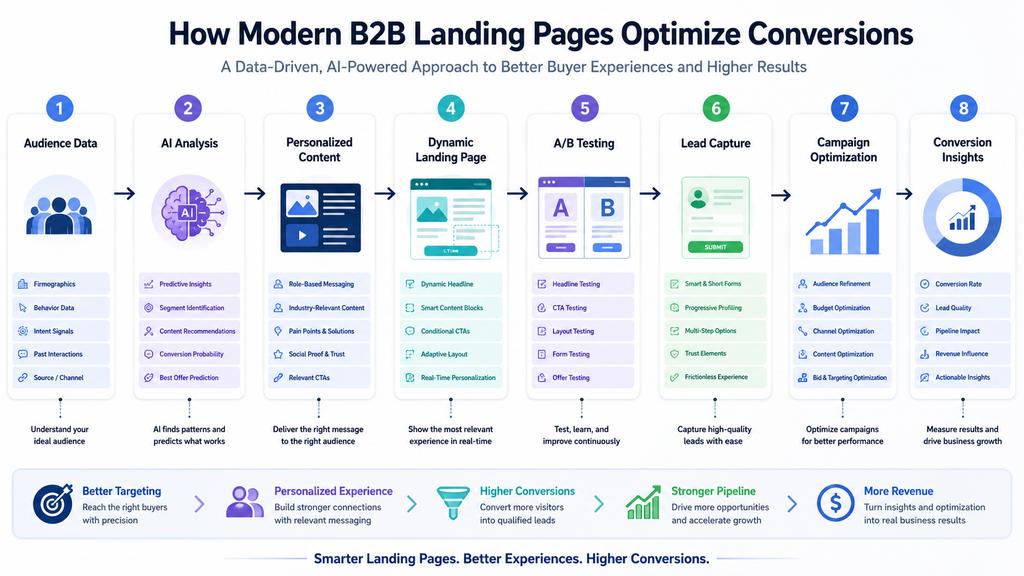
AI can support landing page optimization throughout the marketing process.
Audience research
AI can analyze customer and account data to identify patterns.
Content creation
AI can help marketers develop different messaging variations for testing.
Personalization
AI can support audience segmentation and personalized experiences.
Conversion analysis
AI can identify potential patterns in visitor behavior.
Testing
AI can help marketers generate hypotheses and test ideas.
Campaign optimization
AI can help connect campaign performance with landing-page behavior.
However, AI should support—not replace—marketing strategy.
A poorly positioned offer will not become successful simply because AI generated the copy.
The fundamentals still matter:
Audience + Intent + Value + Trust + Experience + CTA
How to Personalize a B2B Landing Page
Personalization works best when it helps the visitor find relevant information faster.
Here are several practical approaches.
Industry personalization
Create different messaging for industries such as:
- Technology
- SaaS
- Manufacturing
- Financial services
- Healthcare
Company-size personalization
Enterprise buyers may care about scalability and governance, while smaller companies may focus more on speed and cost.
Campaign personalization
Make the landing page reflect the exact campaign that generated the visit.
Buying-stage personalization
A first-time visitor may need educational content.
A returning visitor may be ready for:
Book a Consultation
Account-based personalization
For ABM campaigns, businesses can create experiences specifically designed around priority accounts or account segments.
The key is to use personalization where it creates genuine value.
Common B2B Landing Page Mistakes
Even well-designed landing pages can underperform.
1. Using generic messaging
If your headline could belong to any company, it probably isn’t specific enough.
2. Targeting everyone
A page designed for everyone often feels relevant to no one.
3. Focusing only on design
Visual design matters, but messaging and offer relevance are equally important.
4. Using too many CTAs
Multiple competing actions can create confusion.
5. Asking for too much information
Long forms can create unnecessary friction.
6. Ignoring mobile users
Many visitors will experience your page on mobile devices.
7. Not testing
Without testing, optimization becomes guesswork.
8. Measuring only leads
A large number of low-quality leads does not necessarily mean a successful campaign.
9. Using AI without strategy
AI-generated content cannot replace customer research, positioning, or a clear business objective.
Best Practices for B2B Landing Pages in 2026
Follow these practices to build stronger conversion experiences:
- Give each landing page one primary goal.
- Write a clear and specific headline.
- Match landing page messaging with campaign messaging.
- Focus on the visitor’s business challenge.
- Use personalization only when it adds value.
- Keep forms as simple as possible.
- Test pages continuously.
- Optimize for both desktop and mobile.
- Use AI to support analysis and optimization.
- Measure lead quality beyond the initial conversion.
The most successful B2B Landing Pages will combine technology with a strong understanding of human decision-making.
Frequently Asked Questions
What is B2B landing page optimization?
B2B landing page optimization is the process of improving a landing page’s content, messaging, design, user experience, personalization, and conversion elements to attract relevant business buyers and generate qualified leads.
How do you optimize a B2B landing page?
Start by identifying the target audience and search intent. Then create a clear value proposition, match the page to the campaign, optimize the CTA and form, add trust signals, improve mobile performance, and continuously test page elements based on conversion and pipeline data.
What makes a good B2B landing page?
A good B2B landing page clearly communicates who the solution is for, what problem it solves, why the visitor should trust the company, and what action they should take next. It should also provide a fast, simple, mobile-friendly experience.
How can AI improve B2B landing pages?
AI can help marketers analyze visitor behavior, identify audience segments, create content variations, personalize experiences, develop testing ideas, and identify opportunities for conversion optimization.
How does personalization improve B2B landing page conversions?
Personalization makes landing-page content more relevant to the visitor’s industry, company, buying stage, campaign source, or needs. A more relevant experience can make it easier for visitors to understand the value of an offer and take the next step.
What are the best B2B landing page optimization strategies?
Key strategies include matching content to search intent, creating a clear value proposition, using campaign-specific messaging, personalizing experiences, simplifying forms, adding social proof, improving page speed, optimizing for mobile, and continuously testing conversion elements.
How do you measure B2B landing page performance?
Measure traffic, engagement, conversion rate, qualified leads, account engagement, sales opportunities, pipeline, and revenue. B2B marketers should evaluate both immediate conversions and downstream business outcomes.
What is the role of landing pages in B2B demand generation?
Landing pages provide a focused destination for campaigns and help convert interested prospects into leads or other measurable actions. When connected with content, advertising, intent data, CRM systems, and sales follow-up, landing pages can become an important part of a B2B demand generation strategy.
Final Thoughts
B2B landing page optimization is no longer just about changing colors, buttons, or page layouts.
In 2026, successful B2B landing pages combine search intent, strong messaging, AI, personalization, buyer data, campaign alignment, conversion optimization, and continuous testing.
The businesses that treat landing pages as part of their broader demand generation strategy will be better positioned to attract the right buyers, generate higher-quality opportunities, and build a stronger pipeline.
The goal is simple:
Don’t just drive more traffic to your landing page.
Turn the right traffic into meaningful B2B opportunities.