Introduction
B2B marketing is not just about collecting contact details. Businesses also need to build awareness, earn trust, educate potential buyers, and create interest in their solutions.
This is why Demand Generation vs Lead Generation is an important topic for marketing teams in 2026. Although both strategies support business growth, they serve different purposes.
Demand generation helps potential buyers discover your brand and understand the value of your solution. Lead generation focuses on identifying interested prospects and encouraging them to take an action, such as completing a form or requesting a consultation.
Understanding the difference can help B2B businesses plan campaigns more effectively, attract relevant audiences, and build a stronger sales pipeline.
In this guide, we will explain seven key differences, practical examples, common mistakes, and ways to use both strategies together.
Table of Contents
What Is Demand Generation vs Lead Generation?
Demand generation and lead generation are connected, but they have different objectives.
What Is Demand Generation?
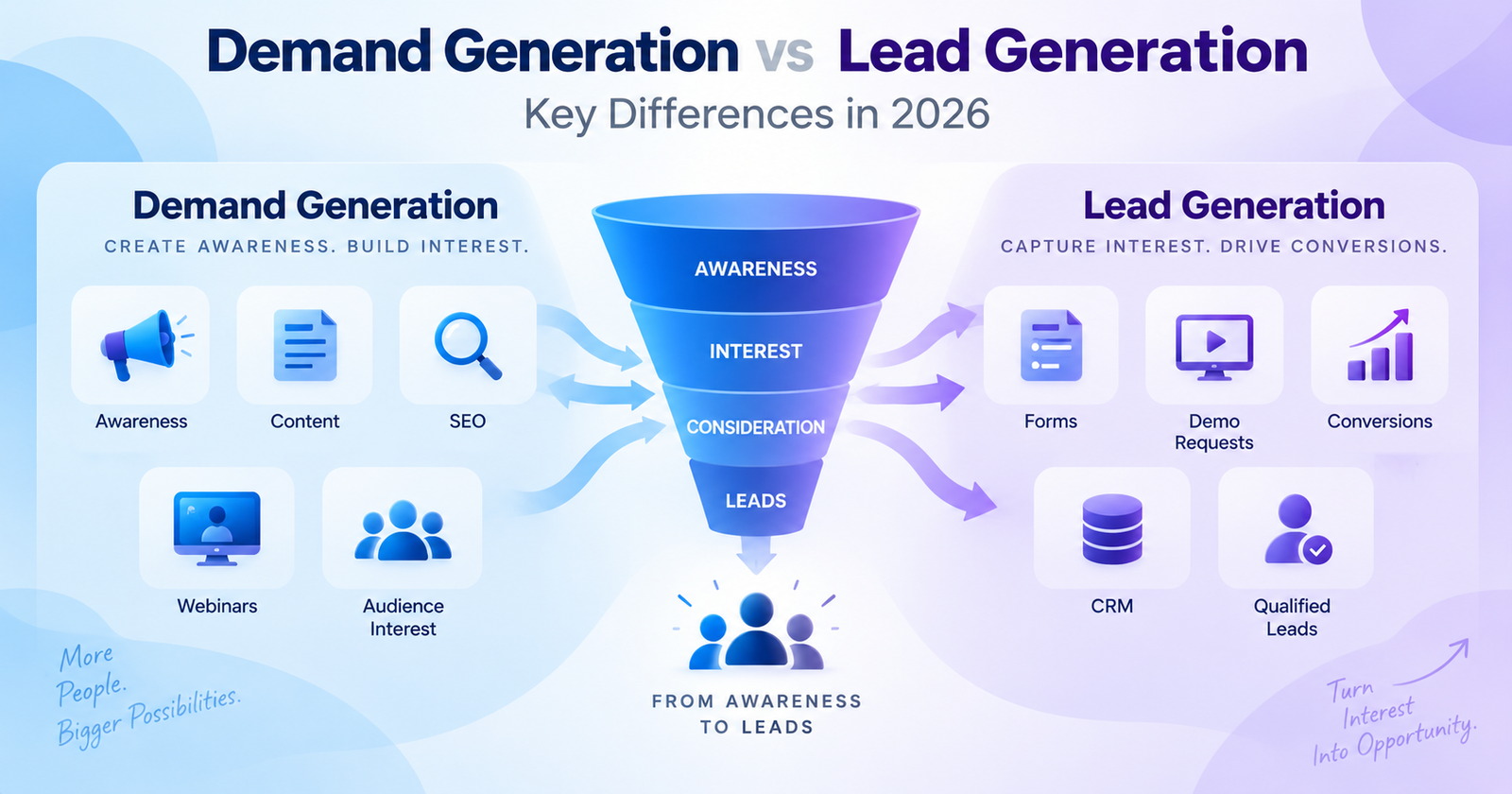
Demand generation is a marketing approach designed to build awareness, interest, and trust in a brand and its solutions.
It helps potential buyers understand a problem, explore possible solutions, and recognize why a business may be worth considering.
Common demand generation activities include:
- Publishing educational blogs and industry insights.
- Sharing useful content on LinkedIn.
- Creating research reports and white papers.
- Hosting webinars and educational events.
- Using SEO to attract relevant organic traffic.
- Sharing expert opinions and customer success stories.
For example, a B2B technology company might publish a blog explaining how businesses can improve lead quality through better data. Readers may find the article useful without immediately contacting the company.
That interaction can still introduce the brand to a potential buyer and help build familiarity over time.
The main objective is to develop awareness and interest among the right audience.
What Is Lead Generation?
Lead generation focuses on attracting potential buyers and encouraging them to take an action that identifies their interest.
This action might involve submitting a form, downloading a resource, registering for a webinar, or requesting a product demonstration.
Common lead generation activities include:
- Creating dedicated landing pages.
- Offering downloadable guides and white papers.
- Running paid search and social campaigns.
- Adding relevant forms to website pages.
- Offering consultations or product demonstrations.
- Developing targeted email campaigns.
For example, the same technology company might offer a downloadable B2B data quality guide through a landing page. Visitors who submit their details become identifiable leads.
The goal is to generate relevant prospects who may eventually become customers.
Demand Generation vs Lead Generation: Main Differences
The simplest way to understand the difference is:
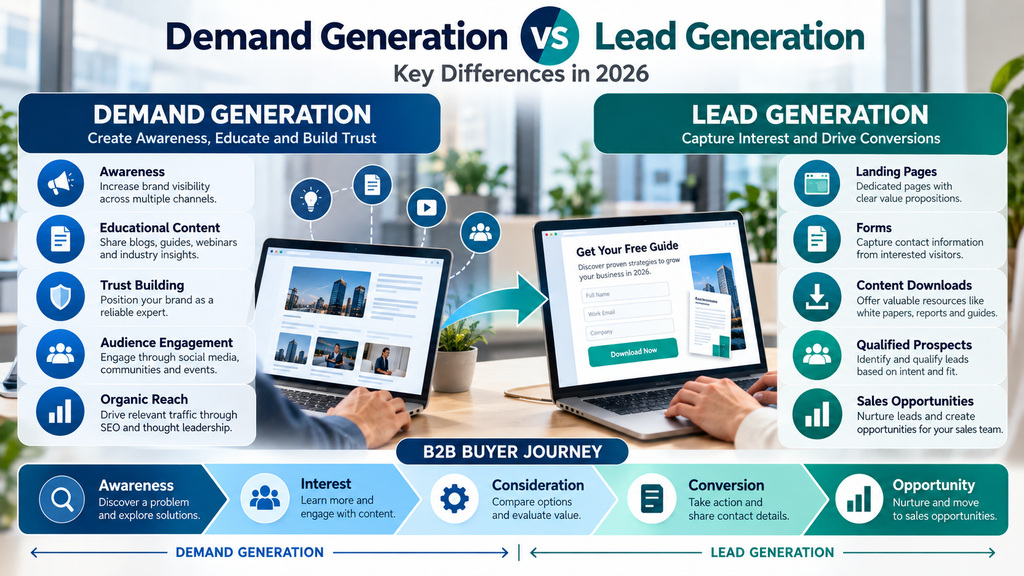
Demand generation creates interest. Lead generation captures that interest.
Demand generation asks:
How can we make the right audience interested in this problem and solution?
Lead generation asks:
How can we convert interested prospects into identifiable opportunities?
A prospect can interact with demand-generation content several times before becoming a lead.
For example:
A buyer searches for information about marketing automation.
They discover an educational article.
They later read a guide about buyer intent data.
A week later, they return through Google.
They eventually register for a webinar.
The articles and educational content created demand.
The webinar registration generated the lead.
Why Demand Generation vs Lead Generation Matters in 2026
B2B buyers often research problems and potential solutions before speaking with a sales representative. They may read articles, compare vendors, watch videos, and ask colleagues for recommendations.
This makes educational content and brand visibility important parts of a B2B marketing strategy.
At the same time, businesses need ways to identify interested prospects, understand their needs, and create opportunities for sales conversations.
Using demand generation without a clear conversion path can make it difficult to connect marketing activities to business outcomes. Using lead generation without building awareness and trust can produce contacts who are not ready to buy.
A balanced strategy addresses both needs.
For B2B marketing companies such as Rich Demand Tech, this means publishing useful educational content while offering relevant next steps, such as white paper downloads, newsletter subscriptions, and consultations.
Demand Generation vs Lead Generation: Key Differences
1. Primary Goal
The main goal of demand generation is to build interest and awareness.
The main goal of lead generation is to capture contact information and create potential sales opportunities.
Demand generation therefore focuses more heavily on:
- Education
- Awareness
- Trust
- Market interest
- Brand visibility
- Buyer engagement
Lead generation focuses more heavily on:
- Form submissions
- Registrations
- Contact capture
- Demo requests
- Qualified leads
- Sales opportunities
2. Position in the Marketing Funnel
Demand generation generally begins earlier in the buyer journey.
A buyer may not even know which solution they need yet.
Demand-generation content helps the buyer understand the problem and available approaches.
Lead generation usually becomes more important after the buyer has developed some level of interest.
A simple journey may look like:
Awareness → Education → Interest → Engagement → Lead → Qualification → Opportunity → Revenue
Demand generation influences the earlier and middle stages.
Lead generation becomes more prominent when the company begins converting that interest into identifiable prospects.
3. Gated vs Ungated Content
Demand-generation content is often ungated.
That means the visitor can access the information without completing a form.
Examples include:
- Blog posts
- Guides
- Videos
- Social posts
- Research summaries
- Educational resources
This reduces friction and allows more buyers to discover the company’s expertise.
Lead-generation campaigns often use gated experiences.
For example:
Download our complete report by entering your business email.
The business receives contact information in exchange for access to a valuable resource.
Neither approach is automatically better.
The right choice depends on the buyer’s stage and the value of the content.
4. Success Metrics
Demand generation and lead generation should not be evaluated using exactly the same metrics.
Demand Generation Metrics
Useful demand-generation metrics can include:
- Organic search impressions
- Website traffic
- Branded search volume
- Content engagement
- Returning visitors
- Social reach
- Account engagement
- Buyer intent signals
- Marketing-influenced pipeline
Lead Generation Metrics
Lead-generation metrics can include:
- Number of leads
- Cost per lead
- Form conversion rate
- Marketing-qualified leads
- Sales-qualified leads
- Lead-to-opportunity rate
- Demo requests
- Pipeline generated
- Customer acquisition cost
The most important lesson is that neither strategy should be measured using volume alone.
A campaign producing 1,000 poor-quality leads may be less valuable than one generating 100 highly relevant prospects.
5. Content Strategy
Demand-generation content usually answers educational questions.
Examples:
- What is B2B intent data?
- How does marketing automation work?
- Why does B2B data quality matter?
- How can businesses improve demand generation?
Lead-generation content typically gives the visitor a reason to take the next step.
Examples:
- Download the full research report
- Register for the webinar
- Request a personalized demo
- Get the comparison checklist
- Book a consultation
A strong B2B strategy needs both types of content.
Examples of Demand Generation
Imagine a B2B marketing technology company wants to attract marketing leaders.
It could publish:
Educational SEO content
Articles targeting questions buyers are already researching.
Original research
Industry benchmarks, reports, surveys, and market insights.
Thought leadership
Expert perspectives distributed through LinkedIn, newsletters, videos, or events.
Intent-focused content
Resources helping prospects understand buying signals and customer behavior.
For example, our guide to B2B Intent Data explains how companies can identify and use buyer signals.
Educational webinars
Sessions that help prospects solve specific problems without immediately pushing a sales pitch.
All of these activities can create interest without necessarily generating an immediate lead.
Examples of Lead Generation
Lead generation begins converting some of that audience into identifiable prospects.
Examples include:
White paper download
A visitor provides a business email to receive an in-depth report.
Demo request
A prospect asks to see the company’s platform.
Webinar registration
The business captures attendee information during registration.
Newsletter signup
A visitor gives permission for continued communication.
Contact form
A prospect contacts the company directly about a product or service.
These actions allow marketing and sales teams to continue the relationship.
How Demand Generation and Lead Generation Work Together
The strongest B2B marketing strategies do not choose one and ignore the other.
Demand generation creates the environment in which lead generation becomes more effective.
Consider this sequence:
Step 1 — Awareness
A potential buyer discovers an educational article through search.
Step 2 — Education
They read additional resources and begin understanding their problem.
Step 3 — Interest
They return to the website, follow the company, or consume additional content.
Step 4 — Intent
Their behavior indicates stronger interest in a particular solution.
B2B Intent Data can help teams identify and interpret some of these signals.
Step 5 — Conversion
The prospect downloads a report, registers for an event, or requests a demo.
Now they have become a lead.
Step 6 — Nurturing
Marketing continues delivering useful information based on the prospect’s interests.
B2B Marketing Automation can help companies manage these workflows more efficiently.
Step 7 — Sales Opportunity
When the prospect demonstrates sufficient fit and buying intent, the lead can move into a sales conversation.
Demand generation and lead generation therefore support different parts of the same revenue process.
Should B2B Companies Focus on Demand Generation or Lead Generation?
Most B2B companies need both.
Focusing only on lead generation can create problems.
Companies may collect large databases of contacts who have very little buying intent.
Sales teams then spend time contacting prospects who are not ready to purchase.
Focusing only on demand generation can also create problems.
A company may build awareness and attract an audience but fail to provide clear opportunities for interested buyers to take the next step.
The stronger strategy is to balance both activities.
Use demand generation to:
- Educate your market
- Build credibility
- Create awareness
- Generate interest
- Increase buying intent
Then use lead generation to:
- Capture interested prospects
- Identify potential buyers
- Qualify opportunities
- Begin nurturing
- Connect qualified prospects with sales
Where Does Intent Data Fit?
Intent data can help connect demand generation and lead generation.
Not every visitor who consumes content completes a form.
However, businesses can analyze certain behavioral signals to better understand which topics and solutions prospects appear interested in.
Intent signals might include:
- Repeated website visits
- Product-page engagement
- Content consumption
- Topic research
- Pricing-page activity
- Event participation
- Comparison-page visits
These signals can help marketing teams prioritize accounts and provide more relevant experiences.
The important point is that intent does not automatically equal purchase readiness.
Signals should be combined with account fit, engagement, context, and other qualification criteria.
Where Does Marketing Automation Fit?
Marketing automation helps companies manage the transition from initial interest to ongoing engagement.
For example, when someone downloads a report, marketing automation may:
- Add the prospect to the CRM.
- Record the content they downloaded.
- Send relevant follow-up information.
- Track additional engagement.
- Update lead or account scoring.
- Notify sales when qualification criteria are met.
This makes marketing automation useful for both demand generation and lead-generation programs.
However, automation should support relevance rather than simply increasing the number of messages prospects receive.
Good data is essential here. Poor or outdated information can reduce the effectiveness of both automation and lead qualification. Our guide to B2B Data Quality explains why accurate customer and prospect data matters.
Common Demand Generation and Lead Generation Mistakes
Measuring Success Only by Lead Volume
More leads do not automatically mean more revenue.
Companies should also evaluate lead quality, account fit, pipeline contribution, and conversion.
Gating Everything
If every useful resource requires a form, prospects may leave before they have enough reason to trust the company.
Give buyers enough ungated educational content to understand your expertise.
Asking for a Demo Too Early
Someone reading their first educational article may not be ready to speak with sales.
Provide useful next steps appropriate to the buyer’s stage.
Poor Marketing and Sales Alignment
Marketing and sales should agree on:
- Ideal customer profile
- Qualification criteria
- Lead definitions
- Sales handoff
- Follow-up expectations
- Pipeline measurement
Without alignment, marketing may optimize for volume while sales cares about quality.
Ignoring Data Quality
Duplicate, outdated, or inaccurate records can create poor segmentation and wasted sales activity.
Maintaining strong B2B Data Quality helps both marketing and sales work from more reliable information.
Best Practices for 2026
Build Content Around Buyer Problems
Start with genuine customer questions rather than publishing content only because a keyword has search volume.
Create Topic Clusters
Connect related articles instead of publishing isolated posts.
For example:
B2B Demand Generation
can connect to:
- Demand generation vs lead generation
- B2B intent data
- Marketing automation
- B2B data quality
- Landing-page optimization
- Demand-generation KPIs
- Demand-generation strategy
This gives readers a clear path to continue learning while strengthening the site’s internal content structure.
Reduce Unnecessary Friction
Not every page needs a form.
Let buyers learn before asking them to convert.
Create Clear Conversion Paths
When prospects are ready, make the next step obvious.
That could include:
- Downloading research
- Joining a newsletter
- Registering for an event
- Contacting the company
- Requesting information
Measure Pipeline, Not Just Activity
Traffic and leads are useful indicators, but ultimately B2B marketing needs to contribute to qualified opportunities and revenue.
Frequently Asked Questions
1. What is the difference between demand generation and lead generation?
Demand generation creates awareness, interest, and buying intent among potential customers. Lead generation captures information from prospects who have demonstrated interest and converts them into identifiable leads.
2. Is lead generation part of demand generation?
Lead generation can be considered one component of a broader demand-generation strategy. Demand generation supports the buyer journey from awareness through interest, while lead generation focuses more specifically on converting that interest into identifiable prospects.
3. Which comes first: demand generation or lead generation?
Demand generation often begins first because buyers typically need awareness and interest before they are ready to provide contact information. However, both activities can operate simultaneously across different audiences and stages of the funnel.
4. Can a company generate demand without generating leads?
Yes. Buyers can discover articles, watch videos, interact with a brand, research solutions, and develop purchase interest without completing a form. This activity can still influence future buying decisions.
5. What are examples of demand-generation activities?
Examples include SEO, educational content, webinars, research, thought leadership, social content, events, account-based marketing, paid awareness campaigns, and intent-data programs.
6. What are examples of lead-generation activities?
Examples include demo requests, contact forms, gated white papers, webinar registrations, free trials, consultations, newsletter signups, and pricing requests.
7. Should B2B companies prioritize demand generation or lead generation?
Most B2B companies need both. Demand generation creates the interest that makes lead generation more effective, while lead generation gives interested buyers a clear path toward becoming qualified opportunities.
8. What is demand generation vs lead generation?
Demand generation vs lead generation refers to the difference between creating interest in a product or service and capturing that interest through forms, signups, demo requests, or other conversion actions.
Final Thoughts
The difference between demand generation and lead generation becomes simple once their objectives are separated.
Demand generation creates demand.
Lead generation captures demand.
A successful B2B strategy does not treat them as competing approaches.
Demand generation attracts, educates, and builds trust with potential buyers.
Lead generation creates conversion opportunities when those buyers are ready to take the next step.
When both strategies are connected through useful content, accurate data, intent signals, marketing automation, and strong sales alignment, companies can focus less on collecting the maximum number of contacts and more on creating qualified pipeline.
For a complete framework covering strategy, funnels, KPIs, channels, AI, and measurement, continue with our B2B Demand Generation: Complete Guide for 2026.
Understanding demand generation vs lead generation helps B2B teams build a marketing strategy that creates awareness first and converts interested buyers at the right stage.