Introduction
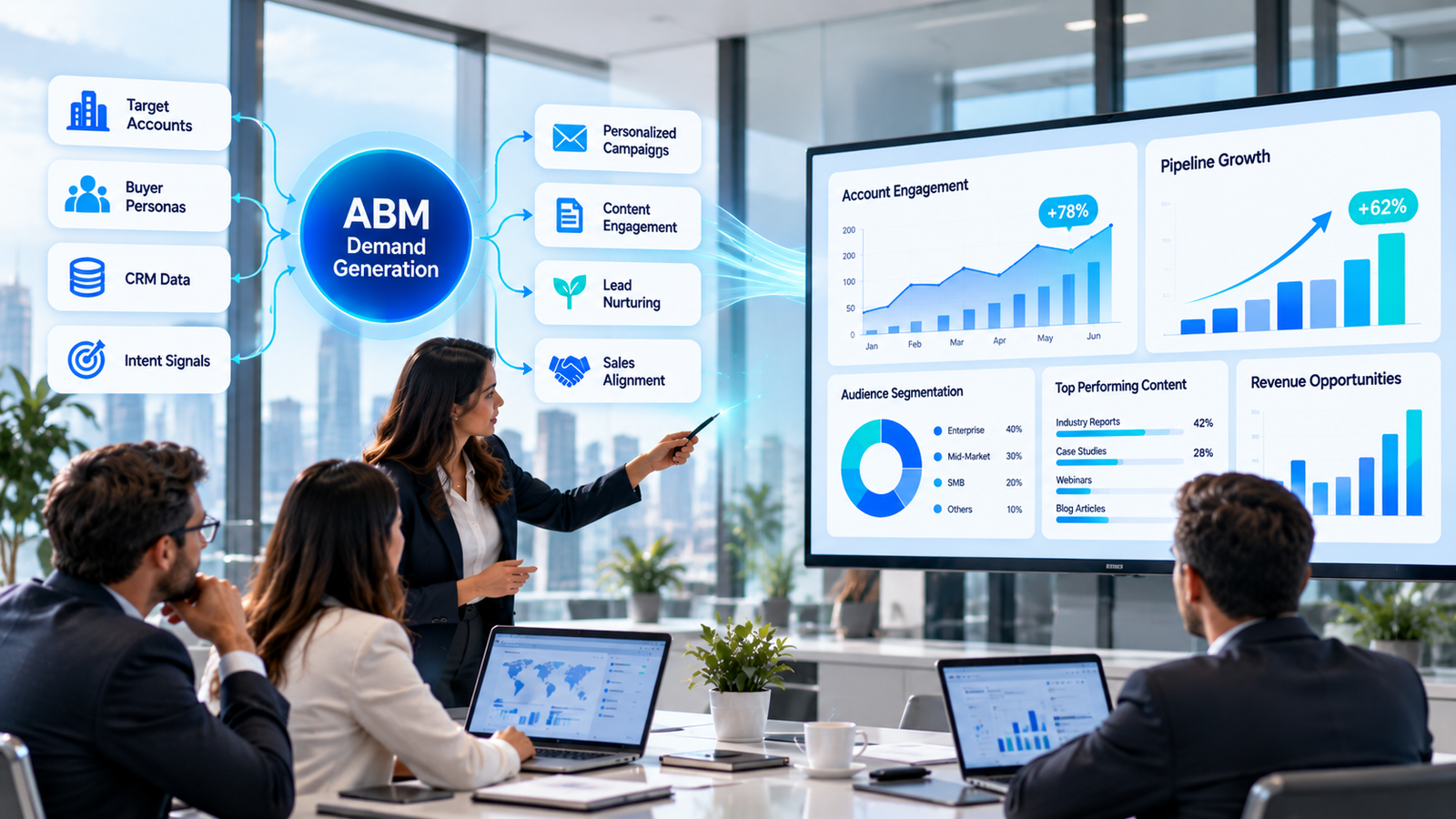
B2B marketing is becoming more focused on the quality of engagement, not simply the number of leads generated. Companies need to identify the right accounts, understand their buying needs, create relevant experiences, and work closely with sales throughout the customer journey.
This is where ABM Demand Generation becomes valuable.
ABM can make demand generation more focused by connecting broad audience-building activities with specific target accounts.
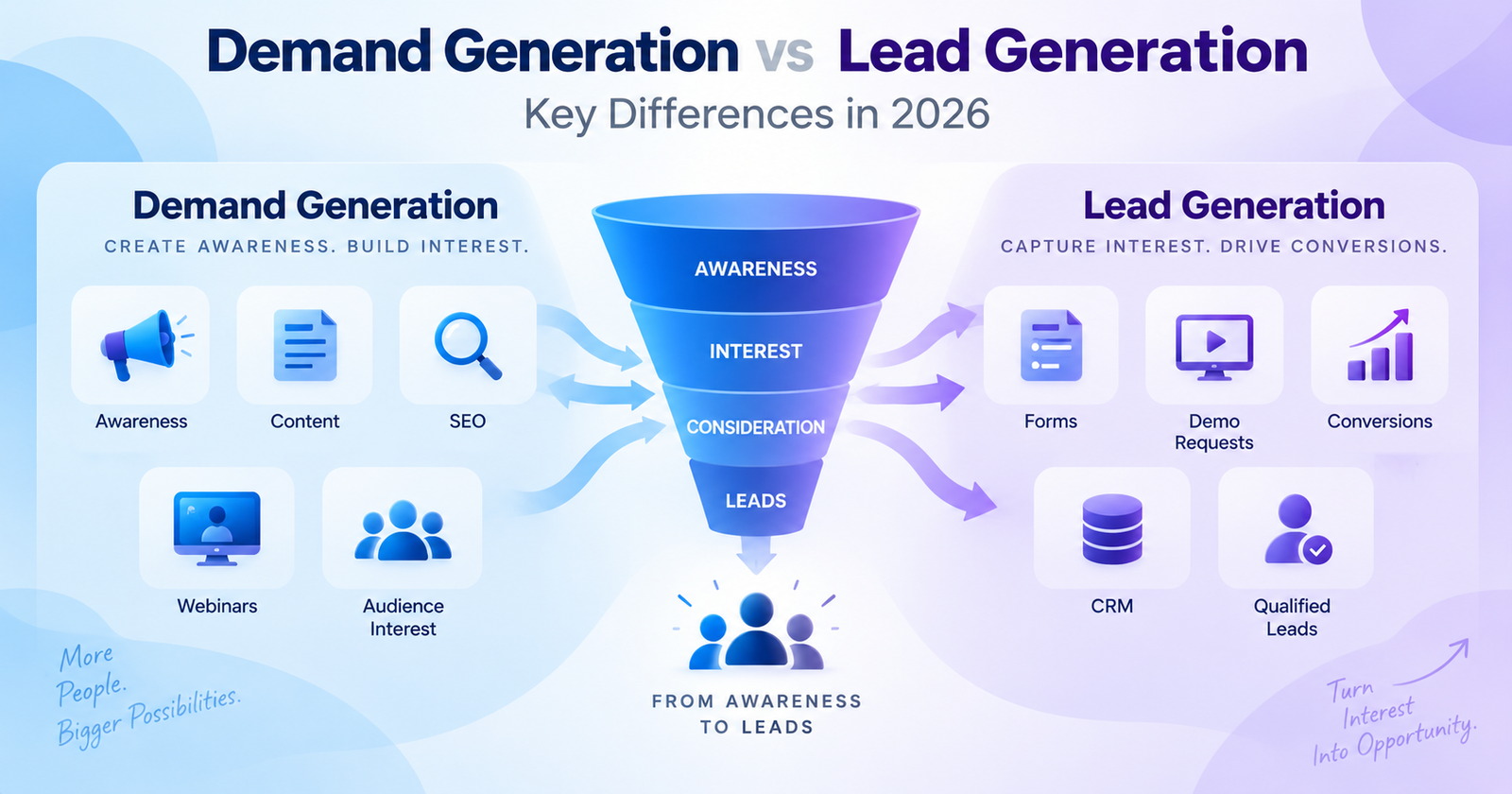
Account-Based Marketing (ABM) focuses marketing and sales efforts on specific accounts that fit a company’s business objectives. Demand generation, meanwhile, creates awareness, interest, and engagement around a company’s products or services.
When these approaches work together, marketing teams can create broader demand while giving additional attention to high-value accounts.
Salesforce describes ABM as a strategy for targeting specific high-value accounts with personalized marketing and sales efforts, while also noting that ABM can complement traditional lead generation rather than replace it.
Table of Contents
What Is ABM Demand Generation?
ABM Demand Generation combines the reach of demand generation with the account-level focus of account-based marketing.
Traditional demand generation may attract a broad audience through channels such as:
- SEO
- Content marketing
- Paid advertising
- Webinars
- Social media
- Email campaigns
- Events
ABM adds another layer of focus.
Instead of treating every prospect the same, marketing teams identify accounts that closely match their ideal customer profile and create more relevant experiences for them.
For example, imagine a B2B software company selling an enterprise analytics platform.
A broad demand generation campaign may attract hundreds of businesses interested in analytics.
An ABM approach can then identify a smaller group of companies that match the company’s ideal customer profile. Marketing can create account-specific campaigns for those organizations while sales receives information about engagement from those accounts.
This creates a connected path:
Market Awareness → Target Accounts → Engagement → Nurturing → Sales → Pipeline
Why ABM Demand Generation Matters in 2026
B2B buying journeys are increasingly spread across multiple channels.
This creates a challenge for marketing teams.
A prospect may discover a company through search, read a blog post, visit a product page, download a report, interact with an email, and later speak with sales.
If these interactions are treated as separate activities, valuable context can be lost.
ABM helps bring account-level context into the process.
Instead of asking only:
“How many leads did this campaign generate?”
Teams can also ask:
“Which target accounts are engaging, what are they interested in, and what should happen next?”
That shift can make marketing and sales conversations more focused.
7 Powerful ABM Demand Generation Strategies
1. Define Your Ideal Customer Profile
A strong ABM program starts with a clear Ideal Customer Profile (ICP).
Your ICP should describe the characteristics of companies that are most relevant to your business.
Consider factors such as:
- Industry
- Company size
- Revenue range
- Geographic market
- Technology environment
- Business challenges
- Buying requirements
- Existing customer characteristics
For example, a B2B cybersecurity company may define its ICP around mid-market and enterprise companies with specific security requirements and technology environments.
The goal is not simply to create a large account list.
The goal is to create a useful definition of the accounts your organization wants to engage.
2. Build a Focused Target Account List
Once the ICP is defined, create a target account list.
Accounts can be prioritized using a combination of:
- Firmographic data
- Existing CRM information
- Website engagement
- Intent signals
- Previous interactions
- Product fit
- Buying-stage information
- Sales intelligence
You can divide accounts into different tiers based on strategic importance and the level of personalization required.
For example:
Tier 1: Highly personalized account campaigns
Tier 2: Segment-based personalized campaigns
Tier 3: Broader demand generation with account-level tracking
This allows marketing teams to balance personalization with scalability.
3. Understand the Buying Committee
B2B purchases often involve multiple people.
A single account may include:
- Business leaders
- Department heads
- Technical evaluators
- Procurement teams
- Finance stakeholders
- End users
Each person may have different questions.
A CFO may care about business value and cost.
A technical leader may focus on integrations and security.
An end user may care about usability.
ABM Demand Generation should therefore consider the different roles involved in an account’s buying process.
Create content and messaging that address the needs of different stakeholders rather than sending the same message to everyone.
4. Create Personalized Demand Around Account Needs
Once target accounts and buying roles are understood, build campaigns around their needs.
Personalization does not always mean creating a completely different campaign for every company.
Instead, create relevant segments.
For example:
Industry segment → Industry-specific content
Business challenge → Problem-focused messaging
Buyer role → Role-specific content
Buying stage → Appropriate next step
This approach can make campaigns more relevant without creating an unmanageable workload.
Useful assets can include:
- Industry reports
- Case studies
- Webinars
- Product guides
- Research reports
- Comparison pages
- Landing pages
- Educational blog posts
5. Engage Target Accounts Across Multiple Channels
ABM should not depend on a single marketing channel.
Target accounts may interact with your company through:
- Organic search
- Paid advertising
- Webinars
- Events
- Website content
- Sales outreach
- Downloadable resources
The objective is to create a consistent experience across these touchpoints.
For example, if an account downloads a report about data quality, the next campaign can introduce content related to data management rather than returning to a generic awareness message.
6. Align Marketing and Sales
ABM works best when marketing and sales share information.
Marketing can provide sales with insights such as:
- Which target accounts are active
- Which content they viewed
- Which campaigns generated engagement
- Which contacts interacted
- Which topics attracted attention
- Where accounts appear to be in the buying journey
Sales can then use those insights when planning outreach.
A simple process might look like:
Marketing identifies engagement → Account reaches engagement threshold → Sales receives context → Sales follows up → Marketing continues nurturing
This creates a more connected revenue process.
7. Measure and Optimize Account-Level Performance
ABM requires more than measuring lead volume.
Track metrics that show what is happening at the account level.
Useful measurements include:
| Area | Example Metrics |
|---|---|
| Account engagement | Website visits, content interactions, email engagement |
| Reach | Target accounts reached, buying roles engaged |
| Pipeline | Opportunities created, pipeline value |
| Sales alignment | Marketing-qualified accounts, sales follow-ups |
| Conversion | Account-to-opportunity conversion |
| Revenue | Closed revenue and customer expansion |
The exact metrics should depend on your business model and sales cycle.
The important point is to connect marketing activity with meaningful account progression.
How to Build an ABM Demand Generation Strategy
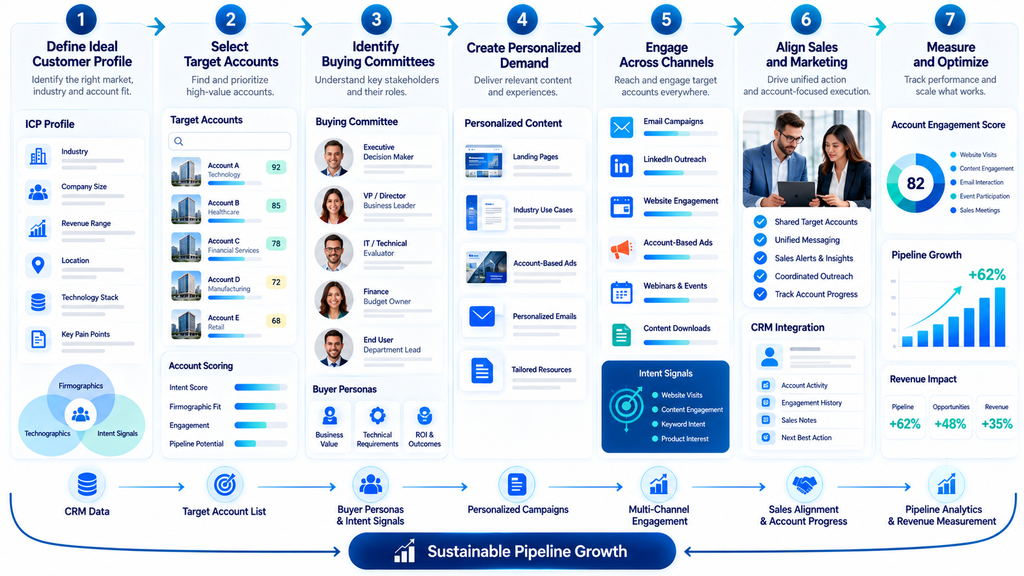
A practical strategy can be built in seven steps.
Step 1: Define Your ICP
Document the industries, company characteristics, business needs, and buying conditions that make an account relevant.
Step 2: Select Target Accounts
Use CRM data, firmographics, intent, engagement, and sales input to develop your target account list.
Step 3: Map Buying Committees
Identify the different people who may influence or approve a purchase.
Step 4: Create Relevant Content
Develop content that answers the questions and challenges of your target accounts.
Step 5: Launch Multichannel Campaigns
Use a combination of organic, paid, email, social, events, website experiences, and sales engagement.
Step 6: Create a Sales Handoff
Define when marketing should involve sales and what information sales should receive.
Step 7: Measure and Improve
Review account engagement, pipeline progression, conversion, and revenue outcomes regularly.
A well-planned ABM Demand Generation strategy can help marketing and sales teams focus on relevant accounts.
This framework keeps ABM connected to the larger demand generation process rather than treating it as a separate marketing activity.
Where B2B Landing Pages Fit Into ABM Demand Generation
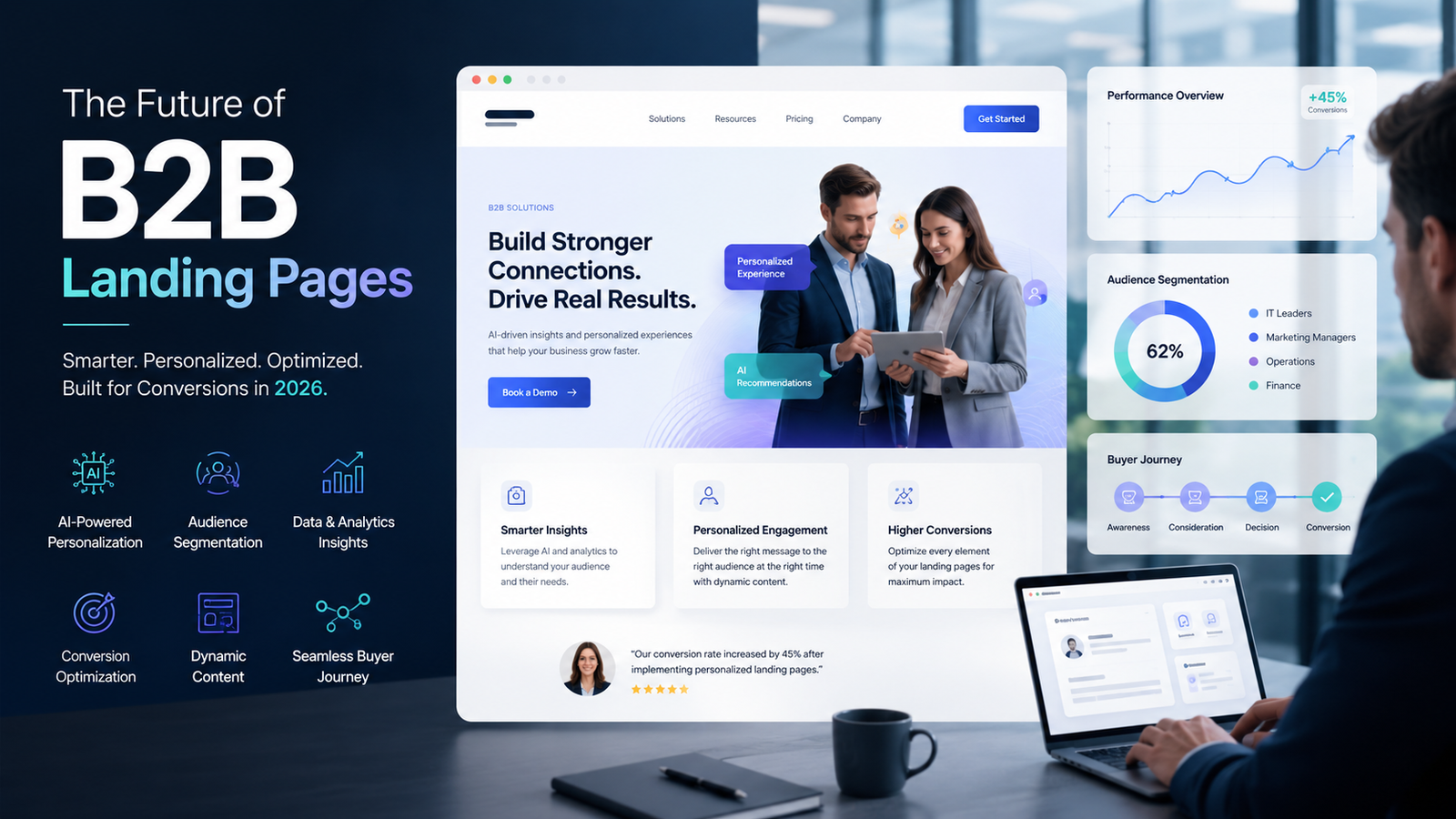
Landing pages can play an important role in account-focused campaigns.
Instead of sending every visitor to the same generic page, businesses can create landing pages around:
- Industry needs
- Specific solutions
- Business challenges
- Buyer roles
- Campaign themes
- High-intent search queries
For example, a technology company targeting financial services could create a page focused specifically on the challenges financial institutions face.
The page can then connect the campaign message with relevant proof points, resources, and calls to action.
Common ABM Demand Generation Mistakes to Avoid
Focusing Only on Lead Volume
Generating more leads does not automatically mean generating more valuable opportunities.
ABM requires teams to consider account quality and engagement.
Choosing Too Many Target Accounts
If every company becomes a target account, the strategy can lose its focus.
Start with a manageable account list and expand as the process becomes more mature.
Treating ABM as Only a Marketing Function
ABM involves marketing, sales, and often customer success.
Without collaboration, account insights can remain disconnected between teams.
Over-Personalizing Everything
Personalization should be useful rather than excessive.
Segment-level personalization can often provide a practical balance between relevance and scalability.
Ignoring Existing Demand
ABM should complement broader demand generation rather than completely replace it. Salesforce explicitly describes ABM as complementary to traditional lead generation.
Best Practices for Sustainable B2B Growth
Keep Marketing and Sales Goals Connected
Agree on target accounts, definitions, handoff processes, and measurement.
Build One Account View
Connect CRM, marketing engagement, website behavior, and sales activity where possible.
Focus on Buyer Needs
Build campaigns around real business problems instead of simply promoting products.
Use Data to Prioritize
Use account and engagement data to decide where additional attention is appropriate.
Test and Improve
Review campaign performance regularly.
Test different messages, content formats, channels, landing pages, and calls to action.
Connect Activity to Pipeline
Do not stop measurement at impressions or clicks.
Frequently Asked Questions
1. What is ABM demand generation?
ABM demand generation combines account-based marketing with demand generation to attract and engage specific high-value B2B accounts. Instead of targeting a broad audience, businesses identify priority accounts and deliver personalized content, campaigns, and experiences based on their business needs and buying behavior.
2. How does ABM improve B2B demand generation?
ABM makes B2B demand generation more targeted and relevant by focusing marketing resources on accounts with the highest revenue potential. Personalized campaigns can improve account engagement, strengthen sales and marketing alignment, and help move qualified accounts toward sales opportunities.
3. How do you build an ABM demand generation strategy?
Start by defining your ideal customer profile (ICP), selecting high-value target accounts, researching decision-makers and buying signals, creating personalized content, launching targeted campaigns, aligning sales and marketing, and measuring account engagement and pipeline performance.
4. What is the difference between ABM and demand generation?
Demand generation focuses on creating awareness and interest across a broader target market, while ABM focuses on specific high-value accounts. ABM uses personalized campaigns and account-level insights to engage selected companies and support their journey toward becoming customers.
5. How do you identify target accounts for ABM?
Businesses can identify target accounts by evaluating factors such as industry, company size, revenue potential, location, technology usage, business challenges, customer fit, intent signals, and previous engagement. These factors help create a prioritized account list based on the ideal customer profile.
6. How does ABM generate B2B leads?
ABM generates B2B leads by identifying relevant companies and engaging the decision-makers within those organizations through personalized content, LinkedIn campaigns, email marketing, targeted advertising, webinars, landing pages, and sales outreach.
7. How can AI improve ABM demand generation?
AI can help identify high-value accounts, analyze intent signals, enrich prospect data, personalize content, predict buying behavior, automate campaign workflows, and prioritize accounts based on engagement. This enables B2B marketers to scale personalized ABM campaigns more efficiently.
8. What are the benefits of ABM for B2B companies?
Key benefits include better targeting, more relevant customer experiences, improved sales and marketing alignment, stronger account engagement, higher-quality opportunities, more efficient marketing spend, and greater potential for predictable pipeline and revenue growth.
9. How do you measure ABM demand generation success?
ABM performance can be measured using metrics such as target-account engagement, website visits, content engagement, marketing-qualified accounts, sales opportunities, pipeline generated, conversion rates, deal velocity, customer acquisition cost, and revenue influenced by ABM campaigns.
10. What are the best ABM strategies for B2B companies?
Effective ABM strategies include creating a clearly defined ICP, prioritizing high-value accounts, using intent data, personalizing content, running account-based advertising, creating personalized landing pages, coordinating sales and marketing outreach, and continuously optimizing campaigns based on account-level engagement.
11. How does ABM help increase B2B sales and revenue?
ABM focuses marketing and sales efforts on accounts that have a strong potential to become customers. By delivering relevant messaging at the right stage of the buying journey, businesses can improve engagement, create better sales opportunities, shorten complex buying cycles, and increase the potential for revenue growth.
12. Can small and medium-sized B2B companies use ABM?
Yes. ABM is not limited to enterprise companies. Small and medium-sized B2B businesses can start with a focused list of high-value accounts and use channels such as LinkedIn, email, content marketing, personalized landing pages, and sales outreach to build meaningful account engagement.
13. How can businesses create a scalable ABM demand generation strategy?
Businesses can create a scalable ABM demand generation strategy by starting with a clearly defined ideal customer profile (ICP) and prioritizing high-value target accounts. From there, marketers can use account and intent data to understand buyer needs, develop personalized content, and run targeted campaigns across channels such as LinkedIn, email, paid advertising, SEO, and personalized landing pages. Sales and marketing teams should work together and use automation and AI to scale personalization, monitor account engagement, and optimize campaigns based on pipeline and revenue outcomes.
Final Thoughts
ABM Demand Generation brings together two important B2B marketing approaches: creating demand across a market and focusing additional attention on accounts that fit specific business priorities.
The strategy starts with a clear ICP and target account list. From there, teams can understand buying committees, create relevant content, engage accounts across channels, align marketing with sales, and measure account-level progression.
The goal is not simply to generate more activity.
By combining account targeting with broader demand creation, ABM Demand Generation can support sustainable B2B growth.
It is to create a more connected process in which marketing and sales understand which accounts matter, what those accounts need, how they are engaging, and what action should happen next.
For B2B companies building sustainable growth, that account-level perspective can become an important part of a broader demand generation strategy.