Introduction
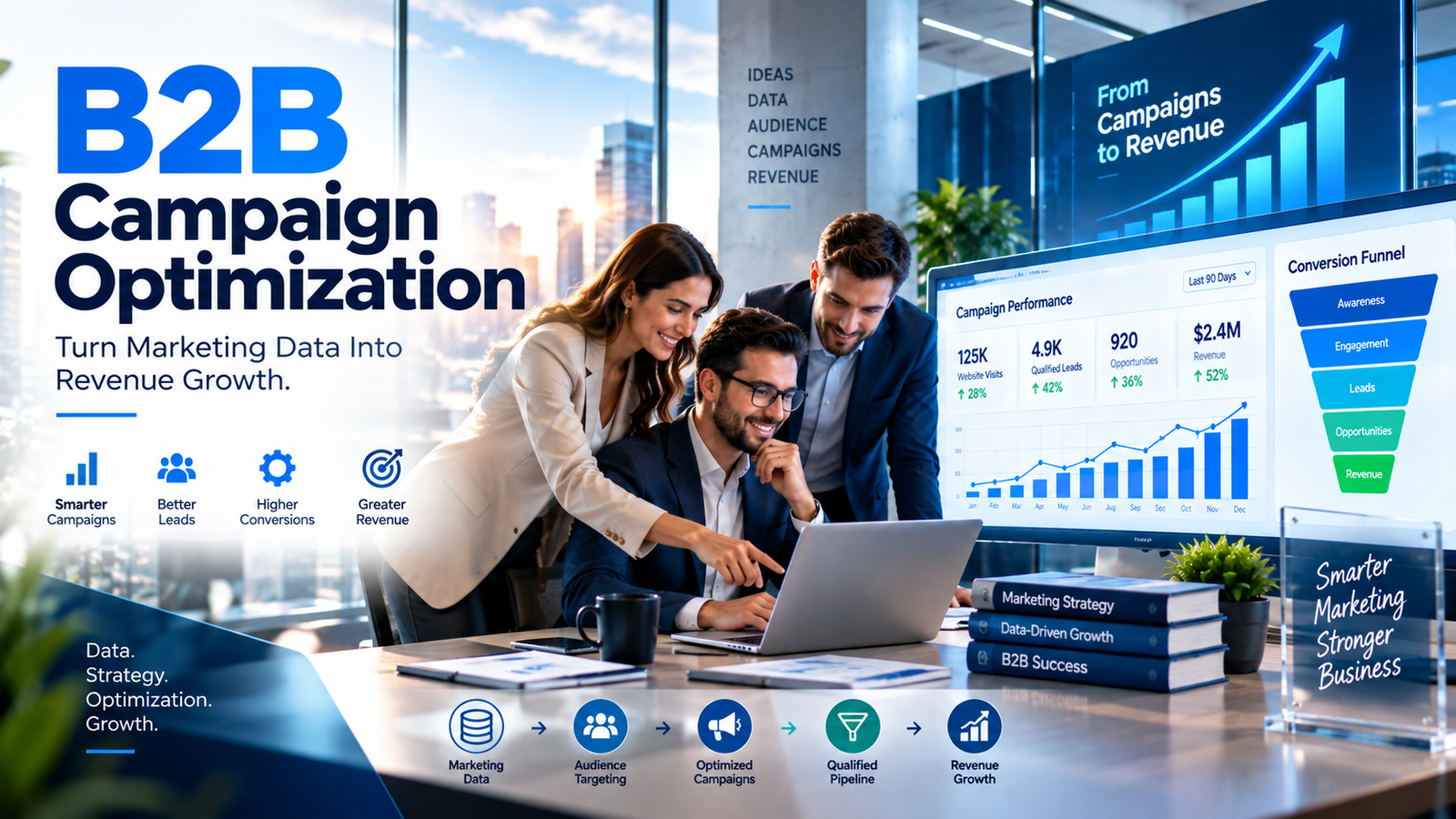
B2B campaign optimization helps marketing teams turn campaign data into better decisions, more qualified leads, and measurable revenue growth. But tracking impressions, clicks, and downloads alone doesn’t show whether a campaign is contributing to the sales pipeline.
In 2026, B2B marketers need to understand which audiences engage, which channels generate qualified opportunities, and where potential buyers drop off. By combining performance data, audience insights, landing-page testing, and sales feedback, businesses can identify what works and improve campaign results over time.
In this guide, you’ll learn seven practical B2B campaign optimization strategies, the key metrics to track, and how to connect marketing performance with pipeline and revenue.
Table of Contents
What Is B2B Campaign Optimization?
B2B Campaign Optimization is the process of continuously improving a B2B marketing campaign using performance data, audience insights, testing, and business results.
It can involve optimizing:
- Audience targeting
- Campaign messaging
- Content
- Email marketing
- Paid advertising
- Landing pages
- Calls to action
- Lead qualification
- Conversion rates
- Campaign budgets
- Sales and marketing alignment
The key word is continuous.
Campaign optimization isn’t something that should happen only after a campaign ends.
Instead, marketers can monitor performance while campaigns are running, identify problems, test improvements, and apply what they learn.
For example, imagine a company launches a campaign promoting a B2B research report.
The campaign receives plenty of clicks, but very few people download the report.
That doesn’t necessarily mean the entire campaign needs to be abandoned.
The problem could be the landing page, form length, offer, messaging, or audience.
Campaign optimization helps marketers investigate where the problem is and make a focused improvement.
Why B2B Campaign Optimization Matters in 2026
B2B buying journeys have become increasingly complex.
A potential customer may discover a company through search, read a blog post, interact with a LinkedIn post, download a white paper, visit a product page, join a webinar, and eventually contact sales.
These interactions can happen across different channels and over different periods of time.
This creates a measurement challenge.
If marketers only look at the final conversion, they may miss the earlier interactions that helped create interest.
Modern campaign optimization therefore requires marketers to look at the bigger picture.
Instead of asking only:
“How many leads did this campaign generate?”
teams can also ask:
- Did we reach the right audience?
- Which content generated meaningful engagement?
- Which channels produced qualified prospects?
- Where are visitors dropping off?
- Which campaigns are contributing to opportunities?
- Which audience segments are responding?
- What should we change next?
These questions turn marketing data into practical decisions.
7 B2B Campaign Optimization Strategies for Revenue Growth
1. Start With a Clear Campaign Objective
Before launching a campaign, define exactly what you want it to achieve.
A goal such as:
“Generate more leads.”
is too broad.
A more useful objective could be:
“Generate qualified opportunities from technology companies with 500+ employees.”
A clear objective helps determine:
- Who to target
- What message to use
- Which channels to choose
- What offer to promote
- Which KPIs to track
Your campaign objective should also connect to a broader business goal.
That might include:
- Pipeline generation
- Customer acquisition
- Revenue growth
- Market expansion
- Product adoption
- Account engagement
When the objective is clear, it becomes easier to identify whether the campaign is moving in the right direction.
2. Use Data to Understand Your Audience
Good campaign optimization starts with understanding the people you’re trying to reach.
Instead of treating every prospect the same, use available data to identify meaningful audience differences.
Look at factors such as:
- Industry
- Company size
- Job role
- Seniority
- Geography
- Business challenges
- Technology environment
- Previous engagement
- Buying signals
For example, a marketing director may care about improving campaign ROI, while a sales leader may care more about qualified pipeline.
Both may be interested in the same solution, but their reasons for buying can be different.
Your campaigns should reflect those differences.
3. Turn Marketing Data Into Audience Insights
Collecting data is only the first step.
The next step is understanding what the data is telling you.
Consider a prospect who visits your website once and reads a general blog post.
Now consider another prospect who:
- Returns to your website several times
- Downloads a white paper
- Visits a solution page
- Watches a webinar
- Opens follow-up emails
- Returns to the website
These behaviors can provide useful context about engagement.
Rather than relying on one individual action, look for patterns across multiple interactions.
This can help marketing teams create more relevant follow-up campaigns and identify areas where prospects may need additional information.
The goal isn’t to assume that every engagement means someone is ready to buy.
It’s to understand the journey more clearly.
4. Personalize Campaign Messaging
Generic messaging can make a B2B campaign feel disconnected from the audience.
Personalization doesn’t necessarily mean creating a completely different campaign for every person.
It can be as simple as adapting the message to different audience segments.
For example:
For marketing leaders:
Focus on campaign performance, efficiency, attribution, and marketing ROI.
For sales leaders:
Focus on lead quality, pipeline visibility, and revenue opportunities.
For executives:
Focus on business growth, efficiency, and measurable outcomes.
The underlying solution may remain the same.
What changes is the way its value is communicated.
Good personalization starts with understanding the buyer’s priorities.
5. Optimize Landing Pages and Conversion Paths
A campaign can attract the right audience and still struggle if the conversion experience is weak.
When someone clicks an advertisement or email, the landing page should continue the same conversation.
Visitors should quickly understand:
What is this?
Why does it matter?
What do I get?
What should I do next?
A strong B2B landing page can include:
- Clear headline
- Specific value proposition
- Relevant benefits
- Supporting proof
- Trust signals
- Simple form
- Strong call to action
Avoid giving visitors too many competing choices.
For example, instead of a generic CTA such as:
Submit
use a more descriptive CTA:
Download the B2B Marketing Report
The second option gives visitors a clearer expectation.
6. Test Campaign Elements Continuously
One of the most practical parts of B2B Campaign Optimization is testing.
Don’t assume that your first campaign version is the best possible version.
You can test:
- Headlines
- Ad copy
- Email subject lines
- Images
- Offers
- CTAs
- Landing page layouts
- Form length
- Audience segments
- Content formats
For example, test these two headlines:
Version A:
“Improve Your B2B Marketing Performance”
Version B:
“Turn Marketing Data Into Qualified Pipeline”
The results can provide useful information about what resonates with your audience.
However, avoid changing everything simultaneously.
If you change the audience, headline, offer, creative, landing page, and CTA at the same time, it becomes difficult to understand which change affected performance.
Focused testing creates clearer learning.
7. Connect Campaign Performance to Revenue
This is where campaign optimization becomes especially important.
Marketing teams often track:
- Impressions
- Clicks
- Website traffic
- Leads
- Downloads
These metrics are useful, but they don’t necessarily show business impact.
A more complete view looks at:
Campaign → Lead → Qualified Lead → Opportunity → Customer → Revenue
Suppose Campaign A generates 700 leads.
Campaign B generates 250 leads.
Campaign A might appear stronger if you only look at lead volume.
But if Campaign B produces more qualified opportunities, the two campaigns are producing different business outcomes.
That’s why B2B marketers should also consider:
- Lead-to-opportunity conversion
- Cost per qualified lead
- Opportunity creation
- Pipeline contribution
- Customer acquisition cost
- Revenue generated or influenced by marketing
The exact metrics depend on the company’s business model and measurement approach.
The principle remains the same: connect campaign activity with meaningful business outcomes.
Key Metrics to Measure B2B Campaign Optimization
Effective B2B campaign optimization requires more than tracking clicks and impressions. Marketing teams should evaluate whether campaigns attract the right audience, generate qualified leads, and contribute to business growth.
| Metric | What It Measures | How to Use It |
|---|---|---|
| Click-through rate (CTR) | Percentage of impressions that generate clicks | Evaluate campaign messaging and relevance |
| Conversion rate | Percentage of visitors who complete a desired action | Identify landing-page or offer improvements |
| Cost per qualified lead | Cost of acquiring a qualified lead | Compare acquisition efficiency across campaigns |
| Lead-to-opportunity rate | Percentage of leads that become sales opportunities | Assess lead quality |
| Pipeline generated | Value of opportunities associated with a campaign | Evaluate potential business contribution |
| Marketing ROI | Return relative to marketing investment | Support budget allocation decisions |
For example, a campaign generating 500 leads may appear more successful than one generating 200 leads. However, if the second campaign produces more qualified sales opportunities at a lower cost, it may deliver greater business value.
Review these metrics together rather than relying on a single performance indicator. The right combination depends on your sales cycle, business model, and attribution setup.
How AI Is Changing B2B Campaign Optimization
AI is becoming an increasingly useful tool for B2B marketing teams.
It can support activities such as:
- Audience segmentation
- Campaign analysis
- Lead scoring
- Content recommendations
- Ad variations
- Email personalization
- Automated reporting
- Pattern detection
- Predictive analysis
For example, AI can help identify unusual changes in campaign performance or groups of prospects that display similar behaviors.
This can save marketers time when analyzing large amounts of information.
However, AI shouldn’t replace human judgment.
Marketing data always needs context.
A sudden increase in website traffic could be caused by a successful campaign, a media mention, a technical change, or another factor.
AI can help identify patterns, but marketers still need to understand what those patterns mean and decide what action makes sense.
Common B2B Campaign Optimization Mistakes to Avoid
Focusing Only on Clicks
Clicks tell you that someone interacted with your campaign.
They don’t tell you whether that person is a relevant prospect.
Always look further down the funnel.
Measuring Only Lead Volume
More leads aren’t automatically better.
Lead quality and opportunity creation are important parts of B2B campaign performance.
Targeting Too Broadly
A large audience may increase reach while reducing relevance.
Start with a clear ideal customer profile.
Ignoring Sales Feedback
Sales teams often have direct conversations with prospects.
Their feedback can reveal objections, customer concerns, and lead-quality issues that aren’t obvious in marketing dashboards.
Changing Too Many Things at Once
Multiple simultaneous changes make it difficult to understand what caused a performance change.
Test focused variables whenever possible.
Ignoring Historical Campaign Data
Previous campaigns contain valuable lessons.
Review historical performance before launching something new.
Look for patterns in:
- Audience
- Content
- Messaging
- Channels
- Conversion rates
- Lead quality
Best Practices for B2B Campaign Optimization in 2026
Keep the Buyer at the Center
Build campaigns around customer problems rather than simply listing product features.
Use Data to Support Decisions
Data should help you understand what is happening and where improvement may be needed.
Connect Marketing and Sales
Marketing and sales should have a shared understanding of lead quality and opportunity stages.
Measure Business Outcomes
Don’t stop at clicks and leads.
Where your measurement setup allows it, connect campaign activity to pipeline and revenue.
Test Before Scaling
Before investing more heavily in a strategy, test your assumptions and learn from the results.
Document What You Learn
Every campaign should provide insights that improve the next campaign.
A Simple B2B Campaign Optimization Framework
If your team is just getting started, use this simple seven-step process.
Step 1: Define
Set your campaign objective, audience, offer, and primary KPI.
Step 2: Plan
Develop the messaging, content, channels, landing page, and measurement framework.
Step 3: Launch
Start the campaign and collect performance data.
Step 4: Measure
Monitor engagement, conversions, lead quality, and downstream activity.
Step 5: Analyze
Look for patterns, weak points, and opportunities.
Step 6: Optimize
Test focused changes to targeting, messaging, content, or conversion experiences.
Step 7: Repeat
Apply what you learned to the next campaign.
The process is simple:
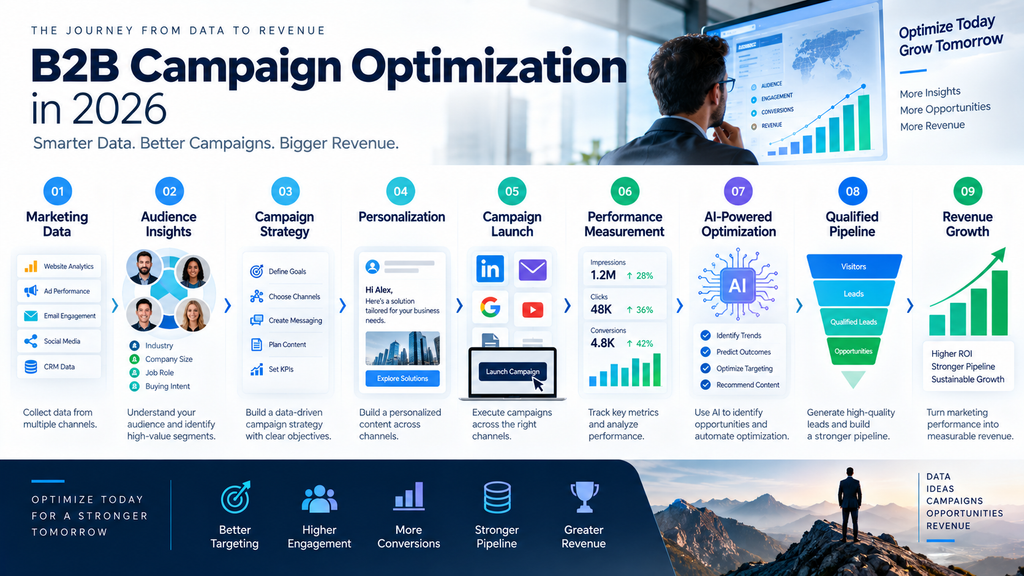
Plan → Launch → Measure → Analyze → Optimize → Repeat
Turning Marketing Data Into Revenue Growth
The biggest opportunity in campaign optimization is moving from data collection to action.
Imagine your data shows that a particular audience segment consistently engages with your content and produces qualified opportunities.
That insight could influence future targeting.
Or perhaps your campaign generates strong traffic but very few conversions.
That may indicate an issue with the landing page, offer, messaging, or audience.
Another campaign may generate many leads but few opportunities.
In that situation, marketers may need to examine targeting or lead qualification.
Different problems require different solutions.
That’s why campaign optimization shouldn’t be about chasing one metric.
It should be about understanding where the buyer journey can be improved.
Over time, these improvements can help create a more efficient path from:
Awareness → Engagement → Conversion → Qualified Opportunity → Revenue
Frequently Asked Questions About B2B Campaign Optimization
1. What is B2B Campaign Optimization?
B2B Campaign Optimization is the process of improving B2B marketing campaigns using data, audience insights, testing, and performance analysis to increase conversions, lead quality, pipeline, and revenue.
2. Why is B2B Campaign Optimization important in 2026?
B2B buyers interact with multiple marketing channels before making a purchase. Campaign optimization helps businesses understand these interactions, improve targeting, personalize messaging, and make better use of marketing data.
3. What are the key B2B Campaign Optimization strategies?
Key strategies include defining clear campaign goals, targeting the right audience, analyzing marketing data, personalizing messaging, optimizing landing pages, testing campaign elements, and connecting campaign performance with pipeline and revenue.
4. How can marketing data improve B2B campaigns?
Marketing data can reveal which audiences, channels, content, and messages generate meaningful engagement. Marketers can use these insights to improve targeting, identify conversion problems, and make more informed campaign decisions.
5. How can AI support B2B Campaign Optimization?
AI can help with audience segmentation, lead scoring, campaign analysis, personalization, content recommendations, performance reporting, and identifying patterns in large datasets. Marketers can then use these insights to make strategic decisions.
Final Thoughts
B2B Campaign Optimization is becoming an increasingly important part of modern B2B marketing.
The goal isn’t simply to collect more data or produce bigger marketing reports.
The goal is to use data to make smarter decisions.
Start with a clear campaign objective.
Understand your audience.
Create relevant messaging.
Use behavioral data to identify meaningful patterns.
Optimize your landing pages.
Test your assumptions.
Measure lead quality and pipeline.
And connect marketing activity with revenue wherever your measurement setup allows.
Most importantly, treat optimization as an ongoing process.
Every campaign can teach your team something about your audience, your messaging, and your marketing strategy.
When those lessons are applied consistently, marketing data becomes more than a reporting tool.
It becomes a practical resource for building more relevant campaigns and supporting sustainable revenue growth.